
A GoPro bow mount gives you first-person footage of the entire shot sequence, from the draw through the release. Whether you hunt whitetail from a treestand or shoot 3D targets on the weekend, a bow hunting camera can also help you review what happened after the shot.
The trick is choosing a mount that fits both your bow and your camera. Some mounts attach at the bow’s stabilizer location, while others clamp directly around part of the bow. Camera connections vary too, particularly as GoPro and other action camera designs have changed over the years.
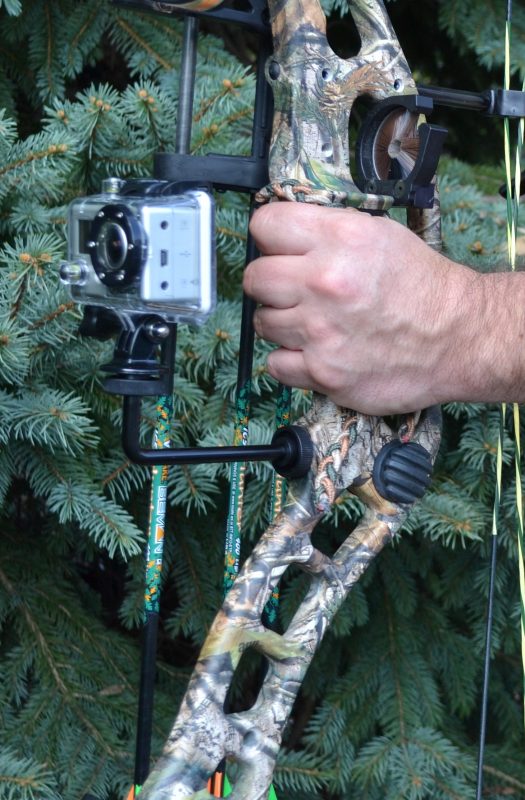
This guide covers the mounting hardware you need, the tradeoffs between stabilizer and clamp-style mounts, and five current options worth considering.
Quick Comparison: Best GoPro Bow Mounts
| Mount | Best For | Camera Compatibility |
|---|---|---|
| StaBowMount | Lightweight, stabilizer-held setup | GoPro, Insta360 (2-prong mount) |
| GoPro Gun/Rod/Bow Mount | Official GoPro clamp mount | All GoPro cameras |
| BOWPRO Compound Bow Mount | Budget-friendly stabilizer option | GoPro, Insta360, DJI (2-prong) |
| Painted Arrow MAG-PRO GP | Hunters who want quick-detach convenience | GoPro, Tactacam (magnetic dock) |
| VGSION Sportsman Clamp | Affordable clamp alternative | GoPro and compatible action cameras |
What You Need to Know Before Buying
Compound bow cams generally split into two mounting styles: stabilizer-port mounts and clamp mounts. Most compound bow camera mounts use the stabilizer mounting area on the front of the riser. A common stabilizer thread on modern compound bows is 5/16″-24, but verify the specification on your particular bow before ordering a mount. Some mounts thread into the stabilizer location directly, while others are held in place when the stabilizer is tightened, which matters if you want to keep using your existing stabilizer.
The other major approach is a clamp mount. These grip an appropriately sized part of the bow or stabilizer instead of relying on a threaded port. A clamp can give you more position choices, though finding the right camera angle takes more experimentation than a fixed stabilizer-area mount.
Understanding GoPro and 1/4″-20 Connections
The 1/4″-20 thread is the traditional camera tripod standard, used widely on cameras, tripods, and mounting accessories. GoPro cameras are best known instead for their interlocking finger-style mounting system, though some newer GoPro configurations and adapters also support 1/4″-20 connections.
The safest approach is to inspect your exact camera and compare its mounting interface with the bow mount before buying. If one uses 1/4″-20 and the other uses GoPro-style fingers, an inexpensive adapter can usually connect the two.
StaBowMount
The StaBowMount Classic from Left Side Armory is one of the cleanest choices if you want a dedicated action camera mount without adding much weight or complexity to the bow. Instead of replacing the stabilizer, it is held in place by the stabilizer itself and positions the camera straight downrange for a true point-of-view angle.
Left Side Armory lists the Classic at 1.41 ounces and builds it from durable nylon. The camera end uses GoPro’s standard 2-prong mounting interface, so any GoPro model or Insta360 camera drops right in with the thumb screw you already have. No tools required, and the company backs it with a lifetime warranty.
GoPro Gun/Rod/Bow Mount
GoPro’s own Gun/Rod/Bow Mount takes a completely different approach. Instead of the bow’s stabilizer connection, it clamps around an appropriately sized part of the bow or stabilizer, fitting components between 0.4″ and 0.9″ in diameter (10 to 23mm). The system supports one or two cameras for front-facing or rear-facing footage, and was designed specifically for guns, fishing rods, and bows.
Because it is an official GoPro accessory, the 2-prong interface fits every GoPro model as intended, and the non-reflective matte black finish keeps it from flashing in sunlight. The tradeoff is that a clamp-style position takes more adjustment to get right than a fixed stabilizer mount, so use the GoPro preview to verify framing before shooting.
BOWPRO Compound Bow Mount
The BOWPRO is another stabilizer-port mount built specifically for compound bows. Like the StaBowMount, it threads into the standard 5/16″-24 stabilizer hole and uses GoPro’s 2-prong interface, and it is compatible with GoPro, Insta360, and DJI action cameras that share that same finger mount system.
Made from high-strength black nylon, the BOWPRO is built for field conditions, and the tool-less installation keeps things simple. For hunters who want a dedicated stabilizer-port mount and find the StaBowMount unavailable or out of budget, the BOWPRO covers the same use case well.
Painted Arrow MAG-PRO GP
The Painted Arrow MAG-PRO GP takes a different approach again, using rare-earth magnets instead of a thread or GoPro finger mount. The base still installs at the standard 5/16″-24 stabilizer port, but the camera sits on a magnetic dock that pops on and off in one motion, with no thumb screw required.
That is the main advantage. If you would rather carry the camera separately through the woods and dock it in seconds once you are set up, the MAG-PRO GP handles that better than any threaded mount. Painted Arrow builds it from 14 gauge carbon steel with a dual layer powder coating and includes a foam dampening strip to help control vibration at the shot. It works with GoPro and Tactacam cameras and ships as a complete kit aside from the camera itself.
VGSION Sportsman Clamp
The VGSION Sportsman Clamp is a good alternative if you like the clamp-style approach but do not need the official GoPro accessory. It fits surfaces between 0.4″ and 0.9″ in diameter and is built from metal and reinforced plastic, with an adjustable clamp angle that supports GoPro and compatible action cameras including several Insta360 models.
A stabilizer-area mount makes more sense if you always want the camera in the same place. A clamp makes more sense if you want to move the camera around or use the same mount on other equipment. This is a lower-cost way into that flexibility than the official GoPro clamp.
GoPro Tripod Adapter
The GoPro Tripod Adapter is not a bow mount on its own, but it is useful if your mounting base has a standard 1/4″-20 tripod thread and you need to connect a GoPro. The adapter bridges any 1/4″-20 threaded surface to GoPro’s 2-prong mount system, so if your base terminates in a 1/4″-20 screw rather than a GoPro-style finger, you can thread this on rather than replacing the whole base. It works with the GoPro in its housing or bare, using the tripod hole on the bottom of the camera.
Stabilizer Mount vs. Clamp Mount
For most compound bow hunters, this is the main decision. A stabilizer-port mount, like the StaBowMount, BOWPRO, or Painted Arrow MAG-PRO GP, gives you a fixed, repeatable camera position every session, and the footage looks like a genuine archer’s point of view because the camera sits where your stabilizer rod would be.
A clamp mount, like the GoPro Gun/Rod/Bow Mount or VGSION Sportsman Clamp, works on bows without a stabilizer port and lets you experiment with side angles or move the camera to a different platform entirely. The tradeoff is that finding the right clamping position takes trial and error, and footage can vary between sessions if the clamp shifts.
For most hunters, the stabilizer port mount is the better starting point. If quick removal between sits matters more than a fixed position, the magnetic dock on the Painted Arrow MAG-PRO GP is worth a closer look instead.
Installing a Camera and Checking Bow Balance
Installation varies by mount, so follow the manufacturer’s directions, but a few checks apply to every setup. Never work on the mount with an arrow nocked. Install the bow-side bracket securely without forcing or cross-threading any hardware, then attach the camera using the correct GoPro fingers, magnetic dock, or adapter for your setup.
Before shooting, verify that the camera and mount stay clear of the string, cables, limbs, cams, arrow, rest, sight, and your hand throughout the full draw and release cycle, not just at rest. Use the camera’s preview to confirm your target area is actually in frame, since a mount pointing downrange does not guarantee the footage is centered.
Any accessory changes a bow’s weight and balance to some degree, and how noticeable that is depends on the camera and mount weight and how far it sits from the riser. Do not install a camera the morning of a hunt and assume the bow feels the same. Shoot several practice groups with the complete setup attached, and if the bow suddenly feels front-heavy or unfamiliar, adjust the mounting position or reconsider how much hardware you have attached.
Frequently Asked Questions
What is the best GoPro mount for a compound bow?
The StaBowMount is the strongest all-around pick for a true downrange point-of-view angle. If you want quick-detach convenience between sits, the Painted Arrow MAG-PRO GP’s magnetic dock is worth the tradeoff, and the GoPro Gun/Rod/Bow Mount or VGSION Sportsman Clamp suit hunters who want a movable clamp instead.
What size is a compound bow stabilizer thread?
Most compound bows use a 5/16″-24 threaded stabilizer port, which is what the StaBowMount, BOWPRO, and Painted Arrow MAG-PRO GP all thread into.
Is there a specific GoPro mount for a compound bow?
Yes. The StaBowMount and BOWPRO are both purpose-built GoPro mounts for compound bows that thread into the stabilizer port, while the Painted Arrow MAG-PRO GP offers a magnetic alternative at the same mounting location.
Do all GoPro cameras have a 1/4″-20 threaded hole?
No. GoPro mounting arrangements vary by model and generation, and most use GoPro’s 2-prong finger mount system instead. The GoPro Tripod Adapter bridges a 1/4″-20 base to that 2-prong interface when needed.
Can I use an Insta360 camera on a bow mount?
Yes, when the Insta360 camera or its adapter uses the same 2-prong mounting interface as the bow mount. The StaBowMount, BOWPRO, and VGSION Sportsman Clamp are all marketed for GoPro and compatible Insta360 models.
Will a bow-mounted camera affect accuracy?
A lightweight mount positioned at the stabilizer port adds minimal weight and has negligible effect on accuracy for most shooters. Practice a few rounds with the full setup attached before hunting season, and adjust if your groups or shooting comfort change.
Can I mount a GoPro to a recurve bow?
Possibly, but the stabilizer-based mounts in this guide are built for compound bows with a compatible port. A clamp mount like the GoPro Gun/Rod/Bow Mount or VGSION Sportsman Clamp offers more flexibility on other bow designs, provided the mounting location does not interfere with the bow.