
Choosing the right GoPro motorcycle mount is the difference between smooth, usable 4K ride footage and a jittery blur ruined by engine harmonics and highway wind load. A bracket that feels rock-solid in your garage faces a completely different physical test at 70 mph once V-twin or inline-four engine pulses, fork shock, and aerodynamic drag hit the camera body. After more than twenty years of testing camera and cockpit mounts on sportbikes, cruisers, and heavy touring rigs, we have found that matching the mounting mechanism and vibration isolation to the exact bar diameter or helmet contour is what keeps your camera secure and your footage sharp.
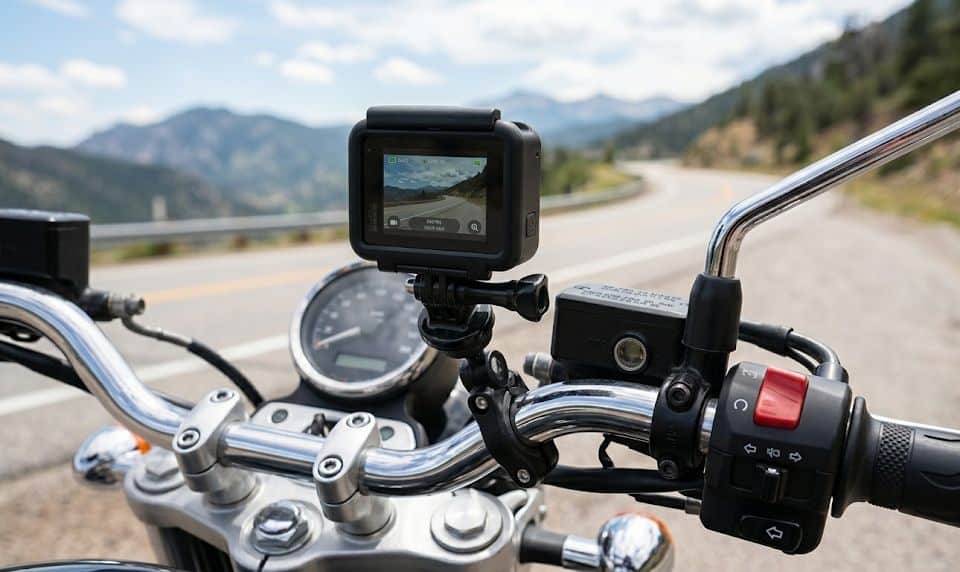
Quick Answer: For an immersive rider’s-eye POV with natural body damping, start with the GoPro Official Flat + Curved Adhesive Mounts on your helmet. For a vibration-isolated clamp on 0.625-inch to 1.14-inch handlebars or crash bars, choose the RAM Small Tough-Claw with GoPro Adapter, or pick the Forevercam CNC Aluminum Handlebar Mount for a compact, low-profile bar clamp with 360-degree rotation. For temporary centered cockpit shots on smooth metal tanks or windscreens, use the RAM Twist-Lock Suction Cup Mount with a backup tether.
Below, we compare our four top-performing motorcycle action camera setups, explain how high-frequency engine buzz affects modern digital stabilization, and break down the best mounting locations across your helmet and chassis. If you are also outfitting your cockpit with navigation or phone hardware, browse our main motorcycle mounts hub and our complete GoPro mounts guide.
Best GoPro Motorcycle Mounts Compared
No single motorcycle GoPro mount fits every tube diameter and fairing profile. Use the comparison table below to match each mount’s attachment method and clamping range to your helmet, handlebars, engine guards, or bodywork.
| Mount | Fits / Attachment | Best For |
|---|---|---|
| GoPro Flat + Curved Adhesive Mounts | 3M VHB adhesive bases (3 flat + 3 curved) for smooth helmet shells and fairings | Best overall rider POV with minimal wind drag and natural neck damping |
| Forevercam CNC Aluminum Handlebar Mount | Clamps to 0.6-inch to 1.3-inch (15mm to 33mm) round handlebars and mirror stalks | Clean, low-profile handlebar mounting with 360-degree indexing rotation |
| RAM Tough-Claw with GoPro Adapter | Tool-free claw clamp for 0.625-inch to 1.14-inch rails with 1-inch B-size rubber ball | Best vibration isolation on crash bars, engine guards, and odd-shaped tubing |
| RAM Twist-Lock Suction Cup Mount | 3.3-inch industrial twist-lock vacuum base with 1-inch B-size ball system | Centered cockpit and windscreen views on smooth, non-porous tank or fairing panels |
Important Note on Image Stabilization: Modern GoPro HERO cameras feature impressive in-camera HyperSmooth stabilization, but high-frequency engine vibration can still overwhelm the digital sensor and gyroscopes. That resonance produces micro-jitters and rolling-shutter blur that ruin 4K clarity, especially in low light. When clamping directly to a motorcycle frame, crash bar, or handlebar, a rubber-isolated system like the RAM 1-inch elastomeric ball acts as a mechanical low-pass filter before those vibrations reach the camera.
1. GoPro Official Flat + Curved Adhesive Mounts (Best Overall POV)
If your priority is immersive first-person riding footage, the official GoPro Flat + Curved Adhesive Mount pack (part AACFT-001, which includes three flat bases and three curved bases) remains one of the smartest starting points. A low-profile adhesive buckle base bonded to a smooth helmet shell delivers the most natural rider point of view while avoiding the bulky joints and wind drag of multi-arm clamp rigs. These industrial-strength 3M VHB bases also work well on smooth, rigid fiberglass or ABS fairing panels and gloss-painted fuel tanks.
The reason this setup performs so well on a motorcycle is mechanical simplicity. Once the 3M VHB foam tape is applied to a clean, matching surface contour and allowed to cure for a full 24 hours before riding, there are no intermediate pivot joints to flex or rattle. Just as important, mounting the camera on your helmet decouples the GoPro from the motorcycle chassis: your torso, shoulders, and neck act as a natural biological gimbal that absorbs high-frequency engine buzz before it ever reaches the camera sensor.
- Included Hardware: Three flat adhesive bases and three curved adhesive bases backed with genuine waterproof 3M VHB industrial foam tape.
- Strengths: Ultra-low profile minimizes aerodynamic pull on your neck at highway speeds; zero ball joints to slip; captures exactly where the rider looks through corners.
- Fitment Limits to Know: Standard rectangular curved pads need 100 percent foam contact against a smooth crown, brow, or side helmet curve. Many modern full-face sport and ADV helmets have sharp center chin ridges and large chin-bar intake vents where a flat or standard curved pad cannot sit flush; for sculpted chin bars, see our dedicated GoPro helmet mounts guide for chin-specific brackets and strap options.
- Removal Tip: While VHB adhesive holds tenaciously in rain and heat, it can be removed later without damaging helmet paint by gently warming the foam pad with a hairdryer and peeling it back slowly.
2. Forevercam CNC Aluminum Handlebar Mount (Best Low-Profile Bar Clamp)
For riders who want a compact, all-metal clamp for standard motorcycle handlebars or tubular mirror stalks without building a multi-piece ball-and-socket rig, the Forevercam CNC Aluminum Handlebar Mount is a clean, durable solution. Machined from billet aluminum rather than brittle injection-molded plastic, it clamps onto round tubes ranging from 0.6 inches to 1.3 inches (15mm to 33mm) in outer diameter. That range covers 7/8-inch (22mm) sport and naked bike bars, 1-inch (25.4mm) cruiser bars, and 1.25-inch (31.8mm) fatbars, as well as many thinner 15mm accessory crossbars.
Its standout convenience feature is the integrated 360-degree indexing rotation head with a locking thumbscrew. You can point the GoPro straight ahead through the windscreen for road footage, then rotate the camera 180 degrees toward the cockpit to capture rider-facing angles without loosening the main handlebar clamp bolts. Because the GoPro 3-prong mounting fingers sit directly on top of the hinged aluminum ring, the lever arm is extremely short, preventing highway wind blast from folding the camera backward.
- Clamping Range: Fits 0.6-inch to 1.3-inch (15mm to 33mm) round tubes using the included protective inner rubber grip liners.
- Strengths: CNC-machined aluminum body resists UV degradation and over-tightening cracks; compact footprint fits tight handlebar sections crowded with switchgear and clutch perches; 360-degree indexing swivel base.
- Fitment Limits to Know: Because billet aluminum is completely rigid and only uses a thin protective rubber strip inside the jaw, it transmits more high-frequency engine buzz into the camera than an elastomer ball system like RAM. It performs best on smoother engines or when mounted near the center handlebar riser clamping area where bar resonance is lowest.
3. RAM Tough-Claw with GoPro Adapter (Best Modular System & Vibration Control)
When you want a motorcycle-grade clamp that you can move in seconds between handlebars, tubular crash bars, luggage racks, and odd-shaped frame rails, the RAM Small Tough-Claw with GoPro Adapter (kit part RAP-B-400-A-GOP1U) is our top modular recommendation. The Small Tough-Claw jaw clamps tool-free onto round, square, and irregular rails from 0.625 inches to 1.14 inches (15.9mm to 29mm) in outer diameter simply by twisting the oversized composite wing knob. Elastomeric rubber jaw pads grip the metal bar firmly without marring powder coat or chrome.
This complete kit pairs the Small Tough-Claw base with a short B-size double socket arm and RAM’s universal 1-inch ball-to-GoPro 3-prong adapter. If your motorcycle has oversized 1.25-inch or 1.5-inch highway engine guards (common on Harley-Davidson Touring bikes and large cruisers), note that the Small Tough-Claw tops out at 1.14 inches; for thicker highway bars, step up to the Medium RAM Tough-Claw base (part RAP-B-404U), which clamps from 1.0 inch to 1.875 inches.
Real-World Experience: I have used RAM mounts on motorcycles for nearly 20 years, and the Tough-Claw is the clamp I trust on an exposed crash bar or engine guard. Because the B-size system sandwiches two 1-inch elastomeric rubber balls inside the socket arm, it damps out the harsh high-frequency metal-on-metal buzz that causes rolling-shutter distortion in 4K video. It is bulkier than a tiny fixed ring clamp, but the vibration isolation and lifetime durability make it worth every penny.
- Clamping Range & Hardware: High-strength glass-filled nylon claws with stainless steel hardware; fits 0.625-inch to 1.14-inch outer diameter round tubing and flat-edged brackets.
- Strengths: Dual 1-inch B-size rubber balls provide mechanical vibration damping; infinite ball-and-socket angle adjustment corrects for angled crash bars so your horizon stays level; backed by RAM’s lifetime warranty.
- Fitment Limits to Know: Significantly bulkier than single-piece handlebar rings. Always use the included short B-size socket arm on a motorcycle rather than a medium or long arm to minimize wind leverage and pendulum shake.
4. RAM Twist-Lock Suction Cup Mount (Best Centered Tank & Fairing Shot)
A suction cup mount is not a universal fix for every bike, but the RAM 3.3-Inch Twist-Lock Suction Cup Mount with GoPro Adapter is an outstanding tool when you want a centered cockpit view from a smooth fuel tank, upper fairing, or rigid touring windscreen without sticking permanent 3M VHB pads to your paintwork. Looking through the windscreen with the tachometer, handlebars, and rider hands in the lower third of the frame creates a composed, cinematic perspective that works wonderfully for sportbikes and long-distance touring videos.
Unlike cheap push-cup suction mounts that pop off as soon as outdoor temperatures change, RAM’s 3.3-inch industrial vacuum base uses a mechanical cam twist-lock ring that pulls a deep vacuum seal against flat or very gently curved, non-porous surfaces. Like the Tough-Claw kit, it connects to your camera through a short B-size socket arm and 1-inch rubber ball GoPro adapter, giving you full tilt and horizon leveling even when the tank or fairing panel sits at a steep angle.
- Attachment Footprint: 3.3-inch diameter mechanical twist-lock suction base paired with a short B-size socket arm and GoPro 3-prong ball adapter.
- Strengths: Repositionable in seconds across different smooth panels; leaves zero adhesive residue on expensive factory paint; 1-inch rubber ball joints help damp fairing buzz.
- Surface & Safety Rules: Only holds a vacuum on clean, smooth, non-porous gloss metal, fiberglass, or polycarbonate/acrylic windscreens. Never place a suction cup over matte/denim paint, textured plastics, vinyl tank graphics, or painted pin-stripes, which allow air to seep under the rubber lip. Always attach a secondary safety tether looped to a solid handlebar or mirror bracket when running a suction mount on a motorcycle.
What Makes Motorcycle GoPro Mounting Different?
Motorcycles punish camera mounts far harder than car dashboards or bicycle frames. A car windshield mount mostly contends with normal suspension movement and occasional potholes, and if you are rigging a pedal bike, you can check our bicycle mounts for GoPro cameras guide for lighter-duty bar clamps. On a motorcycle, your GoPro holder has to survive a constant four-way mechanical battle:
- High-Frequency Engine Harmonics: High-revving inline-fours and heavy-pulsing V-twins or single-cylinder thumpers generate continuous chassis resonance that can back out unthreaded thumbscrews and overwhelm digital image stabilization sensors. (If you also mount a smartphone on your bars, read our guide to motorcycle vibration dampeners and camera protection to understand why smartphone OIS sensors require even stricter isolation than action cameras.)
- Highway Wind Torque: At 70 mph to 80 mph, a GoPro housing acts like a miniature sail. If your mount relies on a long plastic extension arm or stacked 90-degree pivot knuckles, aerodynamic drag creates leverage that can rotate a weak clamp on the handlebar or fold the camera backward at speed.
- Aggressive Lean Angles: Because motorcycles lean 30 to 45+ degrees through corners and pitch under hard front braking, any play in a cheap ball joint causes the camera to lag or droop mid-corner, forcing your horizon-leveling software to crop and warp the video.
- UV, Heat, and Weather Exposure: Motorcycle mounts live outdoors in direct sun, engine heat, road grit, and rain. Budget ABS plastic clamps turn brittle under UV exposure and snap at the hinge pin; marine-grade aluminum, stainless steel fasteners, or glass-filled nylon composites are mandatory for road survival.
Best GoPro Mounting Locations on a Motorcycle
Where you place your camera changes both the storytelling perspective and the level of vibration your mount has to handle. Experienced motovloggers and track riders usually combine two of these positions to cut between angles.
Helmet Mounting: Chin Bar vs. Top or Side
Helmet mounting is the classic motorcycle action-camera setup because the camera looks wherever you look, naturally tracking apexes, mirrors, and instruments. It also produces some of the smoothest footage because your body isolates the helmet from direct frame vibration. Within helmet mounting, placement matters:
- Full-Face Chin Position: Preferred by most street and sport riders because it places the lens near eye level, frames the handlebars and gauges symmetrically, and creates minimal wind lift on your neck at highway speed.
- Side or Brow/Crown Position: Easier to fit with standard curved 3M VHB pads from the GoPro Adhesive Kit when your helmet has an angular chin vent, though top mounts sit higher in the windstream and side mounts require an offset pivot arm that can block one peripheral edge of the helmet.
Handlebars and Cockpit Controls
A handlebar clamp is the most reliable bike-mounted position for riders who want a consistent forward view or a rear-facing rider shot without wearing extra weight on their helmet. Clamping as close as possible to the center handlebar risers or triple clamp minimizes bar flex and vibration amplitude compared to clamping near the outer bar ends. Because handlebars are always within reach, you can also see the camera’s recording tally LED and start or stop clips safely at a stoplight.
Fuel Tank and Upper Fairing
Mounting to the front of a smooth fuel tank or upper fairing creates a balanced cockpit shot that frames the instrument cluster, windscreen, and road ahead. On sportbikes and sport-tourers, a tank-mounted suction cup or curved VHB adhesive base keeps the camera completely tucked behind the windscreen bubble, eliminating wind noise and aerodynamic drag while showing the rider’s steering inputs and body positioning.
Crash Bars, Engine Guards, and Passenger Pegs
Clamping a RAM Tough-Claw low on an adventure bike’s tubular crash bar or a cruiser’s highway engine guard delivers dramatic, high-speed ground-rush footage with the front wheel or suspension moving in the side of the frame. The tradeoff is that engine guards bolt directly to the frame near the cylinder heads, exposing the camera to stronger vibration, radiant engine heat, bug strikes, and front-tire road spray.
Rear Tail Section and Grab Rails
Clamping to a tubular rear luggage rack, passenger grab rail, or tail cowl lets you capture a following chase-cam perspective or film riding companions behind you on group rides. Because tail subframes can whip over sharp expansion joints, keep the mount arm short and verify that the clamp clears your saddlebags and rear turn signals.
How to Reduce Vibration and Wind Noise on a Motorcycle GoPro Setup
Even the sturdiest motorcycle GoPro mount will produce shaky video if the mounting geometry amplifies resonance. Follow these four field-proven setup rules to keep your 4K footage rock-steady:
- Keep the Lever Arm as Short as Possible: Long extension arms, stacked 90-degree plastic pivot joints, and tall risers turn small engine vibrations into wide pendulum swings. Connect your GoPro buckle directly to the adhesive base, or use RAM’s shortest B-size socket arm (1.75 inches socket-to-socket) rather than a medium or long arm.
- Eliminate Play inside the GoPro 3-Prong Fingers: If the plastic mounting fingers feel slightly loose before you tighten the thumbscrew, pinch a thin rubber O-ring or a strip of electrical tape alongside the buckle base, and use a metal thumbscrew or a quarter-turn with a Phillips screwdriver so vibration cannot back the bolt out.
- Avoid Unbraced Plastic Windscreens and Thin Fairing Edges: Never clamp or suction-mount a camera to the top edge of a thin, unbraced acrylic windscreen or a floppy plastic fender. Even if the clamp holds tight, the plastic panel itself will flutter in the windstream and ruin your footage.
- Test at Low Speed Before a Full Ride: Ride a two-minute loop at 35 mph to 55 mph and play the clip back on your phone via the GoPro Quik app. Checking framing, horizon level, and micro-jitter early saves you from returning from a two-hour canyon ride with unusable video.
Common Mistakes to Avoid
- Skipping the 24-Hour Cure Window on 3M VHB Pads: Sticking a curved adhesive base onto a cold or wax-coated helmet and snapping a camera on five minutes later is the number-one cause of adhesive failure. Clean the surface with isopropyl alcohol, press firmly for 60 seconds at room temperature, and wait 24 hours before riding.
- Ordering the Wrong Clamp Diameter for Crash Bars: Standard handlebars measure 7/8 inch (22mm) or 1 inch (25.4mm), whereas cruiser highway bars and ADV engine guards often measure 1.25 inches (32mm) to 1.5 inches (38mm). Measure your tube with calipers before ordering a Small vs. Medium Tough-Claw.
- Trusting a Suction Cup or Clamp Without a Secondary Tether: Any exterior camera mounted to a fuel tank, fairing, or crash bar should have a braided stainless steel or paracord safety tether looped through the GoPro hinge pin and anchored to a solid frame point.
- Forgetting Wind-Slam Audio Protection: Above 40 mph, raw wind roar over a bare GoPro microphone clips the audio track into pure static. Tuck bike-mounted cameras behind the windscreen, use a foam windslayer cover, or run an external helmet microphone inside your cheek pad.
Frequently Asked Questions
Will GoPro adhesive mounts stay on a motorcycle helmet at highway speeds?
Yes, genuine GoPro Curved and Flat Adhesive Mounts use industrial 3M VHB foam tape that easily withstands triple-digit highway wind loads when properly installed. The surface must be smooth, non-porous, cleaned with isopropyl alcohol (free of helmet polish or bug wax), matched closely to the pad’s flat or curved contour so the entire foam pad makes contact, and allowed to cure for 24 hours before attaching the camera.
Does motorcycle engine vibration damage a GoPro camera like it damages smartphones?
No. Unlike modern smartphones, which use delicate spring-suspended Optical Image Stabilization (OIS) lenses and closed-loop magnetic autofocus actuators that physically wear out under motorcycle vibration, GoPro HERO cameras use fixed-focus lenses and electronic image stabilization (HyperSmooth). Engine vibration will not break a GoPro’s lens mechanism, though excessive high-frequency buzz can still create blurry rolling-shutter artifacts in your video if the mount is not dampened.
What size RAM Tough-Claw do I need for a motorcycle?
For standard 7/8-inch (22mm) and 1-inch (25.4mm) handlebars, passenger grab rails, and 1-inch adventure bike crash bars, choose the Small RAM Tough-Claw (clamping range 0.625 inches to 1.14 inches). If you are clamping to 1.25-inch fatbars or thick 1.25-inch to 1.5-inch cruiser highway engine guards, step up to the Medium RAM Tough-Claw (clamping range 1.0 inch to 1.875 inches).
Is it better to mount a GoPro on your helmet or on the motorcycle handlebars?
Helmet mounting is best for immersive, rider-perspective storytelling because your neck naturally smooths out road shock and the camera follows your eyes through turns. Handlebar or crash-bar mounting is better when you want zero extra weight on your helmet, a steady bike-referenced frame showing the road or rider, or a secondary B-roll angle to cut together with your helmet footage.
Bottom Line: Choosing the Right GoPro Motorcycle Mount
For the cleanest first-person perspective and the least engine vibration, start with the GoPro Official Flat + Curved Adhesive Mounts on your helmet. If you prefer keeping the camera off your helmet, choose the Forevercam CNC Aluminum Handlebar Mount for a compact, rotating bar clamp on 0.6-inch to 1.3-inch tubing, the RAM Tough-Claw with GoPro Adapter for rubber-dampened versatility on crash bars and frame rails, or the RAM Twist-Lock Suction Cup Mount for temporary centered shots on a smooth fuel tank or windscreen. If you are also setting up navigation or communications in your cockpit, check out our guides to the best motorcycle phone mounts and Garmin Zumo XT motorcycle mounts.