
If you’ve tried a MagSafe car mount and had your phone slowly slide off, wobble over bumps, or fall the first time you hit a pothole, you are not alone. Most MagSafe mounts look great in photos but fail in real-world driving.
The problem is not MagSafe itself. It is how the mount is designed, where it is placed, and how strong the magnets actually are under load. A mount that works fine on a smooth highway can completely fall apart in a truck, SUV, or rough-road daily driver.
After testing different mounting styles across a wide range of vehicles, from compact sedans to larger trucks, the best MagSafe car mounts come down to three things: mount stability, magnet strength, and placement. This guide focuses on mounts that actually hold up over time, not just the ones with the best marketing.
Quick Comparison: Best MagSafe and Qi2 Car Mounts
| Mount | Charging | Mount Type | Best For |
|---|---|---|---|
| Anker Prime Qi2 | 15W/25W Qi2 | Vent Clip | Daily Commuting |
| VICSEED Steel Core Vent Mount | No | Vent Clip | Non-Charging Backup |
| Andobil Vacuum Suction MagSafe Mount | 15W Wireless | Dash/Windshield | Eye-Level View |
| RAM Drill Down Mount | Optional Head | Bolt-Down | Trucks and Off-Road |
| EXELIQ Cup Holder Charger Mount | 15W Wireless | Cup Holder | No Vent or Dash Space |
What You Need to Know Before Buying
The MagSafe car mount category has two completely different products that share the same name: mounts that hold your phone magnetically with no charging, and mounts that hold and wirelessly charge simultaneously. The distinction matters because they work differently and require different accessories.
Charging vs. Non-Charging Mounts
A MagSafe-compatible mount with wireless charging requires a USB-C power source to deliver power to the mount. A non-charging magnetic mount just holds your phone. Non-charging mounts are simpler and can have stronger magnet options since they do not need to route power through the mount. Charging mounts are more convenient but add a power cable to manage.
Qi2 vs. MagSafe
Qi2 is the open standard version of MagSafe, developed by the Wireless Power Consortium. In practical terms, a Qi2-certified charger delivers the same 15W fast-charging speed as Apple’s MagSafe and works with all MagSafe iPhones. We recommend Qi2-certified mounts as the best value in the wireless charging category.
Magnet Strength Claims
Ignore the “80LB suction” and “2400gf magnetic force” marketing claims on cheap Amazon listings. These figures often describe the suction cup holding the mount to your dashboard, not the magnetic hold on your phone. What matters is the number and grade of magnets (N52 is the highest consumer grade) and whether the mount is optimized for MagSafe ring alignment. A well-designed 12-magnet N52 array will outperform a poorly designed 20-magnet budget mount every time.
Mount Location Trade-offs
Air vent: The most popular placement for both Apple MagSafe and Belkin car vent mounts. Easy to install, no tools required, and it keeps the phone within easy reach. Downsides: it blocks airflow, can rattle on cheap mounts, and not every vent style grips well, particularly on vehicles with thin or angled slats. Metal hook-style clips hold up far better over time than friction-based plastic ones. For a closer look at clip styles and which vehicles they fit best, see our full guide to car air vent mounts.
Dashboard or windshield (suction): More stable viewing position. Suction cups require regular inspection to maintain grip. Best for drivers who want eye-level placement.
Bolt-down: Most stable option available. Requires drilling into the vehicle. Ideal for trucks, off-road vehicles, and permanent setups.
Cup holder: A good option when vent space is limited or the dashboard has no flat surface for a suction base, common in older trucks and some SUVs. Keeps the phone lower in the cabin than a vent or dash mount, so it works best for drivers who mainly use it for charging rather than active navigation.
Best Overall: Anker Prime Qi2 (Our Daily Driver, Hands-On Tested)
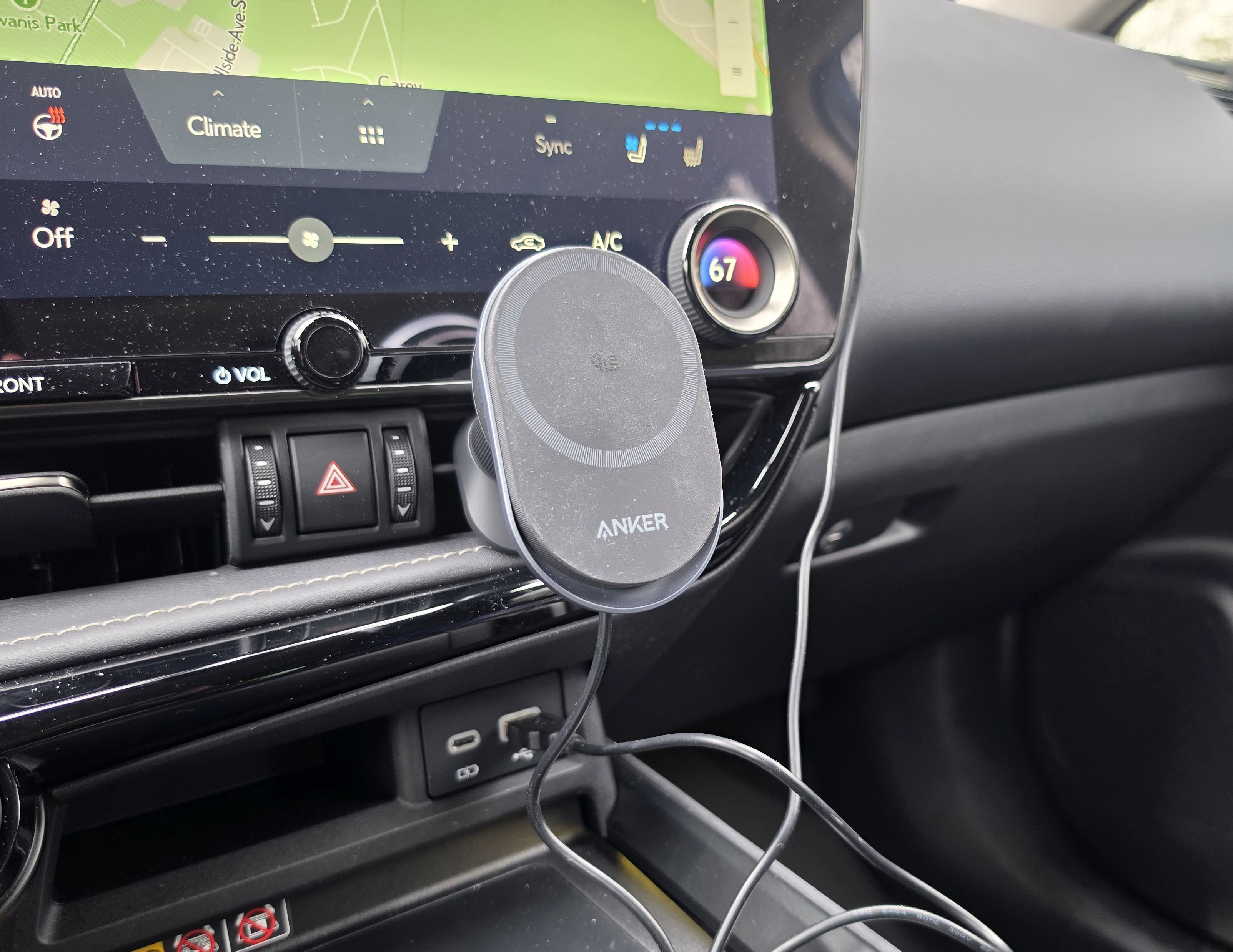
The Anker Prime Qi2 is the easiest recommendation on this list, and it is the mount we use every day in our own vehicle. If you want a mount that just works every time you get in the car, with strong hold, fast charging, and no constant adjustments, this is the one. While most mounts top out at 15W, the Anker Prime pushes up to 25W under the right conditions, which is a noticeable difference on longer drives.
It also solves a common problem with wireless charging mounts: heat. Many mounts get warm enough to slow charging or cause the phone to throttle performance. The Anker includes built-in active cooling and a stable vent clip that locks onto standard slats without the wobble found in cheaper options. If you have compared Belkin or Apple-branded vent mounts and found the hold underwhelming, the Anker Prime’s clip mechanism is noticeably more secure than either.
The biggest difference compared to cheaper mounts is how quickly it locks into place and starts charging. There is no fussing with alignment. It is also worth reading our full review of the Anker Prime for the technical breakdown.
View Anker Prime Qi2 on Amazon
Best Non-Charging Vent Mount: VICSEED Steel Core Vent Mount (Researched Pick)
Not everyone wants a power cable running to their vent mount. If you already charge your phone before you leave the house, or you just want a simpler mount with fewer parts to fail, the VICSEED steel core vent mount is the pick. Dropping wireless charging out of the design means the mount can dedicate more of its build to holding power and vent grip instead of routing power through the head.
The vent clip uses a metal core rather than the friction-based plastic hinge found on budget mounts, which is the same detail that separates long-lasting vent mounts from the ones that sag and rattle after a few months. The magnet array is built for direct MagSafe alignment, and it ships with metal rings for Android phones and non-MagSafe cases.
This is the mount to reach for as a backup in a second vehicle, or any time simplicity and a lower part count matter more than charging convenience.
View VICSEED Vent Mount on Amazon
Best Dash and Windshield Mount: Andobil Vacuum Suction MagSafe Mount (Hands-On Tested)
If you prefer mounting your phone higher up, closer to eye level rather than at vent height, the Andobil Vacuum Suction MagSafe Mount is the pick for dash and windshield placement. Unlike vent mounts that sit lower in the cabin, a suction-based dash or windshield mount keeps your phone in your natural line of sight, which is a genuine safety advantage for navigation-heavy driving.
Andobil combines their strongest suction base with a high-powered magnet array for MagSafe iPhones. The suction mechanism is significantly more aggressive than standard suction cup mounts, and the 360-degree adjustable head lets you find the exact viewing angle for your driving position. It fits iPhone 12 through 17 Pro Max natively, and includes metal ring adapters for Android phones and non-MagSafe cases.
Andobil is a brand we use and recommend consistently across the site. Their vent mounts are among the most reliable in the category, and this suction model brings the same build quality to a higher mounting position. It does not include wireless charging, which keeps the design simpler and eliminates one more point of failure.
View Andobil Vacuum Suction MagSafe Mount on Amazon
Best for Rough Roads and Stability: RAM Drill Down Mount (Researched Pick)
If you have ever had a mount fall off, shake, or slowly drift out of position while driving, the problem usually is not the magnet. It is the mounting base. That is exactly what the RAM Drill Down system solves. This is a permanent installation that bolts directly into your dashboard or console, creating a rock-solid platform that will not move, flex, or detach over time.
Paired with a MagSafe-compatible head, this becomes the ultimate setup for trucks or off-road vehicles. Because it uses the standard RAM 1-inch ball system, you can customize the arm length and mounting angle to fit any cabin perfectly without worrying about suction cup failure or vent clip wobble.
There is zero vibration once it is in place. For daily driving on rough roads, highway commutes, or any situation where mount failure is not an option, the RAM Drill Down is the most dependable base available.
View RAM Drill Down Mount on Amazon
Best Cup Holder Mount: EXELIQ Cup Holder Charger Mount (Researched Pick)
Not every vehicle has a vent or dashboard that works well for a phone mount. Some trucks have thick, angled vents that will not grip a clip mount, and some dashboards curve in a way that defeats a suction cup. For those cabins, the EXELIQ cup holder charger mount is the answer.
The base expands to fit standard cup holders and locks in place with a turn of the ring, giving you a stable, low mounting point that does not rely on vent tension or suction. The magnetic head still delivers 15W wireless charging, and a built-in heat dissipation system helps prevent the charging slowdown that plagues cheaper cup holder mounts once the phone warms up.
Since it comes as a complete kit, including the charging head, arm, and cup holder base, there is nothing extra to buy to get it working. It is best suited for charging on the go rather than active navigation, since the phone sits lower in the cabin than a vent or dash mount.
View EXELIQ Cup Holder Mount on Amazon
Where MagSafe Car Mounts Actually Fail
Most issues with MagSafe mounts are not caused by the magnets. They are caused by poor mounting locations or weak mounting bases.
Heat kills adhesives. Dashboard mounts using adhesive pads can loosen in hot climates, especially in vehicles that sit in direct sun. Suction and bolt-down mounts do not have this problem.
Vent clips can shift. Cheaper vent mounts wobble or sag over time as the clip loses tension. Metal hook designs hold significantly better than friction-based plastic clips. This is the most common complaint we see about budget Apple and Belkin car vent mounts specifically, since both rely on plastic spring tension rather than a metal hook.
Heavy phones stress magnets. Larger phones need stronger magnet alignment and proper support. A mount designed for an iPhone 12 mini may not reliably hold an iPhone 17 Pro Max without dropping it on a hard stop.
This is why mount selection matters more than brand names alone. A well-mounted mid-tier option will outperform a premium mount placed in the wrong location.
Do MagSafe Car Mounts Work with Android Phones?
Technically yes, but with a caveat. Most MagSafe car mounts include a thin metal ring you adhere to the back of your Android phone or case. The mount’s magnets grip the metal ring. It holds, but the hold strength is weaker than a native MagSafe iPhone since the ring has a smaller magnetic surface area than the iPhone’s built-in MagSafe ring.
For Android users, the better option is a Qi2-compatible Android device (Samsung Galaxy S24 and later, and select Pixel models support Qi2) paired with a Qi2-certified car mount. No ring needed, and you get wireless charging too. If you have an older Android, a high-quality spring-clamp mount with Qi wireless charging is a more reliable solution than a magnetic mount with a ring attachment.
For case compatibility, the Spigen and SupCase lineups adhere well to MagSafe mounts and support Qi2 charging as long as the phone does too.
Frequently Asked Questions
Do MagSafe car mounts work with cases?
Yes, but only if the case is MagSafe-compatible. Standard cases without the MagSafe magnet ring will significantly reduce magnetic strength. Most major case brands (Spigen, Apple, Moment, Peak Design) produce MagSafe-compatible versions for iPhone 12 and newer.
Will a MagSafe mount hold over bumps?
High-quality mounts will, but cheaper options often fail under real driving conditions. Mount stability matters just as much as magnet strength. The RAM Drill Down is the most bump-proof option available since it bolts directly to the vehicle. The Anker Prime, VICSEED, and Andobil suction mount are all solid for normal road conditions, and the EXELIQ cup holder mount is stable as long as the cup holder itself fits it snugly.
Is wireless charging worth it in a car mount?
For most drivers, yes. It eliminates cable clutter and makes short trips more convenient. However, non-charging mounts like the VICSEED are simpler and often more reliable long-term since there are fewer components to fail.
Do MagSafe mounts damage your phone?
No. MagSafe is designed by Apple to be safe for daily use and will not damage your device or its internals.
What USB-C adapter do I need for full charging speed?
To achieve rated charging speeds, your USB-C power source must match or exceed the mount’s power requirement. A 10W USB-C port will bottleneck a 25W Qi2 charger. Check your car’s spec sheet or use a dedicated cigarette lighter USB-C adapter rated at 20W or higher for 15W Qi2 mounts, and 60W for the Anker Prime’s 25W mode.
More Mounting Guides
Looking for mount recommendations for a specific vehicle or mounting location?