
A GoPro and a motorcycle are a natural match, but getting cinematic, high-quality footage on a bike is significantly harder than most people expect. A mount that seems perfectly stable in your garage can turn into a shaky, unwatchable mess once you add engine vibration, wind pressure, road bumps, and high speeds. That is why the best GoPro motorcycle mount is not just about attaching the camera—it is about choosing the right mounting location, the right style of mount, and a setup that stays secure without ruining the shot.
After more than twenty years of testing camera mounts on everything from sportbikes to heavy touring rigs, we’ve learned that the secret to great footage is **vibration isolation**. This guide covers the setups that actually survive the road, the mechanics of motorcycle mounting, and our current top picks for every riding style.
Quick Picks (Skip the research)
- Best Overall POV: GoPro Adhesive Helmet Mounts
- Best for Stability: GoPro Official Handlebar Clamp
- Best Modular System: RAM Tough-Claw with GoPro Adapter
- Best Centered Shot: RAM Suction Cup Mount
GoPro Motorcycle Mount Comparison
| Mount | Style | Best For | Key Feature | Price |
|---|---|---|---|---|
| GoPro Adhesive Kits | Adhesive | Helmet, fairing, tank | Low-profile, no wind drag | $ |
| Forevercam Handlebar Mount | Clamp | Handlebars, mirrors | 360° rotation base | $ |
| RAM Tough-Claw | Modular Clamp | Crash bars, rails, frames | 1″ Rubber ball vibration dampening | $$ |
| RAM Suction Cup | Suction | Smooth tanks, screens | Industrial twist-lock vacuum base | $$ |
What Makes Motorcycle GoPro Mounting Different?
Motorcycles are significantly tougher on camera mounts than almost any other vehicle. A phone mount in a car mostly deals with normal road shock and the occasional pothole. A motorcycle camera mount has to deal with a constant four-way battle:
1. Engine Pulses: High-revving inline-fours or heavy-vibrating V-twins create resonance that can actually loosen mounting bolts over a long ride.
2. Wind Pressure: At 70mph, a GoPro acts like a small sail. If your mount has a long extension arm, the wind torque can actually rotate the mount on the bars.
3. Lean Angles: Because motorcycles tilt and change direction dramatically, the camera’s horizon-leveling software has to work overtime. A weak mount or sloppy ball joint will show its flaws instantly in the footage.
4. Weather Exposure: Unlike car mounts, these live in the rain, salt air, and UV sun. Plastic budget mounts will become brittle and snap; high-grade nylon or aluminum is a requirement.
Best GoPro Mounting Locations on a Motorcycle
Choosing the right spot is just as important as choosing the right mount. Each location creates a completely different style of video.
Helmet (Point-of-View): This is the classic action-camera setup because it gives the most natural point of view. Wherever the rider looks, the camera looks. It is great for twisty roads where head movement tells part of the story. Helmet footage often avoids some bike vibration because the rider’s body naturally absorbs a lot of the high-frequency engine buzz.
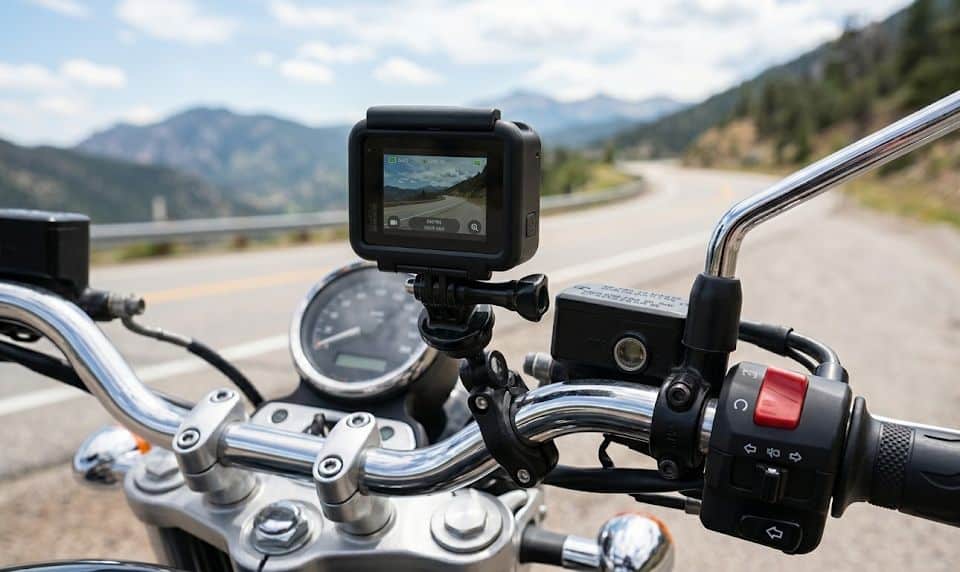
Handlebars: A handlebar or control-area mount is one of the best choices for riders who want stability. It keeps the camera mounted to a solid part of the bike, shows the road ahead clearly, and can include some of the bars or controls in frame for context.
Tank or Fairing Surface: This setup can create a very balanced forward-looking shot. On some bikes, it captures the cockpit nicely without the more exaggerated motion of a helmet cam. It works especially well for touring and long-distance road footage if the surface and adhesive setup are right.
Crash Bars or Engine Guards: These make for great dramatic low-angle footage, especially on ADV and touring bikes. The tradeoff is that lower mounting points often see harsher vibration and significantly more road grime.
Rear Section or Tail: This is useful when you want to include the rider in frame or capture a following-road perspective. It is less common as a primary setup, but very useful as a second angle for YouTube content or group rides.
1) GoPro Flat + Curved Adhesive Mounts
If your priority is helmet footage, this is still one of the smartest starting points. A low-profile adhesive base on the helmet gives you the most natural rider point of view and avoids the extra hardware bulk that some clamp systems add. These mounts are also useful on certain smooth fairing or tank surfaces, though helmet use is where they shine most.
Expert Verdict: GoPro Adhesive Mounts
✓ Pros
- Simple & Low Profile: Minimal wind drag and weight on the helmet.
- Natural Stabilization: Your neck acts as a gimbal to smooth out road bumps.
- POV Accuracy: Captures exactly what the rider is seeing.
✗ Cons
- Permanence: The 3M VHB adhesive requires 24 hours to cure and is difficult to remove.
The reason this setup works so well is that it is simple. There is not much to flex or vibrate. Once the adhesive is properly installed and cured, the base becomes a stable platform for the camera. That simplicity is a real advantage on a motorcycle, where every extra joint can introduce more shake.
2) Forevercam Handlebar Mount
This is one of the cleanest options for motorcycle handlebars and other smaller tubular mounting points. It has a compact footprint, rotates easily, and works especially well if you want a straightforward road-facing shot without building a more involved multi-part system.
Expert Verdict: Forevercam Handlebar Mount
✓ Pros
- 360-Degree Rotation: Easily flip from forward-facing to selfie-mode.
- Tool-less: Quick-release base makes it easy to move between bikes.
- Metal Build: Made of CNC aluminum
✗ Cons
- Rigid Plastic: Transmits more engine “buzz” than rubber-ball systems.
For riders who want to get on the bike and record without overcomplicating things, this is a very strong pick. It suits commuters, weekend riders, and anyone who wants a stable bar-mounted perspective with less experimentation. It also tends to make more sense than oversized generic mounts when your goal is simply a clean handlebar view.
3) RAM Tough-Claw with GoPro Adapter
This is the recommendation for riders who want a tougher, more modular motorcycle-specific setup. It is a very flexible way to mount an action camera to round, square, and odd-shaped rails ranging from .625″ to 1.14″ in outer diameter. Rubber pads provide stable gripping and protection of the mounting surface.
Expert Verdict: RAM Tough-Claw (Medium)
✓ Pros
- Industrial Build: High-strength nylon and stainless steel hardware.
- Vibration Dampening: The 1″ rubber ball acts as a mechanical shock absorber.
- Modular: Compatible with hundreds of other RAM arms and accessories.
- Warranty: Lifetime warranty
✗ Cons
- Size: It is significantly bulkier than official GoPro mounts.
4) RAM Suction Cup Mount
A suction mount is not the default choice for every rider, but it is useful when you want to test centered positions on a smooth tank, windscreen, or fairing-like surface. It can give you a balanced cockpit-style shot that looks very different from a helmet or bar angle. This is especially appealing for road riders who want a more composed touring-style view.
Expert Verdict: RAM Suction Cup
✓ Pros
- Vacuum Power: Twist-lock base creates a much stronger seal than push-style cups.
- Flexibility: Easily move the camera to different smooth panels for new angles.
- Warranty: Lifetime warranty
✗ Cons
- Surface Sensitivity: Only works on smooth, non-porous metal or glass.
The important thing here is surface quality. Suction mounts are only as good as the surface they are attached to, so they make more sense on smooth, clean areas than on textured or highly curved panels. This is one of those mounts that works best when used thoughtfully rather than as a universal solution for every motorcycle. Be sure that grip is secure—we always recommend a secondary tether when using a suction mount.
How to Reduce Vibration on a Motorcycle GoPro Setup
The easiest way to reduce vibration is to keep the setup short and simple. Long extension arms, stacked adapters, and overly complex ball-joint chains give vibration more places to show up. A shorter, tighter mount almost always performs better on a motorcycle.
Mount location matters too. A solid handlebar or well-supported crash bar usually behaves better than a thin plastic windscreen edge or a lightly braced accessory bracket. Helmet footage often avoids some bike vibration because the rider’s body naturally absorbs a lot of it, though you then get more head movement instead. That is not always bad; in fact, a bit of natural head movement often makes the footage feel more immersive.
Another smart move is to test the setup at lower speeds first. Ride a short loop, review the footage, and see whether the issue is vibration, angle, or horizon level. A quick test run can tell you much more than guessing in the garage.
Helmet vs. Handlebar vs. Tank: Which is Best?
Choose helmet mounting if your priority is storytelling and immersive POV. This is the classic rider’s-eye view and is often the best choice for mountain roads, commuting, and conversational ride footage.
Choose handlebar mounting if your priority is stability and a simple bike-mounted setup. This is often the best all-around choice for riders who want consistent road footage with less fuss.
Choose tank or fairing mounting if you want a cleaner, more centered cockpit shot. This can be a very appealing angle for touring, road reviews, and longer-form ride content where you want more of the bike in frame.
Choose RAM on larger rails if you want more dramatic alternate angles and a system that can expand with your bike and filming style.
Building a custom motorcycle rig?
We have vehicle-specific mounting guides for motorcycles, ranging from Harley-Davidsons to Adventure Touring rigs.
Common Mistakes to Avoid
Using too many adapters: Every extra joint is another place for flex and vibration.
Mounting to weak plastics: A camera can be secure but still produce bad footage if the base surface flexes.
Skipping cure time on adhesive mounts: Helmet and fairing adhesive setups need proper prep and at least 24 hours to bond.
Ignoring wind exposure: A mount may feel solid stopped, but wind load at speed changes the physics entirely.
Buying only for looks: Some of the coolest low-angle setups produce the worst practical footage if vibration is not under control.
More Motorcycle Guides: