
Choosing the right RAM mount ball size is one of the most important steps when putting together a RAM mounting system. The ball determines which arms and bases you can use, how much weight the mount is designed to support, and how well the finished setup handles movement and vibration. For most people, the choice comes down to the popular 1-inch B size or the larger 1.5-inch C size, but RAM offers five different ball sizes ranging from tiny camera mounts to industrial-size mounting systems.
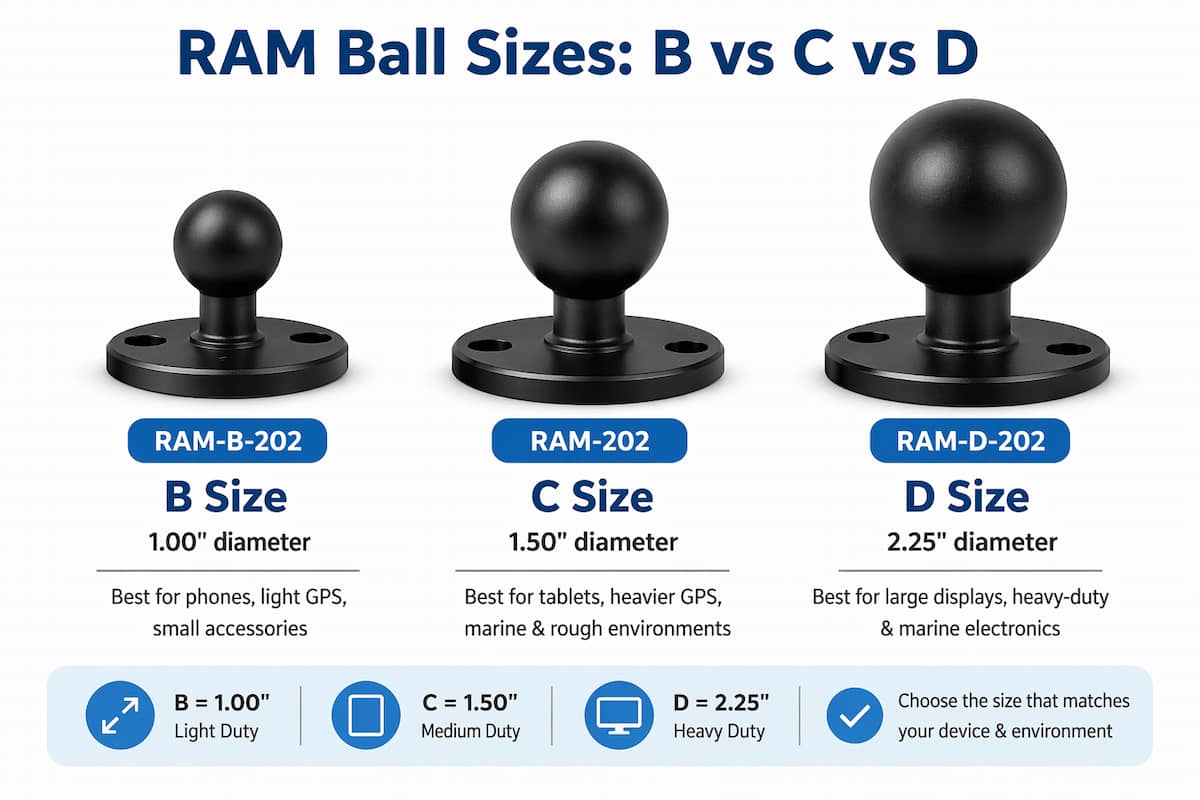
Table of Contents
RAM Mount Ball Sizes at a Glance
RAM currently uses five primary ball sizes: A, B, C, D, and E. The difference between them is much more than diameter. Each size has its own family of compatible socket arms, bases, adapters, and other components.
| RAM Size | Ball Diameter | Approx. Capacity | Typical Applications |
|---|---|---|---|
| A Size | 0.56 inch | 0.5 lb | Action cameras and very lightweight devices |
| B Size | 1 inch | 2 lbs | Phones, GPS units, small tablets, motorcycles |
| C Size | 1.5 inches | 4 lbs | Larger tablets, fish finders, heavier electronics |
| D Size | 2.25 inches | 6 lbs | Rugged tablets, laptops and heavy equipment |
| E Size | 3.38 inches | 15 lbs | Large displays, aviation and industrial equipment |
The weight figures are best treated as guidelines rather than absolute limits. Device weight is important, but arm length, road conditions, mounting angle, vibration, and the strength of the mounting surface can all affect how a RAM system performs.
RAM B Size 1-Inch Ball: The Most Common Choice
If you are researching RAM mount ball sizes for a phone, GPS, motorcycle, or everyday vehicle mount, B size is probably the one you want.
RAM’s B-size system uses a 1-inch diameter ball and is by far the most common RAM configuration. It offers enough holding capacity for phones, most smaller GPS receivers, cameras, and other relatively lightweight electronics without making the mounting system unnecessarily bulky.
B size is particularly popular in vehicles because there is an enormous selection of compatible bases and arms. Suction cup bases, drill-down bases, handlebar bases, motorcycle fork-stem mounts, brake and clutch reservoir bases, and many other RAM components are readily available with a 1-inch ball.
For a typical phone installation, there is rarely a good reason to step up to C size.
- Best for: phones, smaller GPS units, cameras and light electronics
- Ball diameter: 1 inch
- Approximate capacity: 2 lbs with a typical mid-length arm
- Common applications: cars, trucks, motorcycles, ATVs and general-purpose mounting
If you are building a vehicle installation, our vehicle-specific mount guides cover mounting options for many popular cars and trucks. The 1-inch system also appears frequently throughout our GPS mounting guides.
Is B Size Big Enough for a Motorcycle Phone Mount?
In most cases, yes.
There is a tendency to assume that because motorcycles produce more vibration than cars, a motorcycle automatically needs the larger C-size system. That is not how most RAM motorcycle phone mounts are configured.
Many of RAM’s motorcycle mounting components are built around the 1-inch B-size system, including handlebar bases, fork-stem bases, mirror mounts, and brake/clutch reservoir bases.
For a normal smartphone, B size provides a good combination of holding strength, compact dimensions, adjustability, and component availability.
Where motorcycle installations often go wrong is not the ball diameter. It is using an unnecessarily long arm.
The farther the phone sits from the mounting base, the more force is placed on the ball-and-socket connection as the motorcycle moves.
For more motorcycle-specific options, see our motorcycle mount guides.
RAM C Size 1.5-Inch Ball: For Heavier Devices
C size uses a substantially larger 1.5-inch ball and is designed for heavier equipment.
This is where RAM systems start making more sense for larger tablets, marine electronics, fish finders, rugged equipment, and other devices that may be too heavy or awkward for a B-size installation.
RAM rates the C-size system at approximately 4 pounds when used with a typical mid-length arm.
C size can also be useful when the device creates considerable force on the arm because of its dimensions. A large tablet does not need to weigh four pounds to put more stress on a mount than a phone. The additional surface area and distance between the device and mounting point can make the larger system worthwhile.
- Best for: larger tablets, fish finders and heavier electronics
- Ball diameter: 1.5 inches
- Approximate capacity: 4 lbs with a typical mid-length arm
- Common applications: marine electronics, commercial vehicles, off-road equipment and larger tablets
C size should be viewed as a different mounting system, not simply a stronger B-size ball.
The arms, bases, and ball components are physically larger, and B and C components cannot simply be clamped together.
RAM D Size 2.25-Inch Ball: Heavy-Duty Mounting
The 2.25-inch D-size ball is a major jump in physical size.
The first time I handled one, I was surprised by how large it was compared with the familiar 1-inch B ball. Put the two next to each other and they hardly look like parts of the same mounting system.
D size is intended for equipment such as rugged tablets, laptops, larger marine electronics, and heavy commercial or industrial devices. RAM lists an approximate capacity of 6 pounds with a typical mid-length arm.
Most consumers mounting phones, GPS receivers, or conventional tablets will never need one.
- Best for: rugged tablets, laptops and heavy electronics
- Ball diameter: 2.25 inches
- Approximate capacity: 6 lbs with a typical mid-length arm
- Common applications: commercial fleets, marine electronics and industrial equipment
Our marine mounting guides cover many of the applications where larger RAM systems start to become relevant.
RAM A Size 0.56-Inch Ball: The Smallest System
The A-size system sometimes gets left out of RAM ball size discussions because it is much less common than B or C.
Its ball measures just 0.56 inch in diameter and is intended for lightweight equipment such as action cameras and other very small devices. RAM lists its approximate capacity at half a pound.
If you are mounting a smartphone, tablet, automotive GPS, or fish finder, A size is generally not where you should start.
Its value is keeping a mounting system extremely compact when very little holding capacity is required.
RAM E Size 3.38-Inch Ball: The Largest System
At the opposite end is RAM’s massive E-size system.
The E ball measures 3.38 inches in diameter and has an approximate capacity of 15 pounds with a typical mid-length arm. It is designed for applications such as large displays and demanding aviation or industrial installations.
This is specialized equipment. An E-size system would be massive overkill for a phone, tablet, or conventional GPS.
Still, including E size is important when comparing RAM mount ball sizes because it shows just how broad the RAM system has become. The same basic ball-and-socket concept scales from tiny cameras all the way to large commercial equipment.
How to Tell RAM Ball Size From the Part Number
One of the most useful shortcuts when shopping for RAM components is learning how to read RAM part numbers.
In many cases, the letters immediately following “RAM” identify the ball size.
For example:
- RAM-B-xxxxx generally indicates B size, which uses a 1-inch ball.
- RAM-D-xxxxx indicates D size, which uses a 2.25-inch ball.
C size is the unusual one.
Many C-size components have no size letter between RAM and the model number. For example, a component beginning with RAM-201 belongs to the C-size 1.5-inch system, while a comparable B-size arm uses RAM-B-201.
That little distinction can prevent a very annoying ordering mistake.
Why RAM Ball Size Is Only Part of the Stability Equation
A larger ball can support more weight, but ball size alone does not determine whether a mount will be stable.
There are four major factors to consider:
- Device weight: heavier devices put more force on the arm and socket.
- Arm length: a longer arm increases the force being applied to the mounting system.
- Environment: pavement, off-road travel, motorcycles and boats all subject mounts to different levels of movement.
- Mounting base: even an oversized RAM system cannot compensate for a weak or flexible mounting surface.
Arm length deserves particular attention.
A device mounted two inches from the base places much less stress on the system than the same device positioned several inches away on a long arm.
This is why moving to a shorter arm can sometimes solve a stability problem without moving from B size to C size.
Our RAM arms overview explains the different arm configurations and how arm length affects positioning.
B Size vs C Size: Which Should You Choose?
For most MountGuys readers, this is the real question.
| Application | Recommended Size | Why |
|---|---|---|
| Phone in a car or truck | B | Compact and more than adequate for typical phones |
| Phone on a motorcycle | B | Standard size for many RAM motorcycle components |
| Smaller GPS | B | Usually well within B-size capacity |
| Large tablet | C | More capacity for a larger device |
| Fish finder or marine electronics | C or D | Depends heavily on display size and weight |
| Laptop or rugged equipment | D | Designed for substantially heavier equipment |
The goal should not be to buy the largest ball you can fit.
Instead, choose the smallest RAM system that comfortably supports the device and mounting configuration you plan to use. Larger systems add physical bulk and require larger compatible components.
Common RAM Ball Size Mistakes
A few mistakes account for many RAM mounting problems.
- Assuming a motorcycle requires C size: B size remains the normal starting point for a motorcycle phone mount.
- Using an excessively long arm: extra reach also creates additional force on the ball and socket.
- Mixing B and C components: a 1-inch ball does not properly fit a 1.5-inch socket arm.
- Looking only at device weight: device dimensions, arm length and vibration matter too.
- Buying a bigger system unnecessarily: more capacity also means larger arms, bases and components.
- Ignoring RAM part numbers: similar-looking part numbers can belong to completely different ball-size systems.
How RAM Mount Ball Sizes Fit Into the Complete RAM System
The ball is only one component of a RAM mount.
A typical system consists of a mounting base, ball, double-socket arm, and device holder or adapter. Once you select a ball size, most of the other components need to match that size.
If you are new to RAM mounts, start with our RAM Mounts System Guide. It explains how the different pieces fit together.
You can also learn about adding reach or additional mounting points in our RAM Mount Extensions guide and compare different mounting points in our RAM mount bases guide.
Bottom Line
For most people trying to choose between RAM mount ball sizes, the answer is simpler than it first appears.
B size is the default choice for phones, motorcycles, smaller GPS units, and most light-duty vehicle mounting. Its 1-inch ball is compact, widely supported, and suitable for the devices most people mount.
Move to the 1.5-inch C-size system when you are mounting larger tablets, fish finders, heavier electronics, or another device that clearly benefits from the additional capacity.
D and E sizes are designed for progressively heavier equipment, while the tiny A-size system handles action cameras and other ultra-light devices.
Most importantly, do not choose a RAM ball size based on diameter alone. Device weight, arm length, vibration, mounting location, and the strength of the base all contribute to how stable the finished mount will be.
Choose the appropriate system from the start, keep the arm as short as practical, and RAM’s modular mounting system can provide a remarkably solid installation.