
Every RAM mount system starts with the base. It is the one component that determines where your entire setup lives, and choosing the wrong type means the arm, the holder, and the device all end up in the wrong place too. Get the base right and everything else falls into place around it.
RAM makes more base types than most people realize. The right choice depends on your mounting surface, whether the install needs to be permanent or removable, and what kind of environment the mount will live in. This guide covers each base type, explains what it does well, and flags where it falls short.
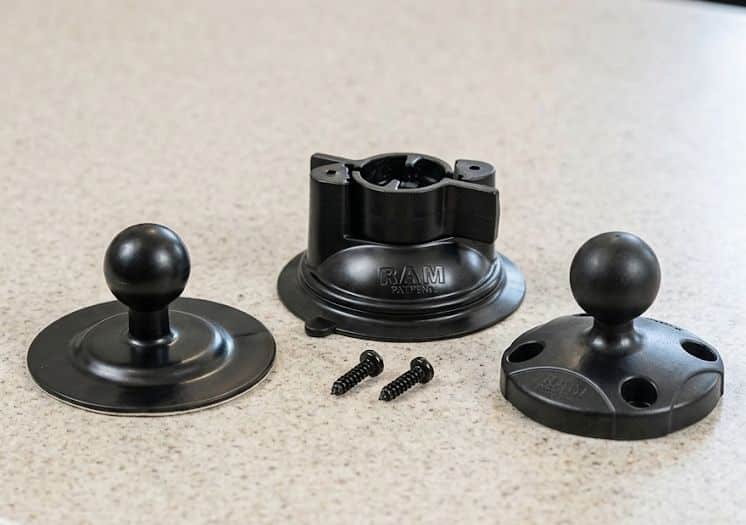
| Base Type | Best For | Install Type |
|---|---|---|
| Handlebar / U-Bolt | Motorcycles, ATVs, bicycles, boat rails | Clamp-on, removable |
| Suction Cup | Car and truck windshields, smooth dash surfaces | Temporary, repositionable |
| Drill-Down (AMPS) | Commercial vehicles, boats, off-road rigs | Permanent, bolted |
| Seat Bolt (No-Drill) | Cars, trucks, fleet vehicles | Semi-permanent, no drilling |
| Adhesive Dash | Lightweight phones on smooth flat dash surfaces | Permanent adhesive |
| Tough-Claw | Roll bars, kayak rails, irregular tubing | Clamp-on, wide size range |
How a RAM Mount System Works
Every setup follows the same structure: a base attaches to your vehicle, an arm positions the device, and a holder secures it.
Ball size determines strength • Arm length affects reach • Base determines placement
Handlebar and Rail Bases
Handlebar bases are the standard starting point for motorcycles, ATVs, bicycles, and any setup that mounts to a round rail. They clamp directly onto tubular bars using a U-bolt, creating a solid anchor that transfers almost no flex to the arm above it. Properly tightened, they hold steady through highway vibration, rough trails, and off-road terrain.
The standard RAM U-bolt base is the RAM-B-231U: a stainless steel U-bolt base with a B size 1″ ball that handles rails from 0.5″ to 1″ in diameter. This covers most bicycle handlebars and smaller motorcycle bars. It is one of RAM’s most purchased bases and a reliable foundation for phones, GPS units, and compact devices.
For higher-vibration motorcycle applications, the RAM Torque series is the better choice. The Torque base uses nylon-insert locknuts rather than standard hardware, which resists loosening from continuous engine vibration in a way that a basic U-bolt can’t match over time. It also ships with sizing inserts to protect the bar surface and fill any gap between the clamp and the rail. The standard Torque base (RAM-B-408-75-1U) fits bars from 3/4″ to 1″. A larger version (RAM-B-408-112-15U) handles 1-1/8″ to 1-1/2″ bars with a C size 1.5″ ball, which is common on cruiser-style motorcycles.
RAM-B-231U Handlebar Base on Amazon
RAM Torque Base (3/4″–1″ Bars) on Amazon
For everything that can be mounted beyond the handlebar on a motorcycle, see our guide to RAM motorcycle bases beyond the handlebar.
Suction Cup Bases
Suction cup bases are the default choice for in-vehicle use on windshields and smooth dash surfaces. They attach without tools, reposition in seconds, and leave no marks on removal. For anyone who moves a mount between vehicles or wants flexibility without committing to a permanent install, a suction base is the practical answer.
RAM’s twist-lock mechanism sets their suction bases apart from the generic options. Rather than relying on passive suction, a quarter-turn lock engages after the cup is pressed to the glass and holds it in place actively. The result is a noticeably firmer connection that doesn’t work loose over time the way bare suction can.
The most common standalone suction base is the RAM-B-224-1U: a 3.3″ twist-lock cup attached to a diamond plate with a B size 1″ ball. This is the base component you buy when you already have an arm and holder and just need a windshield mounting point. It connects to any B size arm.
If the vehicle’s dash doesn’t hold suction well due to texture or curvature, RAM also sells adhesive mounting disks separately. The disk bonds to the dash and creates a smooth, hard surface that the suction cup can grip properly, effectively extending the usefulness of suction bases into vehicles where direct glass mounting isn’t ideal.
RAM-B-224-1U Suction Cup Base on Amazon
For vehicle-specific phone mount setups that use suction cup bases, see our vehicle-specific phone mount guides.
Drill-Down Bases
Drill-down bases create a permanent mounting point by bolting directly to a flat surface. There is no suction, no clamp, no friction. The base is part of the vehicle, and it stays put regardless of vibration, temperature swings, or the weight of the device above it. This makes drill-down bases the first choice for commercial vehicles, boats, off-road rigs, and any application where movement is not acceptable.
Most RAM drill-down bases use the AMPS hole pattern: four threaded holes arranged in a standardized rectangle that is shared across RAM components, Garmin cradles, and hundreds of third-party accessories. Any cradle or holder with AMPS holes connects directly to an AMPS base without adapters. This is the same pattern used by the RAM handlebar AMPS plates and suction cup diamond bases, which is why arms and holders transfer between base types freely within the same ball size.
The most common drill-down base is the RAM-B-202U: a 2.5″ round aluminum plate with the AMPS hole pattern and a B size 1″ ball. It is the foundational drill-down component for phones and GPS units. Rectangular plate variants exist for different form factors, and C size (1.5″ ball) versions scale up to tablets and larger devices.
RAM-B-202U Drill-Down Base on Amazon
Marine electronics installs almost always use drill-down bases. For specific GPS and fish finder mounting kits, see our marine electronics mounting guides.
Seat Bolt Bases
Seat bolt bases attach to the hardware under your vehicle’s front seat, using the existing seat rail bolt to create a solid mounting point without drilling into the dashboard or console. The base extends upward with a rigid arm to position a device at console height. Installation is typically five to ten minutes with a wrench, and the entire mount removes cleanly if you need to return the vehicle to stock.
This approach is common in fleet vehicles, police and emergency vehicles, delivery trucks, and GPS-intensive commercial applications where a suction cup isn’t adequate and drilling into the dash isn’t an option. The holding strength is far greater than any suction or adhesive solution because the base is effectively bolted to the vehicle’s frame through the seat track.
The RAM-B-316-1U is the standard seat bolt base for general use. It consists of the RAM POD I base, which attaches to the seat rail bolt, connected to an 18″ rigid aluminum rod that can be bent to the exact angle needed, terminating in a B size 1″ ball socket arm. The companion RAM-B-316-1-202U version adds a round AMPS plate at the end instead of a ball arm, for direct connection to AMPS-compatible cradles without an additional arm.
RAM-B-316-1U Seat Bolt Base on Amazon
For vehicle-specific no-drill seat rail mounts engineered to fit particular truck and van models, RAM also produces the No-Drill VB series. These use pre-fit brackets designed around the passenger seat rail hardware of specific vehicles and are covered in the relevant GPS mount guides.
Adhesive Dash Bases
Adhesive bases bond directly to the dashboard using a pressure-sensitive pad, creating a low-profile mounting point that requires no hardware and leaves no holes. For a flat, smooth dash surface with a lightweight device, it is the least intrusive base option in the RAM lineup.
RAM’s standard adhesive base is the RAP-B-378U, also called the Flex Adhesive Base. The 2.5″ composite base plate has a slight flex to it, which helps it conform to mildly curved surfaces that a rigid base would bridge. It ships with a double-sided PSA adhesive pad and an alcohol prep pad. Once applied and cured, it attaches to any B size double socket arm.
The tradeoff is permanence. Once the bonding pad has cured, removal can leave residue or damage soft-touch dash materials. Surface compatibility matters too: textured finishes, vinyl wraps, and heavily contoured areas are not reliable candidates. Clean, flat, hard plastic gives the best bond.
RAP-B-378U Flex Adhesive Base on Amazon
Tough-Claw Bases
The RAM Tough-Claw is a gripping base rather than a bolt-down or suction base. A hinged jaw clamps around tubing and tightens with a single knob, accommodating round, square, and irregularly shaped rails without any tools beyond your hand. This makes it useful anywhere a conventional U-bolt handlebar base won’t work: oval tubing, square rail sections, kayak gunwales, roll bars, luggage racks, and similar surfaces are all fair game.
The standard model is the RAP-B-400U, a small Tough-Claw with a B size 1″ ball that handles rails from 0.625″ to 1.14″ in diameter. It is particularly popular for kayak and canoe use, where the mount grips the cockpit rim or side rails without drilling, and for adventure motorcycle setups where luggage rack tubes are a more practical mounting point than the handlebar. A larger version (RAP-B-404U) covers rails up to 1.5″ for heavier-gauge tubing. Both are available with C size 1.5″ ball for tablet-weight loads.
RAP-B-400U Tough-Claw Base on Amazon
Choosing the Right Base
The base is the one component in a RAM setup that you cannot work around. The arm and holder can be swapped freely within the same ball size. The base is determined by your environment, and it shapes every other decision from there.
If you are on a motorcycle, you are almost certainly on a handlebar or Torque base. If you are in a vehicle and want flexibility, a suction cup base is the practical first choice. If the install needs to be permanent or the device is heavy, drill-down or seat bolt is the answer. Get the base right first, then select the arm and holder to match.
Ball size is the other half of this decision. B size (1″ ball) covers phones, handheld GPS, and most compact devices. C size (1.5″ ball) handles tablets and heavier loads. The ball size on your base determines which arms and holders are compatible, so confirm it before ordering any other component.
For more on how the three parts of a RAM system fit together, see our complete RAM Mounts system guide.
Frequently Asked Questions
What is the most common RAM mount base?
The suction cup base is the most widely purchased for vehicle use. The handlebar U-bolt base is standard for motorcycles and bicycles. Both typically use a B size 1″ ball.
What is the AMPS hole pattern?
AMPS stands for Accessory Mounting Pattern System. It is a standardized four-hole layout used by RAM and many device manufacturers including Garmin. Any AMPS cradle or plate mounts directly to any RAM AMPS base without adapters, which is one of the key reasons the RAM system is so modular.
Do all RAM bases use the same arms?
Within the same ball size, yes. A B size base pairs with any B size arm and any B size holder. Ball size must match across all three components. The most common sizes are B (1″) for phones and GPS, and C (1.5″) for tablets and heavier devices.
Can I use a RAM suction cup base on a textured dashboard?
Not directly. The twist-lock suction cup requires a smooth, non-porous surface. RAM sells adhesive mounting disks separately: the disk bonds to the dash and creates a smooth hard surface the suction cup can grip properly.
Is a seat bolt base more secure than a suction cup?
Significantly. A seat bolt base uses the vehicle’s existing structural hardware and does not rely on suction. It handles heavier devices, rougher roads, and will not release unexpectedly.
What’s the difference between the U-bolt base and the Torque base?
Both clamp to handlebars. The Torque base uses nylon-insert locknuts to resist loosening from engine vibration over time, and it ships with sizing inserts to protect the bar surface. It is the better choice for motorcycles used regularly. The standard U-bolt base is fine for bicycles, occasional use, and lower-vibration applications.