YakAttack is one of those brands that kayak anglers either know deeply or not at all. If you are new to rigging a fishing kayak, the product line can look overwhelming at first: tracks in multiple widths and lengths, mounts with different base systems, rod holders with different locking mechanisms, camera poles in two heights. It is a lot to parse before you spend a dollar.
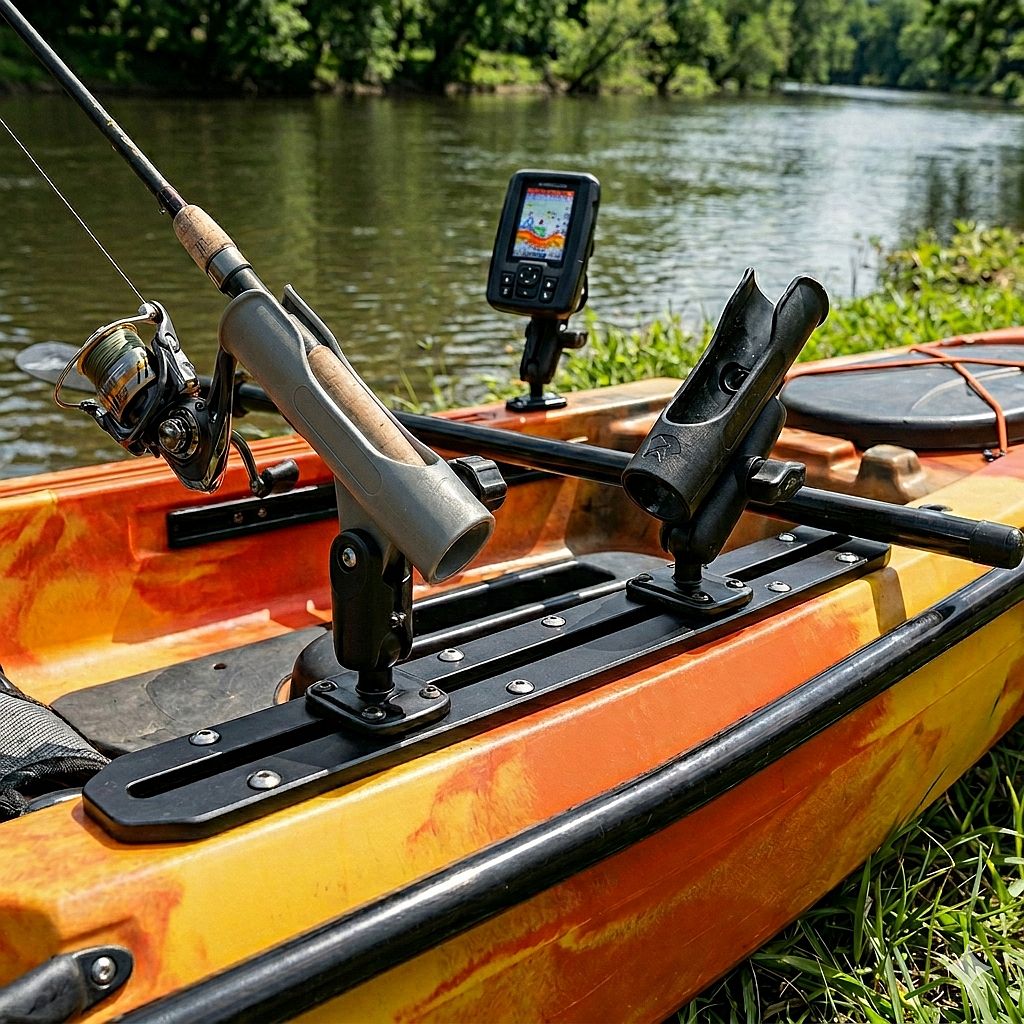
What makes YakAttack worth understanding is that the entire line is a system, not a collection of individual products. The tracks are the foundation. The bases connect the accessories to the tracks. The accessories include rod holders, camera mounts, cup holders, and fish finder brackets, and they all click into those bases the same way. Once you understand the architecture, buying decisions become clear because you are not choosing between unrelated products; you are building a rig piece by piece.
This guide covers the full YakAttack GearTrac system from track selection through accessories. It is organized the way a new buyer should think about it: foundation first, then bases, then accessories. By the end, you will know exactly what to order and in what sequence to build a functional kayak rig from scratch, or to upgrade the one you already have.
Quick answer: Start with GearTrac installed on your kayak. Add a ScrewBall or LockNLoad base. Then attach any YakAttack accessory to that base. Every product in the line follows this same three-layer logic, which is what makes the system expandable over time.
| Product | Layer | Best For |
|---|---|---|
| GT175 Gen II GearTrac | Track | Building from scratch, rod holders, trolling setups |
| GTSL90 SpectraLite | Track | Light accessories, recreational kayaks, entry-level builds |
| ScrewBall Base | Base | RAM accessories on GearTrac, simple single-accessory setups |
| LockNLoad Base | Base | Included with Omega, Zooka II, PanFish Pro accessories |
| Omega Rod Holder | Accessory | Mixed rod types including fly, maximum versatility |
| Zooka II Rod Holder | Accessory | Spinning and casting only, simplicity and reliability |
| PanFish Portrait Pro | Accessory | GoPro or camera mount at working height above deck |
| DoubleHeader with RotoGrip | Accessory | Paddle management, hands-free fishing |
How the YakAttack System Works
Before getting into specific products, it is worth spending a moment on the underlying architecture because it changes how you shop. Most kayak accessories are standalone products: you buy a rod holder, you mount it to your kayak with screws, and it lives in one spot forever. If you want a different position, you drill new holes. YakAttack works differently.
The system has three layers. The first is the track, a length of aluminum channel (GearTrac) or a fixed mounting point (MightyMount) that gets permanently attached to your kayak. The track itself does nothing except provide a platform. The second layer is the base: either a ScrewBall, which is a simple 1-inch ball mount that rides in the track channel, or a LockNLoad base, which is a more sophisticated lever-actuated mechanism. The third layer is the accessory: rod holder, camera mount, fish finder bracket, cup holder, or anything else YakAttack makes. The accessory snaps onto the base, which rides in the track.
The practical result of this architecture is that every accessory is repositionable in seconds without tools. A rod holder that lives at the stern for trolling can move to the gunwale for casting in under a minute. A camera mount that was pointing forward can shift position on the track without changing the camera angle relative to the water. The track is permanent; everything above it is not. That flexibility is the reason serious kayak anglers choose YakAttack over bolt-on alternatives.
Layer One: The Track Systems
GearTrac is the foundation of everything. Getting this choice right matters because the track is the one component you are committing to semi-permanently by screwing it into your hull. YakAttack makes several versions, and the differences between them are meaningful.
GT175 Generation II: The Heavy-Duty Standard
The GT175 Gen II is the track most serious kayak anglers should default to. It is aluminum, hard-anodized, and built for applications that put real load on the mounting hardware: trolling rod holders under tension, fish finder mounts subjected to constant water movement, camera poles at full extension. The wider 1.75-inch profile provides better surface contact with the kayak deck and more resistance to torquing forces than the narrower GT90.
Installation does not require access to the inside of the hull, which matters because most production fishing kayaks have closed or partially closed hull sections that make inside-access impractical. The GT175 uses topside-only screw installation, and the optional FullBack backing plate distributes load across a wider hull area for high-stress applications like heavy trolling setups. For most rigging, the GT175 installs cleanly without the FullBack. For rod holders under trolling load or anything that will take a sudden hard pull, adding the FullBack is the right call.
The GT175 is available in 4-inch, 8-inch, 12-inch, and 16-inch lengths. A 4-inch section works for a single accessory point in a tight spot near the seat. A 12 or 16-inch section gives you a full rigging zone along the gunwale where you can position two or three accessories and slide them as needed. Measure the flat surfaces on your kayak deck before ordering.
The Top Loading version (GTTL175) adds one important usability improvement: accessories drop in from the top rather than sliding in from the end of the track. On a standard GT175, if you have three accessories installed and want to add a fourth in the middle, you have to remove everything to the right of your target position first. With top loading, you drop the new accessory in anywhere on the track independently. For dense rigging setups, top loading is worth the slight additional cost.
GT90: Medium-Duty Aluminum
The GT90 is the narrower aluminum track at 0.9 inches wide. It has the same marine-grade aluminum construction and anodized finish as the GT175 but a smaller footprint, useful in two specific situations: kayaks with limited flat deck surface where the wider GT175 will not physically fit, and rigging zones where low profile matters more than maximum load capacity.
If your accessories are primarily camera mounts, GPS holders, and cup holders that will not be under active fishing tension, the GT90 handles them without issue. If you plan to run trolling rods through track-mounted rod holders, step up to the GT175. The load capacity difference becomes relevant when a fish hits a trolling rod and puts a sudden hard lateral force on the mount base.
Like the GT175, the GT90 is available in a top-loading version (GTTL90) for the same convenience benefit. Both variants come in 4-inch through 16-inch lengths.
GTSL90 SpectraLite: The Entry-Level Polymer Track
The GTSL90 is the polymer version of the GT90, made from marine-resistant hard plastic rather than aluminum. It costs less and comes in several colors including lime, orange, yellow, blue, and black, which some anglers use deliberately to color-code rigging zones on complex setups. The trade-off is durability: the SpectraLite handles light accessories and repositioning use but is not the right track for high-load applications like trolling rod holders or heavy fish finder mounts in rough water.
For camera mounts, visibility flags, paddle holders, and cup holders on recreational or light-fishing kayaks, the GTSL90 performs well. Think of it as the right entry point for kayaks where you want to explore the YakAttack system without the cost of full aluminum track everywhere.
View GTSL90 SpectraLite on Amazon
MightyMount and MightyMount XL: Single-Point Fixed Bases
Not every kayak rig needs a full length of track. The MightyMount is a fixed-point base that installs at a single location on the kayak hull and accepts any YakAttack accessory that uses a standard MightyBolt attachment. It is smaller and lower profile than a track section, useful in spots where track length does not make sense: the bow tip, a narrow section between other rigging, or a position where only one accessory will ever live.
The MightyMount XL is the larger version designed for longer-footprint applications. It functions mechanically like a short section of GearTrac: accessories can be installed from either end and a few extra turns of the knob are needed to remove them, which adds security for high-use accessories. The GridLoc MightyMount XL adds a textured grip surface and cutouts specifically to accommodate the TrackTeeth on LockNLoad accessories, preventing any lateral sliding under load.
Tip: If your kayak already has factory-installed track (many Hobie, Old Town, and Wilderness Systems fishing kayaks do), you may not need to add GearTrac at all. Check your existing track width and profile against YakAttack’s compatibility list before buying. The ScrewBall and LockNLoad systems work with most third-party track formats.
Layer Two: The Base Systems
Once the track is installed, the base is what bridges it to any accessory. YakAttack uses two base technologies across the product line, and understanding the difference between them tells you which accessories use which system.
The ScrewBall: Simple, Universal, Proven
The ScrewBall is a 1-inch ball mount that slides into any YakAttack GearTrac channel and tightens in place via a knob underneath. A rubber washer on the underside compresses against the track walls when tightened, creating a friction lock that resists both rotation and sliding. It is extremely simple: slide in, hand-tighten, done. The 1-inch ball on top is compatible with any RAM Mounts ball-and-socket arm, which opens up a wide range of accessories beyond the YakAttack ecosystem.
That RAM compatibility is an underappreciated feature of the ScrewBall. If you have an existing RAM GPS mount, RAM phone holder, or any other RAM accessory on a 1-inch ball socket, a ScrewBall in the GearTrac gives you an instant track-integrated mounting point for it. This is the mechanism that lets kayak anglers mix and match YakAttack track hardware with RAM accessories without any adapters.
LockNLoad: The Advanced Lever System
LockNLoad is YakAttack’s second-generation base technology and the mechanism used by all of their premium accessories including the Omega rod holder, the Zooka II, and the PanFish Portrait Pro camera mount. The operating principle is a three-mode lever: locked, adjustment, and removal.
In locked mode, the accessory cannot rotate and cannot slide off the track. To adjust position or angle, you squeeze the lever once, moving the system into adjustment mode: the accessory can now rotate freely for angle changes but still cannot be removed from the track. This is the critical detail for fishing: if a fish strikes a rod in a LockNLoad holder, the reel may rotate in the holder but the mount base will not come off the track. To fully remove the accessory, you flip the lever out fully to release mode. The whole sequence takes two seconds and the level of accidental-removal protection it provides is genuinely superior to any screw-tighten base system.
LockNLoad accessories use TrackTeeth on the underside of the base, small ridges that engage with the track channel walls to prevent lateral sliding even in adjustment mode. The combination of TrackTeeth and the lever mechanism makes LockNLoad the right base system for any accessory that will be under active load during fishing.
Layer Three: The Accessories
With track and base sorted, every accessory in the YakAttack line becomes a straightforward add-on. Here are the most significant ones worth understanding in depth.
Omega Rod Holder: The Universal Fishing Solution
The Omega is YakAttack’s most versatile rod holder design. The innovation is a 360-degree rotating collar that captures the reel rather than just the rod blank. Spinning reels stow in their natural downward orientation. Casting reels sit securely without the reel hanging awkwardly to one side. Fly rods, which most kayak rod holders cannot accommodate at all due to their wider grip diameter, fit without modification.
The multiple modes of the collar give a single rod holder meaningful versatility across different fishing styles. An angler who casts, trolls, and occasionally fly fishes from the same kayak can do all three with one Omega rather than a different holder for each technique. The Omega Pro version adds a 4-inch extension arm that raises the reel higher off the deck, which matters for longer rod butts and for anglers who want the reel positioned higher for easier access while seated. Both versions use the LockNLoad base.
View Omega Rod Holder on Amazon
Zooka II Rod Holder: Geometry Over Moving Parts
The Zooka II takes a fundamentally different approach to rod retention than the Omega. Where the Omega uses a mechanical collar to capture the reel, the Zooka II uses the geometric relationship between the tube opening and the rod/reel profile to lock gear in place without any moving parts. You insert the rod at the correct angle and the geometry of the tube prevents it from coming out under normal fishing conditions.
A rod holder with no moving parts on the body is inherently more reliable in a saltwater environment than one with rotating collars and locking mechanisms. The trade-off is that the Zooka II does not accommodate fly rods and is less flexible across different reel sizes than the Omega collar system. For anglers who use spinning or casting gear exclusively and want the simplest, most reliable rod holder possible, the Zooka II is the right choice. It includes the 4-inch extension arm and the LockNLoad base as standard.
PanFish Portrait Pro: Camera Mount for Fishing Kayaks
The PanFish Portrait Pro puts the camera at a useful working height above the deck without introducing the vibration and wind-catch issues of taller pole systems. At 11.5 inches tall, the aluminum construction is the detail that separates it from cheaper camera track mounts. Aluminum does not flex under load the way composite plastic does, and flex in the camera arm is the primary cause of vibration blur in fishing footage.
The LockNLoad base with its mid-session reposition capability is particularly useful for camera work because the best angle changes depending on whether you are paddling, casting, or fighting a fish. Ships with both a 1/4-20 camera ball and a GoPro-specific attachment, so it works with action cameras and standard small cameras without an adapter. Made in the USA, backed by YakAttack’s Built for Life Guarantee. For a deeper look at kayak camera options, see our GoPro kayak mount guide.
View PanFish Portrait Pro on Amazon
PanFish Pro: The Tall Camera Pole
Where the Portrait Pro stands 11.5 inches, the PanFish Pro stands 33 inches. This is the elevated-angle option: it puts the camera above head height for wide shots that show the full kayak, the angler, and the surrounding water simultaneously. It is a specialty tool rather than a primary camera mount, most useful for content where variety of angles matters for viewer engagement.
The PanFish Pro’s split mast has an articulation point at the midpoint that allows one-handed panning while paddling or fishing. The camera ball is the same system as the Portrait Pro: 1/4-20 and GoPro compatible. At 33 inches of elevation, the LockNLoad base is doing significant work keeping the mount rigid against lever forces from the extended arm.
Fish Finder Mounts: Electronics Integration
YakAttack makes a range of dedicated fish finder mounts for most major electronics brands, with LockNLoad bases that integrate directly into GearTrac. Model-specific versions exist for popular units including the Lowrance Hook2 series, the Garmin Striker series, and the Humminbird Helix lineup. The advantage of a dedicated fish finder mount over a ball-and-socket generic solution is rigidity: a fish finder on a ball mount will vibrate in rough water, making the screen difficult to read. The LockNLoad mount locks the electronics bracket at a fixed angle with no play in the joint, keeping the screen stable even in chop.
VISICarbon Pro: Safety and Visibility
The VISICarbon Pro is one of the most practical safety products in the kayak fishing market. The carbon fiber mast deploys to 48 inches and collapses to 14 inches for stowage inside the flag itself. At that height, the flag makes the kayak visible to powerboats at a distance where a low-profile hull would otherwise be invisible in chop or glare.
The LED module built into the mast provides 360-degree visibility for night fishing or low-light conditions, running for 100 hours on three AA batteries. It mounts to any GearTrac, MightyMount, or compatible track system, and the SilentSlip foam base also fits flush-mount rod holders for kayaks without track systems.
RotoGrip Paddle Holder and DoubleHeader
The RotoGrip uses a rotating jaw that accommodates standard diameter kayak paddles across nearly all shaft sizes. When you set a rod down to land a fish or take a photograph, having the paddle secured to the kayak rather than floating away or balanced across the cockpit is a practical necessity. The RotoGrip installs on any MightyMount or GearTrac point and releases the paddle in one motion.
The DoubleHeader mounts two RotoGrip holders offset from a single track point, keeping both halves of a two-piece paddle secured independently. For serious kayak anglers who break down their paddle frequently while fishing, the DoubleHeader eliminates the problem of a loose paddle half sliding around the deck.
View DoubleHeader with RotoGrip on Amazon
Track Compatibility: What Works with What
YakAttack’s system integrates with most third-party track systems in the kayak fishing market. Scotty Fishing Products track, RAM Mounts track, and YakGear track are all directly compatible with YakAttack ScrewBall and LockNLoad bases without adapters. This matters for anglers whose kayaks came with factory-installed non-YakAttack track: you do not need to replace it to run YakAttack accessories.
The exception brands are FeelFree Kayaks, 3 Water Kayaks, and Jonny Boats, which use a slightly different track geometry that requires YakAttack’s AAP-1012 adapter. If you own one of these kayaks, the adapter is a one-time purchase that solves the compatibility problem for every accessory you will ever add.
Factory-installed track on major production fishing kayaks from Hobie, Old Town, Jackson, and Wilderness Systems is generally compatible with YakAttack hardware without modification. The safest approach is to check the track profile on your specific kayak model before ordering, because track standards can vary by hull year and trim level even within the same model family.
Important: The GT90 Top Loading track (GTTL90) is not compatible with RAM Mounts Quick Release Track Bases. If you are mixing RAM and YakAttack hardware on the same kayak, use standard (non-top-loading) GT90 for any track sections where RAM quick-release bases will be installed.
How to Build a YakAttack Rig from Scratch
The logical build sequence for a new rigging project is track first, then base hardware, then accessories. Start by inspecting your kayak for existing flat surfaces where track can mount. The gunwales are the most common location because they put accessories within reach of the seated paddler without crossing the casting or paddling path. The area behind the seat works well for a camera pole or trolling rod holders. The bow deck, if flat and accessible, can support a second rigging zone for a fish finder or secondary rod holder.
For each zone, measure the flat area and select a track length that fits. For most kayak rigging, 8-inch and 12-inch sections are the most practical: long enough to give meaningful position adjustment, short enough to fit between hull features. Install with the included stainless hardware and, for any section that will hold rod holders under active fishing load, add the FullBack backing plate.
Once the track is in, the accessories follow naturally. Every LockNLoad product includes its own base, so the Omega, Zooka II, and PanFish Portrait Pro are all complete kits. ScrewBalls are sold separately for use with RAM accessories or any other ball-socket hardware you want to integrate into the track system.
A full beginner rig covering rod storage, camera mounting, paddle management, and visibility might include: two 8-inch GT175 sections on the gunwale and stern, two Omega or Zooka II rod holders, one PanFish Portrait Pro camera mount, one DoubleHeader with RotoGrip for paddle management, and one VISICarbon Pro for safety. That is a comprehensive functional setup built entirely within the YakAttack system, and every component is repositionable as your fishing style evolves.
The Case for Investing in the System
The upfront cost of a full YakAttack rig is higher than buying individual bolt-on accessories from generic sources. The argument for investing in the system comes down to what happens a year into ownership. Bolt-on accessories lock you into specific hole patterns. Changing the position of a rod holder means drilling new holes, possibly filling old ones, and potentially compromising hull integrity if done repeatedly. YakAttack track, once installed, makes repositioning cost-free and instantaneous for the life of the kayak.
The second argument is ecosystem expansion. Every new YakAttack accessory plugs into existing track without modification. When YakAttack releases a new product, it works in the same system you already have. Generic bolt-on accessories do not share this compatibility, so upgrading one piece often requires changing hardware at the mounting point as well.
YakAttack was founded in 2009 in a garage in rural Virginia by a kayak angler building the gear he wished existed. The brand has maintained its Made in USA production and its Built for Life Guarantee across that entire period, which is a meaningful signal for hardware that lives in a saltwater environment year after year.
Frequently Asked Questions
What is the difference between GearTrac GT90 and GT175?
The GT175 is 1.75 inches wide and designed for high-load applications like trolling rod holders and heavy fish finder mounts. The GT90 is 0.9 inches wide and suited to lighter accessories including camera mounts, GPS holders, and cup holders. If you plan to fish with trolling rods under active tension, start with the GT175.
What is the difference between top-loading and end-loading GearTrac?
On standard end-loading track, accessories slide in from the open end of the rail. Adding one to the middle of a populated track requires removing everything to one side first. Top-loading track (GTTL series) lets you drop accessories into the channel at any point independently, which makes mid-session repositioning much faster.
Does YakAttack GearTrac work with RAM Mounts accessories?
Yes. The YakAttack ScrewBall is a 1-inch ball mount that rides in any GearTrac channel and accepts any RAM Mounts ball-and-socket arm. This lets you run RAM phone holders, GPS mounts, and other RAM accessories directly from the GearTrac without any additional hardware.
Is GearTrac compatible with factory-installed kayak track?
Most factory track on Hobie, Old Town, Jackson, and Wilderness Systems kayaks uses the standard 1/2-inch T-slot profile and is directly compatible with YakAttack ScrewBall and LockNLoad bases without adapters. FeelFree, 3 Water Kayaks, and Jonny Boats use a different geometry that requires the YakAttack AAP-1012 adapter.
What is the difference between LockNLoad and ScrewBall?
The ScrewBall is a simple hand-tighten ball mount that locks in place via friction. The LockNLoad is a lever-actuated three-mode system: locked, adjustment, and removal. LockNLoad provides faster in-session repositioning and better protection against accidental removal under load. It comes built into YakAttack’s premium accessories including the Omega, Zooka II, and PanFish Pro.
Do I need a backing plate when installing GearTrac?
For camera mounts, cup holders, and other light accessories, a backing plate is optional. For rod holders that will be under trolling tension or any mount that may take a sudden hard pull, the YakAttack FullBack backing plate distributes load across a wider area of the hull and is worth including.
Can GearTrac be installed on a boat as well as a kayak?
Yes. GearTrac installs on any flat surface including power boat gunwales, center console edges, and aluminum fishing boat rails. The same accessories designed for kayak track are equally functional on larger boats.
What is the Omega rod holder and how is it different from the Zooka II?
The Omega uses a 360-degree rotating collar that captures the reel, accommodating spinning reels, casting reels, and fly rods in the same holder. The Zooka II uses a fixed tube geometry with no moving parts, which is more reliable in saltwater over time but does not accommodate fly rods. The Omega is the more versatile choice; the Zooka II is the more durable one for anglers who only use spinning or casting gear.
Is YakAttack gear made in the USA?
Yes. YakAttack manufactures its products in the United States and backs them with a Built for Life Guarantee. The brand was founded in 2009 in rural Virginia.