
If you use a Pocket Radar for baseball, softball, tennis, pickleball or other sports, a tripod or fence mount can make it much easier to get consistent hands-free speed readings. The key is choosing a Pocket Radar tripod or mount that fits the way you train.
A tripod gives you the most freedom to position the radar exactly where you want it. At baseball and softball fields, however, a fence or post mount can be even more convenient. Newer magnetic fence mounts also give coaches a way to mount a radar, phone or camera without putting another tripod behind the backstop.
If mounting equipment to a backstop is your primary goal, also see our guide to phone mounts for fences for additional sports mounting ideas.
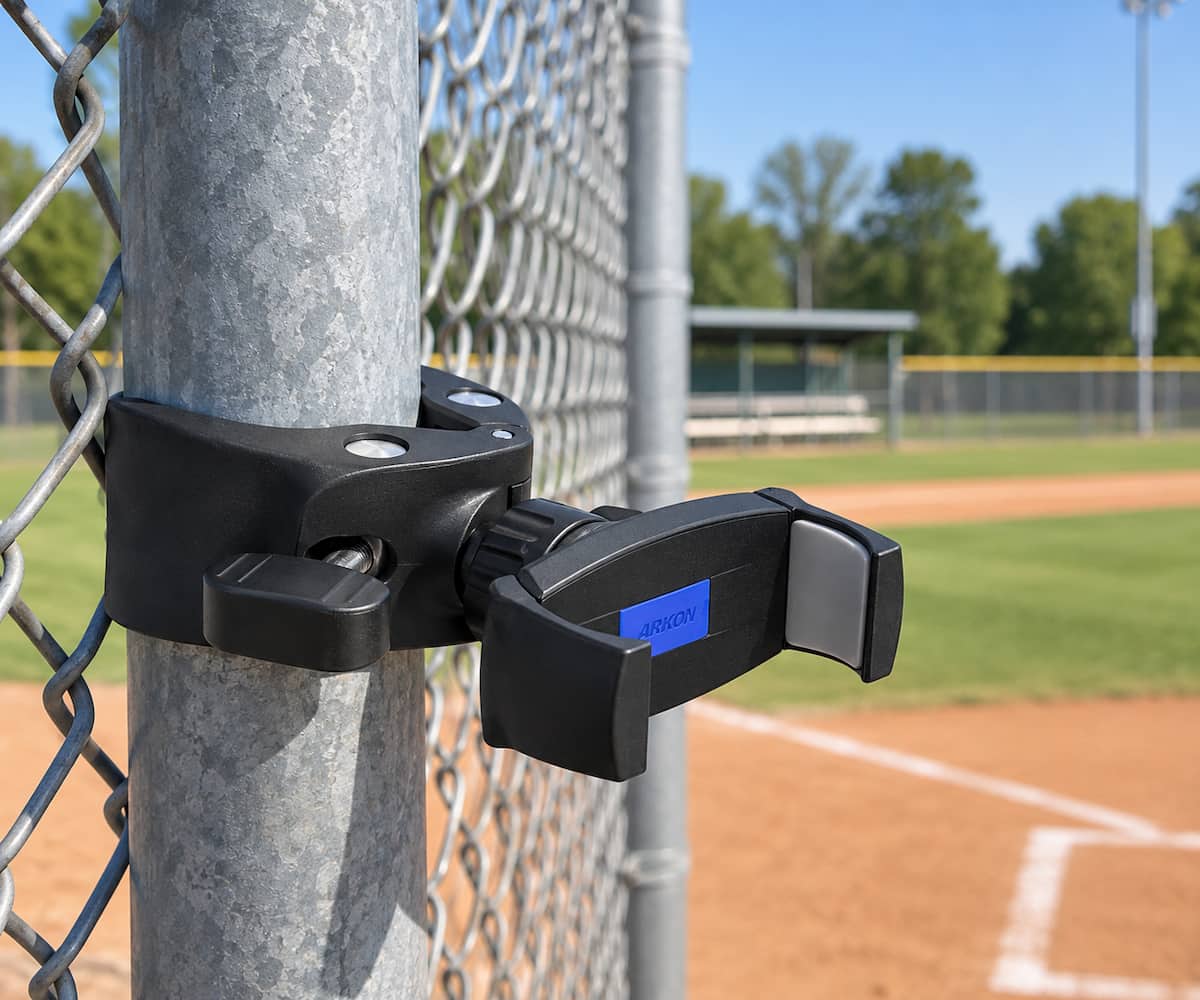
The Arkon MG531 at a Baseball Field
Best Pocket Radar Tripods and Mounts
| Mount | Best For | Mounting Style |
|---|---|---|
| Pocket Radar Universal Mount | Best overall | Tripod / multipurpose |
| WEWOGA Magnetic Fence Mount | Best magnetic sports setup | Fence / metal post |
| NEEWER CA144 Magnetic Fence Mount | Best dual-device magnetic mount | Fence / metal post |
| 4-in-1 Sports Radar Fence Mount Kit | Best dedicated fence kit | Chain-link fence / backstop |
| Arkon MG531 Mobile Grip 5 Post Mount | Best round-post clamp | Post / pole |
Pocket Radar Universal Mount: Best Overall
For most users, the Pocket Radar Universal Mount is where I would start.
This is the official Pocket Radar accessory, and its biggest advantage is flexibility. Rather than limiting you to one mounting method, it provides a practical way to incorporate the radar into a tripod-based training setup.
It is especially useful if your main reason for searching for a Pocket Radar tripod is to get the radar off the ground and positioned consistently during pitching, hitting or other speed drills.
A tripod also lets you adjust the position independently of a fence. That’s useful at training facilities, tennis courts, hockey practices and other locations where there may not be a backstop in the right place.
Another advantage is that you’re not buying a highly specialized mounting system that only makes sense at a baseball field.
WEWOGA Magnetic Fence Mount: Best Magnetic Sports Setup
The WEWOGA Magnetic Fence Mount takes a different approach.
Instead of setting up a tripod behind the field, this mounting kit is designed around attaching equipment to metal structures around a sports facility. It is marketed for Pocket Radar as well as phones and recording equipment used with sports applications.
That makes it particularly interesting for baseball, softball, pickleball and tennis.
The biggest attraction is convenience. If you have a suitable metal surface available, you can avoid spreading tripod legs across the ground behind a backstop or near a training area.
It also makes sense for coaches who use more than just a radar. Phones are now commonly used to record pitches, swings and games, and a mounting system designed around sports recording can be more useful than a radar-only bracket.
Keep in mind that magnetic mounting depends on the material underneath it. Chain-link fences, posts and other structures can vary, so don’t assume every painted or metallic-looking surface will provide the same magnetic hold.
NEEWER CA144: Best Dual-Device Magnetic Mount
The NEEWER CA144 is another magnetic fence and post mounting option, but it stands out because of its dual-device design.
NEEWER lists the CA144 as compatible with Pocket Radar along with phones and action cameras. The mount uses a dual ball-head arm arrangement that provides 360-degree swivel and up to 90 degrees of tilt.
That adjustment is useful with radar because simply attaching the device to a fence isn’t enough. You still need to aim it correctly.
The CA144 is rated to hold up to 2.2 pounds and provides two mounting positions. That opens up some useful sports configurations.
For example, one position can be used for your radar while the other supports a phone or another compatible lightweight device.
That can make the CA144 especially useful for coaches who combine speed measurements with video.
Its foldable metal construction also makes it easier to carry with other training equipment than a full-size tripod.
4-in-1 Sports Radar Fence Mount Kit: Best Dedicated Fence Kit
The 4-in-1 Sports Radar Fence Mount Kit is another option for coaches who primarily use their radar at baseball or softball fields.
Rather than carrying a conventional tripod, you can use the existing backstop as the mounting structure.
That can be a major convenience during games and practices. It keeps equipment off the ground, eliminates tripod legs from the area and reduces the amount of gear you need to carry.
The kit is designed around sports recording and radar use rather than being a general-purpose photography tripod.
I would consider this type of mount when you know that the vast majority of your Pocket Radar use will occur at a fenced sports facility.
If you frequently train in open areas without a suitable fence, however, the official Universal Mount paired with a tripod gives you more freedom.
Arkon MG531 Mobile Grip 5: Best for Round Posts
The Arkon MG531 Mobile Grip 5 is an older design than some of the dedicated sports fence mounts, but it still fills an important niche. This is the photo that accompanies this article. These fit a lot of devices, including a Pocket Radar.
Instead of relying on magnets or a tripod, the MG531 clamps to a round post or pole.
The post clamp accommodates posts approximately 12 to 40mm in diameter, while the spring-loaded holder provides 360-degree positioning.
The MG531 was originally designed primarily as a mobile-device post mount, but its clamp-style holder is confirmed to accommodate the Pocket Radar.
That makes it useful around batting cages and training facilities where you have an appropriately sized round post available.
It’s also mechanically different from the magnetic mounts. You aren’t relying on the mounting surface being sufficiently magnetic. The clamp physically grips the post.
That can be an advantage at facilities where you’re never quite sure what material a painted fence post or support is made from.
What Tripod Works with a Pocket Radar?
When people search for a tripod for Pocket Radar, they’re often looking for the complete setup.
The important distinction is that the tripod and the holder are separate parts.
Once you have a suitable Pocket Radar tripod mount, you generally don’t need some exotic sports-specific tripod. A normal camera-style tripod can provide the base.
You may already own one that will work.
For baseball and softball training, I prefer a conventional tripod with adjustable legs over a tiny tabletop tripod. Being able to adjust the height makes it easier to position the radar for pitching, hitting and other drills.
Stability matters more than extreme height. There usually isn’t any benefit to extending a tall tripod to its maximum height if a lower position gives you the angle you need.
Keeping the setup lower can also make it less top-heavy.
Tripod vs. Fence Mount vs. Post Mount
Now that there are several good mounting approaches, the right choice depends more on where you use your radar than on the radar itself.
A tripod provides the most positioning freedom. You can move it almost anywhere and adjust both height and direction without depending on an existing structure.
A fence mount is particularly convenient for baseball and softball. The backstop is already there, so you’re using it instead of carrying another stand.
A magnetic mount makes setup and removal fast when you have a suitable metal surface.
A post clamp such as the Arkon is useful when a round pole is available and you want a physical clamping connection rather than relying on magnets.
None is universally better.
For pitching instruction at different locations, I’d lean toward the tripod.
For regular baseball or softball games from behind a backstop, I’d lean toward one of the fence systems.
For batting cages and facilities with accessible round posts, the post-clamp approach can be surprisingly useful.
Using Pocket Radar with a Phone
A phone has become an increasingly useful part of a radar setup.
The Pocket Radar Smart Coach can work with the Pocket Radar app, allowing speed information and video to become part of the same training workflow.
That’s one reason the newer dual-device fence mounts are interesting.
Instead of installing one mount for the radar and another for your phone, some mounting systems allow both devices to be positioned from the same general location.
Just remember that mounting compatibility and electronic compatibility are two different things.
A holder may physically accommodate multiple Pocket Radar models, but that doesn’t give every radar the Smart Coach’s app features.
How to Position a Pocket Radar
Even the best Pocket Radar mount won’t compensate for poor positioning.
Radar works best when it is aimed along the direction the object is traveling. As the angle between the radar and the object’s path increases, measurement error can increase.
For pitching, that means you generally want the radar looking as directly as practical along the path of the ball rather than sharply across it from the side.
This is one advantage of an adjustable tripod or ball-head fence mount. You can fine-tune the radar’s direction rather than simply attaching it wherever the fence allows.
Which Pocket Radar Mount Should You Buy?
For the broadest range of uses, the Pocket Radar Universal Mount remains our first choice. It makes the most sense if a tripod is your primary setup or if you don’t yet know exactly where you’ll be using the radar.
For baseball and softball coaches who regularly work from behind a fence, the decision becomes more interesting.
The WEWOGA and NEEWER CA144 provide magnetic mounting options that are especially appealing when you also use a phone or camera during training.
The 4-in-1 Sports Radar Fence Mount Kit is another good choice when your setup revolves around the backstop.
And the Arkon MG531 shouldn’t be overlooked. It’s the oddball of the group, but that’s also why it’s useful. When there’s a suitable round post available, a physical clamp can make more sense than either a tripod or magnetic mount.
The important point is that there is no longer just one practical way to mount a Pocket Radar. Choose the mounting style based on the field, cage or training environment where you’ll use it most often.
Frequently Asked Questions
What is the best Pocket Radar tripod?
For most users, I would pair the Pocket Radar Universal Mount with a stable camera-style tripod. This gives you more flexibility than a mounting system that depends on a particular fence or post.
Can I use a regular camera tripod with Pocket Radar?
Yes, when used with the appropriate Pocket Radar mount or holder. You generally don’t need a proprietary tripod simply to create a hands-free setup.
Can you mount Pocket Radar to a baseball fence?
Yes. Several mounting approaches work around baseball and softball fences, including dedicated fence kits and magnetic mounts designed for sports equipment.
Are magnetic Pocket Radar mounts a good idea?
They can be very convenient when the fence or post provides a suitable magnetic surface. Always test the connection before placing expensive equipment on it, particularly when mounting above the ground.
Can you mount Pocket Radar to a round post?
Yes. A clamp-style post mount such as the Arkon MG531 can be used when the post diameter falls within the clamp’s supported range.
Is a fence mount better than a tripod?
It depends on where you’re using the radar. Fence mounts are convenient at baseball and softball fields, while tripods give you considerably more freedom to position the radar in open training areas.
Related Mount Guides
If you’re mounting additional equipment around a baseball field or sports facility, see our phone mounts for fences guide for additional options for phones, cameras and other equipment.