
Radar detectors are usually supplied with a windshield suction mount, but the windshield is not always where you want the detector. Local mounting rules, windshield coatings, an awkward windshield angle, repeated suction-cup failures, or simply a desire to keep the glass clear can all make the dashboard a better location.
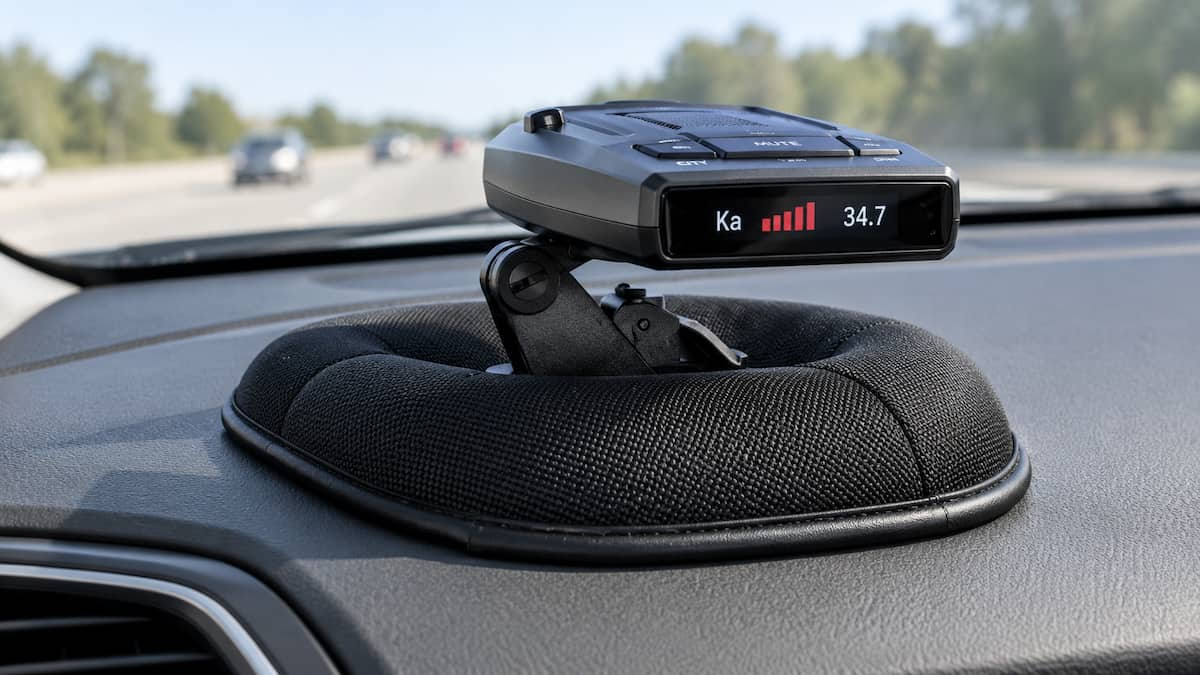
Radar Detector in a Dashboard
The challenge is keeping the detector secure, level and high enough to maintain a clear view through the windshield. Some radar detector dash mounts use a weighted friction base. Others attach directly to the dashboard with adhesive or hook-and-loop material. There are also detector-specific suction mounts that can adhere to suitable smooth dashboard surfaces.
This guide focuses exclusively on those dashboard solutions. If you are comparing windshield, rearview mirror and other mounting styles too, see our complete radar detector mount guide.
Best Radar Detector Dash Mounts at a Glance
| Mount | Best For | Attachment |
|---|---|---|
| Bracketron NavMat | Best overall, no adhesive on the dash | Weighted friction base + detector suction mount |
| iGoevo Hook-and-Loop Dash Mount | Low-profile permanent dashboard installation | Adhesive base + hook-and-loop |
| SDSACZMU Cobra Radar Detector Mount | Compatible Cobra detectors | Reusable suction base on suitable smooth surfaces |
| 3M Dual Lock SJ3560 | Best DIY removable installation | Interlocking adhesive fastener |
1. Bracketron NavMat: Best Overall Radar Detector Dash Mount
The Bracketron NavMat is our favorite solution for most drivers because it solves the windshield problem without creating a new problem on the dashboard.
Instead of gluing anything to the vehicle, the NavMat uses a weighted beanbag-style base with a friction surface underneath. The center provides a smooth mounting area for the suction cup that normally attaches to your windshield.
That distinction is important. You continue using the detector’s proper factory or aftermarket mounting bracket, so there is no need to stick a metal plate, Velcro strip or other adapter directly to the radar detector.
The NavMat can also conform somewhat to dashboard contours instead of requiring a perfectly flat surface.
Another advantage is portability. When you park, you can pick up the entire detector and platform and move it out of sight. There is no suction-ring telltale left on the windshield and no permanent base attached to the dashboard.
This is an older product design, but that is a positive here. It has been used for years with GPS units and other dashboard electronics, and its current listing remains well reviewed.
The downside is size. A weighted friction mount takes considerably more dashboard real estate than a small adhesive base. If your vehicle has a steeply sloped dashboard, a narrow shelf near the windshield, or a large center speaker grille, measure before ordering.
2. iGoevo Hook-and-Loop Dash Mount: Best Low-Profile Option
The iGoevo hook-and-loop mount takes the opposite approach from the Bracketron. Instead of placing a large portable platform on the dashboard, it creates a compact semi-permanent mounting point.
The base attaches to the dashboard, while hook-and-loop material secures the detector to the platform. This keeps the installation low and reduces the amount of hardware visible from the driver’s seat.
We prefer this version over iGoevo’s magnetic radar detector mount. The magnetic model sounds attractive, but its current customer rating falls below the threshold we use for MountGuys recommendations.
The hook-and-loop version has a stronger current review record and avoids relying on an exaggerated claim that one magnetic interface somehow fits every radar detector.
There is still an important compatibility point: the detector needs a suitable surface for the hook-and-loop material. Check the bottom of your detector before installation. Do not cover ventilation openings, serial-number labels, speaker openings or removable battery covers.
The other consideration is the dashboard itself. Adhesive products generally work best on clean, relatively smooth surfaces. Soft-touch materials, leather-wrapped dashboards, heavily textured plastic and recently treated surfaces can all present problems.
3. SDSACZMU Cobra Radar Detector Mount: Best for Compatible Cobra Models
If you own one of the compatible Cobra detectors, the SDSACZMU mount provides another approach.
Unlike a generic platform, this is a radar detector bracket specifically intended for a group of Cobra detectors. The current listing identifies compatibility with models in the Cobra iRadar, ESD, SPX and RAD families, including several RAD 380, RAD 450 and RAD 480i-era detectors.
The mount uses a reusable suction-style base and is marketed for both windshield and suitable dashboard surfaces.
There is a catch. Most dashboards are textured, and suction cups do not magically stick to every dashboard simply because a product description says “dashboard.”
This option makes the most sense when your vehicle has a smooth, hard dashboard mounting area that allows the suction base to seal properly.
If you have a textured or padded dashboard, the Bracketron friction platform or an adhesive installation is usually more predictable.
The advantage here is the detector-specific bracket. You are not improvising a way to attach the Cobra detector to the mount.
4. 3M Dual Lock SJ3560: Best DIY Radar Detector Dash Mount
Sometimes the best radar detector dash mount is not a conventional mount at all.
3M Dual Lock uses rows of interlocking mushroom-shaped stems rather than the soft hook-and-loop design used by ordinary Velcro. Press the two pieces together and they mechanically lock.
Radar detector owners have used Dual Lock to mount detectors directly to flat dashboard locations because it provides a strong connection while still allowing the detector to be removed.
For a clean installation, use only enough Dual Lock to hold the detector securely. More material is not necessarily better.
The major advantage is flexibility. You decide where the detector sits, and there is no bulky platform or suction arm.
The major disadvantage is that adhesive goes on both the vehicle and the detector. That may not be something you want to do to an expensive detector or a leather, soft-touch or delicate dashboard surface.
Does a Radar Detector Work Properly on the Dashboard?
Usually, yes, provided it is mounted correctly.
The most important requirement for radar reception is keeping the detector level, pointed forward and free from significant obstructions.
Dashboard mounting does introduce some considerations that the old version of this article understated.
A detector mounted very low can lose some ability to see laser signals because the vehicle’s hood and windshield wipers may block the detector’s laser sensors. This matters because police laser is a narrow beam and is typically aimed toward the front license plate or headlights.
That does not mean a dashboard mount is bad. It means placement matters.
Position the detector where it can see through the windshield rather than directly into the dashboard, hood or wipers.
Some vehicles also use windshields with metallic coatings or special tint that can interfere with radar or GPS reception. That problem affects windshield-mounted detectors too. Check the owner’s manual if the vehicle uses heat-reflective or coated glass.
Escort and Cobra also warn that some infotainment systems can cause interference when a detector is mounted close to dashboard electronics.
Where Should a Radar Detector Sit on the Dash?
A good dashboard location has four characteristics:
- Clear forward view: The detector should see through the windshield without the dashboard, hood or wipers blocking it.
- Level orientation: Avoid mounting the detector at a steep upward, downward or sideways angle.
- Secure base: The detector should not slide during braking, cornering or normal road vibration.
- Safe placement: Do not put the detector where it interferes with your view, airbags, defroster vents or vehicle controls.
The center of the dashboard near the base of the windshield often provides the best geometry, but every vehicle is different.
Weighted Dash Mount vs. Adhesive Dash Mount
A weighted friction mount is best if you want to avoid attaching anything permanently to the vehicle. It is also convenient if you move the detector between cars or remove it when parking.
The tradeoff is size. Weighted mounts need enough mass and surface area to resist sliding.
An adhesive dash mount is much smaller and creates a cleaner installation. Once positioned, it does not occupy much space.
The tradeoff is permanence. Adhesive may leave residue and can interact poorly with some interior materials.
A Dual Lock installation sits somewhere in between. The attachment itself is compact and the detector remains removable, but adhesive is still involved.
Radar Detector Dash Mounts and Windshield Laws
One reason drivers look for dashboard mounts is concern about windshield obstruction laws.
Be careful with blanket statements claiming that a particular state completely prohibits every object attached to a windshield. Many state statutes contain specific exceptions, permitted mounting zones or limitations based on whether the device obstructs the driver’s view.
Radar detector legality is another separate issue.
If avoiding a windshield installation is important because of local law, check the current statute or official state guidance where you drive rather than relying solely on a product description or an old internet list.
Our windshield mounting laws guide explains why the issue is more complicated than a simple legal-or-illegal list.
What We Would Avoid
Loose non-slip pads. A sticky silicone mat may be fine for coins or sunglasses, but we do not consider a loose detector sitting on a pad to be a proper mounting system.
Unverified universal magnetic mounts. A listing claiming compatibility with Escort, Uniden, Cobra, Valentine One and every other detector does not mean those products share the same mounting interface.
Phone cradles. Radar detectors are not shaped like phones. Side-clamping a detector in a phone holder can block buttons, vents, sensors or speaker openings.
Dashboard suction on heavily textured surfaces. A suction cup requires an airtight seal. Most textured dashboards cannot provide one.
Frequently Asked Questions
What is the best radar detector dash mount?
For most vehicles, we prefer the Bracketron NavMat because it avoids permanent adhesive and lets you use a proper suction-cup radar detector bracket on a weighted dashboard platform.
Can I simply put my radar detector on the dashboard?
We would not. Even if the detector seems stable during normal driving, hard braking or a sharp turn can send it sliding. Use a proper friction platform, adhesive mount or secure fastener.
Does a dash mount reduce radar range?
A properly positioned dashboard installation can work well for radar detection. The more important concerns are orientation, obstructions and windshield construction. Very low mounting can also reduce the detector’s view of laser signals.
Will adhesive damage my dashboard?
It can. Dashboard materials vary widely. Leather, soft-touch coatings and some textured plastics deserve extra caution. If avoiding possible adhesive marks is important, choose a weighted friction mount.
Can I use 3M Dual Lock instead of Velcro?
Yes, if the dashboard and detector both provide appropriate surfaces for the adhesive. Dual Lock creates a firmer interlocking connection than conventional hook-and-loop material and still allows the detector to be removed.
Our Bottom Line
The best radar detector dash mount depends more on your dashboard than on the detector itself.
For most drivers, the Bracketron NavMat is our first choice because it requires no adhesive on the vehicle and allows you to continue using an appropriate suction-cup detector mount.
If dashboard space is tight, the iGoevo Hook-and-Loop Dash Mount provides a much smaller installation. Compatible Cobra owners can also consider the SDSACZMU dashboard and windshield suction mount when the vehicle has a suitably smooth dashboard surface.
For drivers comfortable building a simple installation themselves, 3M Dual Lock remains one of the cleanest ways to secure a detector directly to a suitable flat section of dashboard.
What we would not do is buy a poorly reviewed generic magnetic mount simply because its listing claims to fit every radar detector ever made.