
Whether you’re scouting deer movement, monitoring a food plot, or trying to film your own hunt, getting a camera mounted solidly to a tree is the first problem to solve. The method you choose affects how long the camera stays in place, how much you can adjust the angle, whether it’s legal on the land you’re hunting, and how easy it is for someone else to walk off with it.
There are three main approaches: strap mounts, screw-in mounts, and camera arms. Each has its place. Here’s how to think through which one fits your situation.
Method 1: Strap Mounts
The strap is the most common way to mount a trail camera, and most trail cameras ship with one included. You thread the strap through the slot on the back of the camera housing and cinch it around the tree. Simple, fast, and leaves no mark on the tree.
The main limitation is angle adjustment. When you strap a camera flush against a tree trunk, it points straight ahead — wherever the tree is facing. If the game trail runs at an angle to the tree, you’re stuck either picking a different tree or shimming the back of the camera with a stick or wedge to tilt it. Some straps come with a pivoting bracket that attaches between the strap and the camera, which solves this problem. If you’re using a basic strap, a pivoting mount adapter is worth the few dollars — it gives you tilt and rotation without needing a different tree.
Straps are the go-to for public land hunting, where screw-in mounts are often prohibited or frowned upon. They’re also the right call if you’re moving cameras frequently between spots, since installation and removal takes under a minute.
Best for: Public land, frequent camera moves, trail cameras with built-in strap slots, situations where you want zero tree damage.
Watch out for: Loose straps on smooth-barked trees (beech, young aspen) — the camera can slowly rotate or slip downward over time. Check and re-tighten after the first heavy rain.
Method 2: Screw-In Tree Mounts
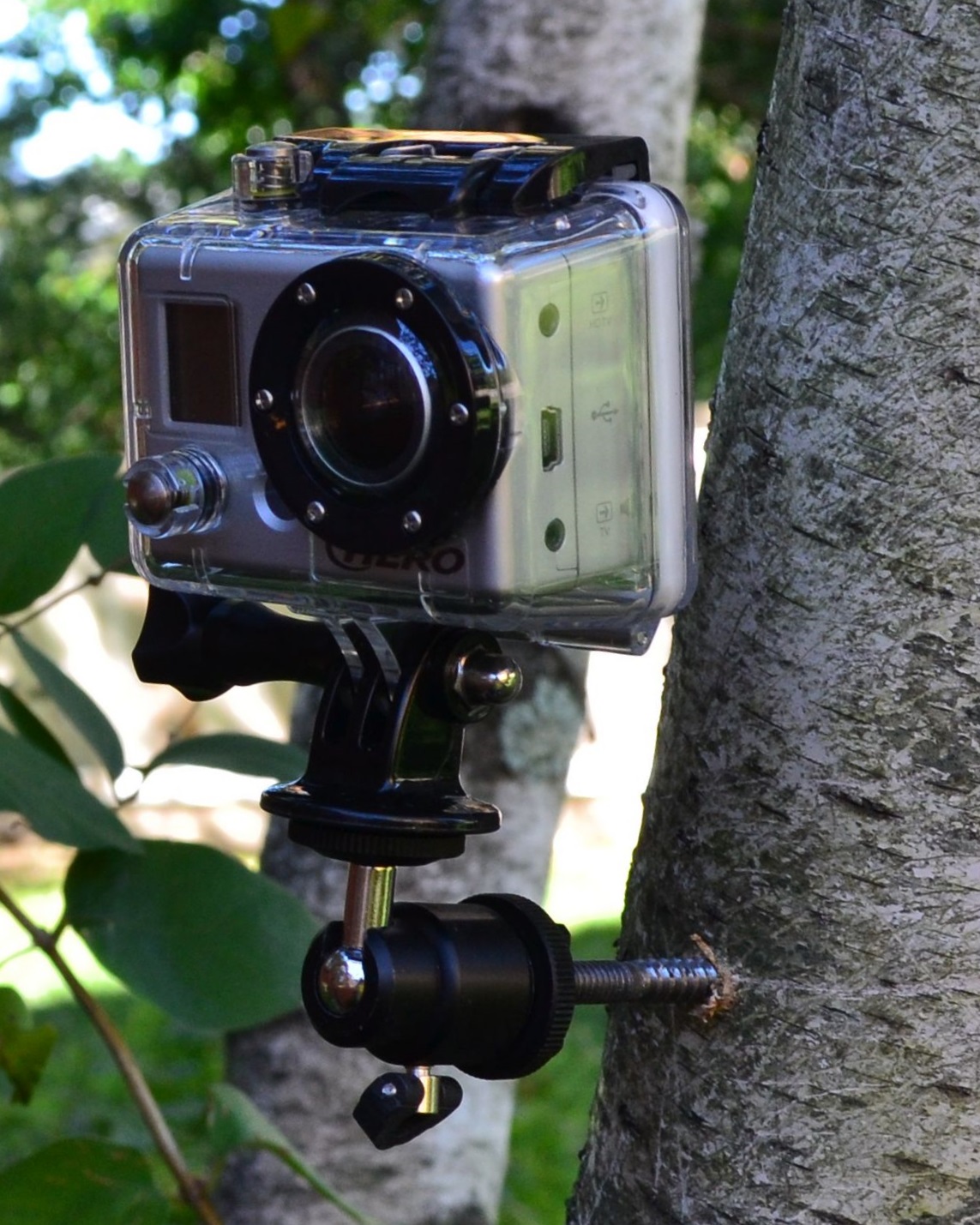
A screw-in mount threads directly into the bark of the tree, giving you a rock-solid platform that doesn’t shift in wind or weather. Most use a self-tapping lag screw on one end and a standard 1/4″-20 threaded connection on the other — the same thread pattern used by tripods and found on the bottom of nearly every trail camera. A ball-and-socket head lets you dial in the exact angle before locking it down.
Installation is straightforward. Press the screw tip against the bark and twist by hand — no tools needed for most designs. It takes a minute or two to get fully seated. For harder wood or larger screws, drilling a pilot hole first makes it easier and reduces the chance of the screw binding up. Use as much thread depth as possible; a shallow bite in the bark won’t hold well over time.
The HME Products Trail Camera Holder is one of the most widely used screw-in designs — inexpensive, adjustable, and compatible with any trail camera that has the standard 1/4″-20 insert. For a more heavy-duty option with a longer arm that keeps the camera away from the trunk (useful for getting a better downward angle on a trail), the HME Better Camera Holder adds an extended arm with full pan and tilt adjustment.
RAM Mounts also makes a screw-in tree mount — the RAM Tough-Tap — built from marine-grade aluminum. It’s a step up in build quality for hunters who run cameras year-round in harsh conditions.
Best for: Private land, long-term camera placements, windy locations, any situation where you want to set it and not think about it for weeks.
Method 3: Camera Arms (For Filming Hunts)
If you’re filming your own hunts from a tree stand — bowhunting especially — a camera arm is a different category of mount entirely. These aren’t trail camera accessories; they’re designed to hold a camcorder or DSLR/mirrorless camera steady while you’re sitting in the stand waiting for a shot.
Camera arms clamp or strap to the tree and extend outward, positioning the camera off to the side so it doesn’t interfere with your draw. The arm itself is typically articulated, letting you swing the camera toward the action when an animal comes in and lock it in position for the shot. The goal is a stable, hands-free filming setup — you’re not holding the camera when the moment comes.
The Fourth Arrow Camera Arm is a widely used option among hunting content creators. It mounts via a strap harness rather than a screw, making it public-land legal, and the arm holds up to ten pounds — enough for a full-size camera with a long lens. A bubble level helps you get the footage perfectly straight before the hunt starts. For bowhunters who want something lighter and more packable, the Talon Micro series is popular for mobile setups.
Using a GoPro for this purpose is a nice idea and we covered this type of use in our GoPro Hunting Mount roundup.
Best for: Self-filming bow hunts, filming a hunting partner, anyone creating hunting content who wants stable footage without a dedicated camera operator.
Not needed for: Basic trail camera scouting — a strap or screw mount handles that fine.
Camera Placement: Height, Angle, and Direction
The mount is only part of the equation. Where and how you aim the camera matters just as much.
Height: For trail cameras monitoring deer, waist height — roughly 2 to 3 feet off the ground — is the standard starting point. Deer aren’t much taller than a person, so a camera at that height captures the whole animal walking through the frame. Mount it higher and you’re shooting down at the animal’s back; too low and you catch legs and belly. The exception is if you’re placing a camera at a scrape or licking branch, where you want the camera closer to head height.
Mounting high — 10 to 15 feet up — is sometimes done to reduce theft risk and avoid spooking deer with the camera at eye level. At that height you’ll need a screw-in mount or specialized high-mount system (the Spy High system was built specifically for this), and you’ll want a mount with significant tilt adjustment to angle the camera down toward the trail.
Angle: Tilt the camera slightly downward. A camera pointing straight ahead often catches sky in the upper portion of the frame, wastes trigger distance on empty background, and can miss animals that walk close to the base of the tree. A slight downward tilt keeps the ground, the trail, and the animal all in frame.
Direction: Keep the sun at the camera’s back if possible. A camera facing east will get direct morning sun in the lens, washing out images during the exact hours deer are most active. Face it north or south to avoid backlighting issues throughout the day.
Distance from the trail: Most trail cameras trigger best between 10 and 20 feet from the target zone. Much closer and fast-moving deer exit the frame before the image is captured. Much farther and the animal is a small blob in the background.
Keeping Your Camera From Getting Stolen
Camera theft is a real problem, particularly on public land and in areas with heavy foot traffic. A few things that help:
A Python cable lock threaded through the camera strap slot and around the tree trunk is the most basic deterrent. It won’t stop someone determined with a bolt cutter, but it slows people down and discourages casual theft. Master Lock makes a camouflaged version specifically sized for trail cameras.
Mounting higher on the tree — 8 to 12 feet — takes the camera out of casual reach. Combined with a cable lock, it makes removal genuinely difficult without a ladder.
Some hunters use security boxes: steel enclosures that bolt directly to the tree and lock with a padlock. They protect against both theft and bear damage (bears are notorious for pawing at trail cameras). Brands like Stealth Cam and Moultrie make model-specific security boxes; universal steel boxes are also available for cameras with standard mounting patterns.
On public land, the most effective theft prevention is simply not leaving cameras out for extended periods. Check and rotate cameras every one to two weeks rather than leaving them all season.
Quick Reference: Which Mount to Use
| Situation | Best Mount Type |
|---|---|
| Public land scouting | Strap mount (no tree damage) |
| Private land, long-term placement | Screw-in mount |
| Moving cameras frequently | Strap mount |
| Windy location, loose bark | Screw-in mount |
| Filming your own bow hunt | Camera arm |
| High mount (theft deterrence) | Screw-in or specialty high-mount system |
| No tree available (field edge, fence line) | T-post mount |