
Bikes used to be simple. You rode, you navigated from memory or a paper map, and you got where you were going. Now your phone is doing the work of a GPS, a speedometer, a fitness tracker, and a camera all at once, and where you put it on the bike matters more than most riders think before their first drop.
The mount market has improved dramatically over the past few years, moving away from cheap spring-loaded plastic cradles toward purpose-built systems with real locking mechanisms. This guide covers what actually separates a good bike phone mount from a bad one, which mounting systems are worth your money, and how to pick the right one for how you ride. If you’re also outfitting the back of the bike, our Garmin Varia mount guide covers radar taillight mounting.
Quick Comparison: Best Bicycle Phone Mounts
| Mount | Best For | Mount Location |
|---|---|---|
| Peak Design Out Front V2 | Road biking and daily commuters | Handlebar (out front) |
| Quad Lock Out Front V3 | Mountain biking and off-road riding | Handlebar or stem |
| SP Connect Micro Bike Mount | Road cyclists wanting a clean, minimal setup | Handlebar or stem |
Why a Cheap Mount Is a Genuinely Bad Idea
The $10 silicone spider mounts and plastic spring cradles you see at big box stores have one thing in common: they grip your phone from the sides only, using tension to hold it in place. That works fine sitting on your desk. On a bike, you are generating constant vibration every time you hit a crack, a root, a curb drop, or a patch of rough pavement. That vibration works against spring tension continuously, and over time, or sometimes all at once on a hard hit, the cradle lets go.
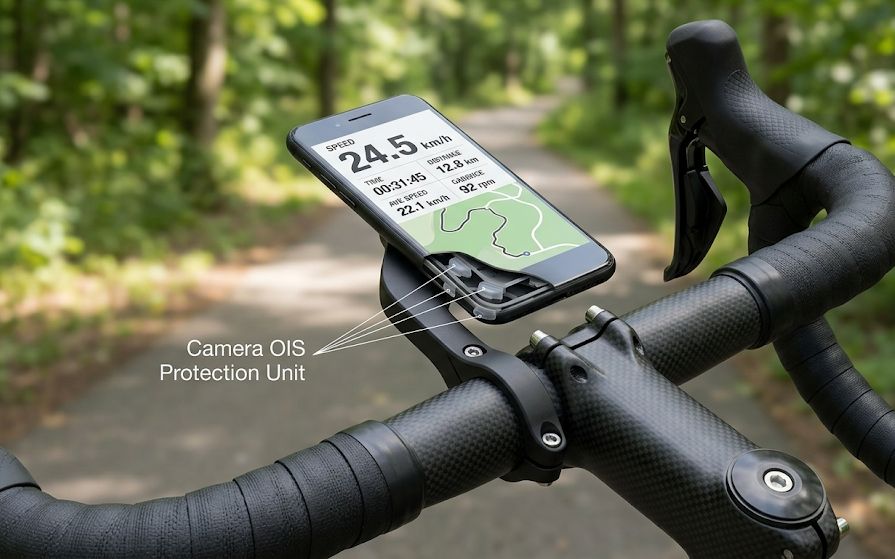
There is also a camera damage issue that does not get enough attention. Modern flagship phones, particularly the iPhone Pro line and Samsung Galaxy Ultra models, have optical image stabilization systems with tiny moving components inside the camera module. Those components are designed to compensate for hand movement during photography, not to absorb sustained road vibration for an hour at a time.
Rigid plastic mounts transfer every bump directly into the phone. The damage is cumulative and is not covered under warranty. A mount with a built-in vibration dampener, typically a rubber or silicone layer between the clamp and the phone, absorbs most of that energy before it reaches the camera hardware. It is a feature worth paying for if you ride anything other than a smooth indoor track.
Case-Based Systems vs. Universal Cradles
The biggest decision you will make is whether to go with a case-based ecosystem or a universal cradle. Both work. They just work differently, and the right choice depends on how much you want to invest in the system long-term.
A universal cradle holds any phone regardless of what case you have on it. You put the phone in, it grips from four sides, and you ride. The RAM X-Grip is the most well-known example of this approach, and it works well on bikes with the right handlebar base. The tradeoff is that cradles add bulk to the cockpit and take a few seconds to load and unload the phone properly each time.
A case-based system uses a proprietary phone case or adapter that clicks, twists, or magnetically locks into a matching mount. The phone goes on and comes off in under a second with one hand. The mount itself is far smaller and lower-profile. The tradeoff is that you are buying into an ecosystem: a specific case, a specific mount, and if you switch phones you buy a new case. All three brands below use this approach, and for regular cyclists who use their phone on the bike consistently, the convenience is hard to give up once you have tried it.
Peak Design Out Front Mount V2: Best for Road and Commuter Riders
Peak Design built its reputation in the camera bag and strap market, but the cycling mount lineup has become genuinely first-rate. The Out Front V2 uses the company’s SlimLink system, which combines a magnet for alignment with a mechanical locking tooth that physically secures the phone in place. The magnetic assist makes one-handed attachment fast and accurate. The lock holds it there. You are not relying on magnetic force alone.
The mount is CNC-machined aluminum, which makes it one of the lightest rigid options available while still feeling like a professional piece of equipment. It installs with a hex bolt or thumbscrew and fits most standard handlebar diameters out of the box. The arm can flip upward if you want to use the phone as a forward-facing camera, and it can also tuck below or behind the bars to free up space for a bike computer without removing the mount entirely.
The one limitation is that SlimLink requires a Peak Design case or their universal adapter. If you already have a case you like, the adapter is a thin adhesive plate that attaches to the back of any case and adds minimal bulk. For road riders and commuters who care about how the cockpit looks and want the fastest possible phone-on, phone-off experience, this is the top pick.
Quad Lock Out Front V3: Best for Mountain Biking and Rough Terrain
Quad Lock has been the benchmark for secure phone mounting in cycling for years, and the Out Front V3 is the most refined version of a system that was already excellent. The locking mechanism is a dual-stage twist-lock: you press the phone onto the mount and give it a quarter turn. It clicks into place with a satisfying mechanical engagement. To remove it, you squeeze a release lever and twist back. There is no spring tension, no magnetic force, no friction. Just a physical connection that does not release unless you tell it to.
That matters a great deal when you are descending a technical trail, hitting root sections, or riding anything where the phone is genuinely getting tested. The V3 is compatible with Quad Lock’s case ecosystem as well as their MAG series, which adds MagSafe compatibility for iPhone users who want wireless charging in a car mount or elsewhere without changing their case. The mount itself flips to position the phone over the stem rather than out front, which is useful on mountain bikes where a protruding mount is more vulnerable in a crash or when pushing through tight trail sections.
Quad Lock also sells a vibration dampener accessory that sits between the mount and the phone. It is worth adding for any sustained off-road riding where camera protection is a concern.
SP Connect Micro Bike Mount: Best for Cyclists Who Want a Clean Setup
SP Connect occupies a slightly different position in the market. While Peak Design appeals broadly to road cyclists and commuters and Quad Lock leans into the performance and off-road segment, SP Connect has its strongest following among dedicated cyclists who want their bike to look a certain way. The brand’s aesthetic is minimal and precise, and the Micro Bike Mount is the most compact option in the lineup, designed for riders who want a phone mount that disappears into the cockpit rather than drawing attention to itself.
The mount uses SP Connect’s SPC+ twist-lock mechanism, which requires a matching SP Connect phone case. It fits handlebar and stem diameters from 22mm to 32mm without tools. The mount head rotates between portrait and landscape orientation, and the overall package is notably light. SP Connect builds a stem cap mount that replaces the bolt cap at the center of the stem entirely, producing one of the cleanest possible phone positions on a road or gravel bike. That particular version is worth investigating if you find even the Micro too prominent on the bars.
Stock availability on Amazon for SP Connect varies more than the other two brands, as they tend to move product through their own site as well. The Micro Bike Mount has been consistently available and is the safest Amazon buy from their lineup at time of writing.
Handlebar vs. Stem: Where to Mount the Phone
Both positions work. The practical difference comes down to riding style and how much you care about the phone’s safety in a crash.
Handlebar mounting, specifically an out-front position where the mount arm extends beyond the bars, gives you the clearest view of the screen without having to look down at a steep angle. It is the preferred setup for road riders and anyone using navigation actively because you can glance at the phone without significantly changing your head position. The exposure is higher: a phone out front is the first thing to hit the ground if the bike goes down on that side.
Stem mounting positions the phone over or just behind the stem, which puts it closer to the body of the bike and lower to the ground in a fall. Mountain bikers generally prefer this position because it protects the phone better on rough terrain and in crashes, and it keeps the phone’s weight closer to the bike’s center of balance. The viewing angle requires looking slightly down rather than straight ahead, which is a minor tradeoff most off-road riders consider acceptable.
Most of the mounts above support both positions through included spacers, flip mechanisms, or separate stem-specific versions in the same ecosystem. Quad Lock’s Out Front specifically advertises the ability to flip for stem positioning, which makes it particularly flexible if you ride both road and trail.
A Note on E-Bikes
E-bikes introduce two complications that standard bicycles do not have. First, motor vibration. Hub-drive motors produce sustained low-frequency vibration through the frame and bars that is harder on phone mounts than typical trail riding. Mid-drive motors route torque through the drivetrain, which creates a different vibration pattern. Neither is as severe as a motorcycle, but both are more demanding than an unpowered bicycle. A mount with a rubber-lined clamp or vibration dampening accessory handles this better than rigid hardware. We cover e-bikes in detail in our electric bike phone mount guide.
Second, handlebar real estate. Many e-bikes ship with an integrated display already positioned at the center of the bars, which limits where a phone mount can go. An offset or out-front design gets the phone away from the display without crowding the controls. If your e-bike’s display takes up significant bar space, the Peak Design or Quad Lock out-front positions are generally the cleanest solution. For heavier e-MTBs where vibration is a larger factor, you may find yourself gravitating toward the same kind of mount used on motorcycles, which we cover in detail in our motorcycle phone mount guide.
Frequently Asked Questions
Do I need a special case for all of these mounts?
Yes, for all three systems above. Peak Design, Quad Lock, and SP Connect all use proprietary cases or adapters. Each brand sells a universal adapter that attaches to the back of any existing case if you do not want to switch. The universal adapter adds a small amount of bulk but makes the mount compatible with whatever case you currently have.
Will a bicycle phone mount damage my camera?
A rigid mount on rough terrain can cause cumulative damage to optical image stabilization components over time. A mount with a vibration dampener significantly reduces this risk. Quad Lock sells a dampener accessory specifically for this purpose. If you ride trails or rough pavement regularly, it is worth the addition.
What handlebar diameter do I have?
Most road bikes and hybrid bikes use 25.4mm or 31.8mm bars. Mountain bikes typically run 31.8mm. E-bikes vary. If you are unsure, measure with calipers or check your bike’s specification sheet. All three mounts above include adapters to cover the most common sizes.
Can I use a motorcycle mount on my bicycle?
In most cases, yes. Motorcycle mounts like the RAM X-Grip use a handlebar clamp that works on bicycle bars with the correct ball base. They are built to higher vibration tolerances than most bicycle-specific mounts, which makes them a reasonable choice for e-bikes or any setup where long-term durability is the priority. We cover the best options in our motorcycle phone mount guide.
Is there a bike phone mount that works without any case at all?
Yes. A universal cradle like the RAM X-Grip holds any phone without a special case. It grips from all four corners using spring tension and includes a safety tether. It works reliably and is the right choice if you switch phones often or prefer not to change your existing case setup. It is bulkier than the ecosystem options above, but it is effective. See our coverage of RAM X-Grip mounts for full details.