
Scotty mounts are built around a modular marine post-and-socket interface that lets kayak anglers and boaters swap Scotty rod holder mounts, fish finder brackets, and camera arms between mounting locations without tools or drilling new holes. Produced in Victoria, British Columbia since the 1950s, Scotty hardware has kept its core post geometry consistent for decades, meaning a post-mount accessory purchased today drops directly into a base installed years ago. For anglers who fish across multiple watercraft or reconfigure their deck layout between trolling, casting, and sonar setups, understanding how the bases, posts, and adapters fit together turns a long catalog of part numbers into a logical rigging plan.
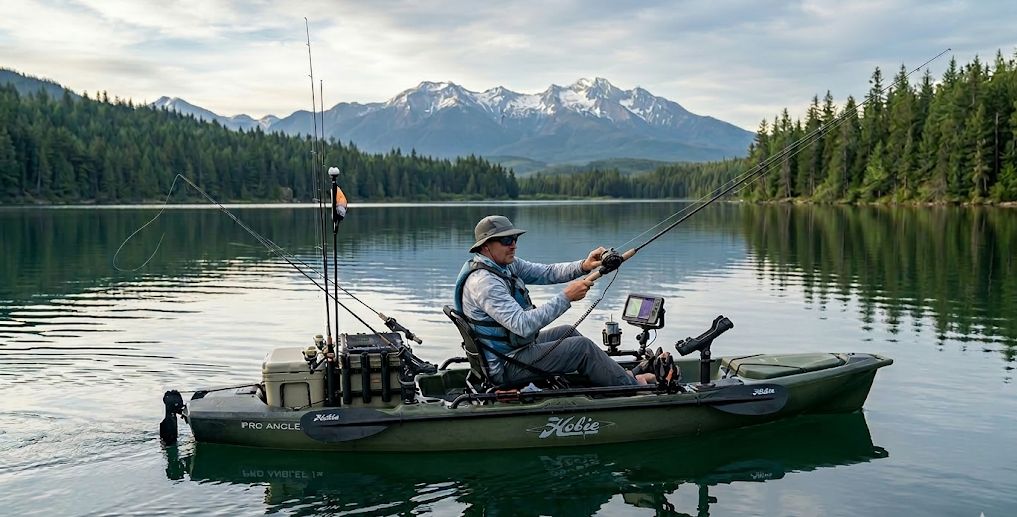
Quick Answer: Scotty mounts work in three layers: the base mount (how hardware attaches to your boat deck, gunwale, rail, or kayak track), the splined post (the universal connection stem), and the accessory head (rod holder, fish finder bracket, or camera mount). Every standard Scotty post-mount accessory fits every Scotty base. Choose the base that matches your hull first, prioritize locking bases (#241L or #244L) for one-hand push-button release, and verify whether your rod holder ships as a complete kit with a base or as a holder-only unit.
This guide explains how the Scotty post-mount interface works mechanically, compares the primary deck, flush, rail, and kayak track bases, breaks down the core rod holder models, and shows how sonar and camera mounts integrate into the same footprint.
How Scotty Mounts and Post-Mount Bases Work
The foundation of the Scotty ecosystem is a standardized splined post and socket interface. Every standard Scotty rod holder, camera arm, transducer bracket, and electronics mount shares the same post diameter, vertical gear splines around the lower stem, and top retention lug. Every Scotty deck base, flush mount, rail clamp, and kayak track adapter accepts that exact post geometry.
On standard non-locking bases like the Scotty 241, the mechanical connection uses an open keyway notch combined with internal rotational retention. The post features 360-degree vertical splines around its lower circumference and a raised key tab near the top of the stem. To insert an accessory into a standard #241 base, you align the post with the single entry/exit notch (oriented perpendicular to the base body) and push the post all the way down until it seats below the internal retaining lip. Once rotated away from that single entry/exit position to any working fishing angle, the top tab locks beneath the internal lip of the base so the rod holder cannot lift out under trolling tension or a heavy strike.
To adjust the horizontal angle in a standard base, you lift the post slightly against the internal lip, just enough to disengage the vertical splines without aligning with the exit notch, rotate it to the new heading, and press it back down into the mating splines. Full removal requires rotating the accessory back to the perpendicular exit alignment and lifting straight out. While simple and durable, rotating a long rod holder to the exact exit angle can be awkward on a narrow kayak deck where paddles, tackle crates, or gunwale gear block the swing arc. That clearance constraint is why Scotty developed the push-button Locking Series (#241L and #244L) covered below.
Every Scotty post-mount accessory adjusts across two independent axes once installed. The splined post indexes 360 degrees horizontally inside the base socket, while a serrated knuckle joint at the top of the post tilts up and down via a large hand-tightened thumb knob. You can swing a rod tip outboard for trolling, angle it upward for drift fishing, or fold an electronics arm flat for transport without tools.
Choosing the Right Scotty Rod Holder Mount and Base
The base is the most important buying decision when comparing Scotty rod holder mounts because it dictates how hardware fastens to your boat or kayak. While every post-mount accessory you buy later is interchangeable, the base is what you commit to when you drill into a gunwale, cut a flush hole, or clamp onto a rail.
| Base Mount | Fits / Attachment | Best For |
|---|---|---|
| Scotty #241 Combination Side/Deck Mount | 4-bolt surface mount (top of deck or vertical side of gunwale) | Permanent budget installs where accessories stay in the base all season |
| Scotty #241L Locking Side/Deck Mount | 4-bolt surface mount with spring-loaded push-button release | Kayaks and boats where you swap rod holders, cameras, and fish finders often |
| Scotty #244L Locking Flush Deck Mount | Recessed cut-in flush deck mount with push-button release and splash cap | Low-profile kayak decks and boat gunwales where snag-free clearance matters |
| Scotty #242 Rail Mount Adapter | Clamps to 7/8-inch and 1-inch round rails (or 1-inch square rails) | Powerboats, pontoons, and Hobie Pro Angler grab rails without drilling holes |
| Scotty #438 Gear-Head Track Adapter / #135 Track Systems | Slides into YakAttack GearTrac and standard kayak T-slot tracks | Adding a Scotty track mount to factory kayak gear rails with zero drilling |
Scotty #241 Combination Side/Deck Mount: The Standard Base
The Scotty 241 Combination Side/Deck Mount is the classic base included in most complete Scotty rod holder kits. It features a dual-entry socket housing that bolts either flat onto a horizontal deck or vertically against the inside wall of a gunwale or transom. The base measures 4 inches by 2 inches with a four-bolt rectangular hole pattern (1-5/16 inches by 3-3/16 inches on center). Always fasten all four bolt holes, using stainless steel machine screws with fender washers and nylock nuts behind thin kayak polyethylene or fiberglass, so heavy trolling drag does not flex or tear the mounting surface.
The standard #241 uses the open keyway notch and rotate-to-retain interlock described earlier. With no internal springs or moving latch parts, it is virtually immune to sand or salt fouling. Its only drawback is the perpendicular alignment required to remove an accessory. For permanent utility boat or gunwale positions where the rod holder stays in place all season, the #241 keeps hardware costs low and lasts for decades.
Scotty #241L Locking Side/Deck Mount: The Upgrade Worth Making
The Scotty 241L shares the exact 4-inch by 2-inch footprint and four-bolt hole pattern of the standard #241, adding a spring-loaded push-button latch on the side of the housing. Instead of rotating the post to a specific exit notch, you align the post at any desired fishing angle and push it straight down into the socket until the button clicks locked. To remove the accessory or change its horizontal direction, you press the side button and lift straight up. No rotation swing clearance is required.
That mechanical upgrade changes how you manage a modular cockpit on the water. When swapping a rod holder for a camera pole or fish finder arm takes two seconds with one hand, you reconfigure your boat for the conditions in front of you instead of leaving gear in a compromised spot because rotating it past other equipment is a hassle. Because the #241L shares the exact bolt centers of the #241, it also serves as a direct drop-in replacement on older boats without redrilling the hull.
Scotty #244L Locking Flush Deck Mount: Clean and Low Profile
Where the #241 and #241L sit proud of the mounting surface so their side socket remains accessible, the #244L Scotty flush deck mount recesses the entire socket barrel beneath the deck. Only a thin 4-inch by 2-inch flange and the push-button release sit at deck level. Eliminating the raised block removes a major snag point for fly lines, cast nets, and paddle strokes on compact fishing kayaks and center console bow decks.
Installing the #244L requires drilling a central clearance hole for the recessed barrel along with the four corner fastener holes, and you must verify at least 2.5 inches of vertical clearance beneath the deck skin before cutting. Like the #241L, it uses the push-button locking latch for straight-in, straight-out accessory swaps, and it includes an attached splash cover that plugs the socket opening when no accessory is installed.
Scotty #242 Rail Mount Adapter: No-Drill Tube Mounting
When drilling into fiberglass or aluminum gunwales is not an option, the #242 Scotty rail mount adapter provides a non-permanent clamping foundation for stainless bow rails, pontoon fencing, and kayak side rails (such as the factory grab bars on a Hobie Pro Angler). The two-piece clamp housing bolts around round tubing from 7/8 inch to 1 inch in diameter, and it includes molded adapter shims that stabilize it on 1-inch square pontoon rails.
Note that the #242 is a rail-to-base adapter bracket rather than a standalone post socket: it forms the clamping saddle on the rail that a #241 or #241L side/deck mount bolts directly onto using the included stainless fasteners. Once paired with a #241 or #241L base, it resists rotational slip under trolling loads far better than generic single-screw pipe clamps.
Important: If your kayak already has factory-installed gear tracks, you do not need to drill the hull for a #241L or #244L base. A Scotty #438 Gear-Head Track Adapter (or the #135 portable track/kayak setup) slides directly into a YakAttack GearTrac or standard T-slot rail, giving you a full Scotty track mount socket that repositions along the rail in seconds.
The Scotty Rod Holder Lineup
Once your base mounts are installed, every post-mount Scotty rod holder drops into the exact same socket. Before ordering, always check whether the part number you are viewing is the rod holder only (designed for anglers who already own bases or are buying #241L/#244L locking bases separately) or a complete kit bundled with a standard #241 base. Matching the holder to your reels and fishing style comes down to cradle geometry and how fast you need to clear the rod on a strike.
| Rod Holder Model | Base Included? | Best Reel Type & Application |
|---|---|---|
| Scotty #229 Powerlock Rod Holder | Holder only (#230 includes #241 base) | Universal open cradle for spinning, baitcaster, and conventional trolling reels |
| Scotty #279 Baitcaster / Spinning Holder | Holder only (#280 includes #241 base) | Light-to-medium spinning and trigger-grip baitcasting setups |
| Scotty #400 ORCA Rod Holder Kit | Includes #241L Locking Side/Deck Mount | Fast one-motion rod release for heavy trolling, salmon, and offshore chop |
Scotty #229 Powerlock Rod Holder: The Universal Workhorse
The Scotty Powerlock rod holder is the brand’s best-selling full-size holder and the safest default for anglers who switch between different reel types. Its open top cradle accepts spinning reels, low-profile baitcasters, round level-wind reels, and conventional saltwater setups without interference. A rotating front locking ring snaps over the foregrip of the rod blank to prevent the rod from bouncing out in rough chop or pulling free on a sudden takedown, a critical upgrade over open gravity cradles.
Keep the part-number distinction in mind when building your cart: the #229 Powerlock linked below is the rod holder and splined post without a base mount, making it the exact part you want when pairing with #241L or #244L locking bases so you do not pay twice for a standard #241 base you will not use. (If you want the Powerlock bundled with a standard #241 base, Scotty labels that complete kit the #230.) Molded from fiber-reinforced engineering-grade nylon, the Powerlock resists UV embrittlement and saltwater corrosion season after season.
Scotty #279 Baitcaster/Spinning Rod Holder: Dedicated Reel Support
The #279 is purpose-built for bass, trout, and inshore anglers who fish exclusively with spinning and baitcasting tackle. Where the wider Powerlock relies on its front locking ring for primary security, the #279 uses a contoured tubular barrel with cushioned side walls that cradle a baitcasting reel low in the frame, plus a deep lower slot that captures the stem of a spinning reel underneath the blank. Low-profile side cutouts also let pistol-grip and trigger-grip casting rods seat cleanly without hanging up on the rim, while a soft latching strap snaps across the top for transport security.
Just like the Powerlock numbering, the #279 is the holder-only SKU with a standard Scotty post and no base mount, allowing you to pair it directly with a #241L locking base, #244L flush base, or #438 track adapter. (Scotty sells the same holder bundled with a standard #241 base under model number #280.)
Scotty ORCA (#400): Fast-Release Security for Heavy Trolling
The ORCA takes a completely different mechanical approach designed for downrigger trolling, salmon fishing, and rough-water offshore use where split-second rod removal matters. Instead of a manual locking ring that you have to flip open with cold hands while a fish is stripping drag, the ORCA uses an enclosed fiberglass-injected nylon barrel with a pivoted internal retention geometry. While trolling, downward pull on the rod tip wedges the rod butt more tightly inside the closed tube, making it virtually impossible for a strike or wave impact to pull the rod overboard.
When a fish hits, you grab the rod foregrip and lift straight up in a single fluid motion: tilting the front of the rod upward pivots the internal cradle open and releases the butt immediately. Unlike the holder-only #229 and #279 listings above, the #400 ORCA kit ships complete with a #241L Locking Combination Side/Deck Mount in the box, giving you a push-button locking base right out of the package. It also drops into a #244L flush deck mount if you prefer a recessed installation.
For a side-by-side breakdown of every specialized holder in the catalog, including the Rocket Launcher tubular holder, Striker steel-reinforced offshore holder, and Fly Rod models, see our Scotty Rod Holders: Complete Guide to Every Model.
Scotty Fish Finder Mounts and Camera Brackets
The Scotty post-mount interface extends well beyond rod holders to cover marine electronics, transducer arms, and action cameras. This cross-category compatibility is a major advantage for anglers using Scotty kayak mounts to run a sonar head unit, a transducer deployment arm, and a camera alongside their rods on a tight cockpit rail.
A Scotty fish finder mount (#272, #273, and #368 universal sounder plates) uses a multi-pattern top bracket pre-drilled for Garmin Striker/ECHOMAP, Lowrance Hook/Elite, and Humminbird Helix gimbal brackets, attached directly to a standard Scotty splined post. When dropped into a #241L locking base on your gunwale, the sonar screen can pivot 360 degrees to face you while casting forward or turn toward the stern when landing a fish. Paired with Scotty’s #140 or #141 Kayak/SUP Transducer Arm Mount in an adjacent base, you can lift your entire sonar and transducer assembly out of the water in seconds when beaching your kayak or loading it onto a roof rack.
Camera mounts, including the Scotty #134/#136 Camera/Compass Mount and the #139/#151 Ball System camera arms, use the exact same post stem to hold both standard 1/4-20 tripod threads and three-prong GoPro fingers. A #241L base that holds a trolling rod during the morning bite can swap to an action camera pole in ten seconds without tools. For a deeper comparison of over-the-shoulder booms, low-profile deck bases, and tethering hardware on the water, check our best GoPro kayak mounts guide.
Scotty Kayak Mounts and Track System Compatibility
One of the most useful traits of Scotty kayak mounts is how cleanly they bridge into T-slot kayak gear tracks from YakAttack, RAM Mounts, and factory hull rails (such as Old Town, Native Watercraft, Bonafide, and Hobie tracks). Using the Scotty #438 Gear-Head Track Adapter, you slide a stainless T-bolt into any standard 1/2-inch top-loading or end-loading kayak track and twist the Gear-Head collar to lock a vertical Scotty post socket in place. That single Scotty track mount adapter opens the entire Scotty rod holder and accessory line to track-rigged kayaks without drilling a single hole in your hull.
Interoperability also works in the opposite direction. Scotty offers its own 1-inch and 1.5-inch ball mounts with a Scotty post on the bottom (such as the #152 Ball with Post), allowing you to plug a RAM-compatible socket arm directly into an existing Scotty #241L or #244L deck base. Meanwhile, anglers who want to understand how T-bolt track dimensions, YakAttack MightyBolts, and post adapters interact across brands can review our kayak track mount systems and rod holders guide.
For anglers rigging a new kayak from scratch, the practical takeaway is that you never have to treat Scotty and track hardware as mutually exclusive ecosystems. Installing a section of aluminum or polymer track with a Scotty #438 Gear-Head adapter gives you fore-and-aft sliding adjustment along the gunwale while retaining the fast drop-in post interface of Scotty rod holders.
Maintenance and Saltwater Care
Scotty molds its bases, posts, and rod holder bodies from fiber-reinforced engineering-grade nylon rather than cast aluminum or mild steel, a deliberate material choice for harsh marine environments. High-strength nylon will not pit, galvanic-corrode, or seize when bolted to aluminum gunwales or exposed to salt spray, and Scotty pairs its mounts with marine-grade stainless steel fasteners where metal hardware is required.
The one maintenance routine that matters in brackish or saltwater environments involves the push-button latch inside the #241L and #244L locking bases. Because the button relies on an internal stainless spring and sliding latch channel, dried salt crystals and fine beach sand can accumulate inside the button pocket if the mount is repeatedly submerged in surf launches or soaked by salt spray. Left uncleaned, salt buildup makes the button feel gritty and prevents it from snapping all the way back out to lock the post.
Preventing latch sticking takes thirty seconds at the washdown hose: after every saltwater trip, remove the rod holder, direct low-pressure fresh water into the open socket and side button, and press the button in and out five or six times to flush dissolved salt and grit out of the spring cavity. Once dry, a light mist of marine-safe dry silicone or PTFE lubricant keeps the latch action crisp without attracting sand the way heavy grease does.
Building a Scotty Rig: Where to Start
Start every Scotty rigging plan from the hull up rather than buying a rod holder in isolation. Map out your primary seating position, paddle stroke arc (or pedal drive clearance), and reach zone first, then choose the base style that suits each mounting surface:
- Flat gunwales or vertical coaming walls: Go straight to the #241L Locking Side/Deck Mount backed with stainless machine screws, fender washers, and nylock nuts.
- Open bow or stern kayak decks with internal hull access: Choose the #244L Locking Flush Deck Mount so empty bases sit flat and never snag fly line, landing nets, or clothing.
- Round 7/8-inch to 1-inch boat rails or Hobie Pro Angler bars: Pair the #242 Rail Mount Adapter with a #241L base for a solid clamp that requires no drilling.
- Factory kayak gear tracks: Use the #438 Gear-Head Track Adapter so you can slide your Scotty socket forward or aft to fine-tune cockpit ergonomics on the water.
Once your bases are set, select the holder that matches your primary rods. Choose the #229 Powerlock if you run a mix of spinning, baitcasting, and conventional outfits; choose the #279 Baitcaster/Spinning Holder for dedicated light-tackle casting and spinning rigs; or step up to the #400 ORCA Kit when trolling heavy gear or fishing rough water where an instant upward strike release is non-negotiable.
Important: Install locking bases (#241L or #244L) from day one rather than standard #241 bases if you plan to move gear around on the water. The price difference per base is just a few dollars, and starting with push-button locking bases saves you from unbolting and swapping out standard bases later.
Frequently Asked Questions
Are all Scotty rod holders compatible with all Scotty mounts?
Yes, every standard Scotty post-mount rod holder, camera mount, and fish finder bracket uses the same splined post diameter and lug geometry, so it fits any #241, #241L, #244L, #242, or #438 base regardless of when either piece was manufactured. The only exception in the entire Scotty catalog is the oversized Laketroller/Downrigger mounting bracket system (#1023/#1026), which is designed specifically for heavy downrigger booms rather than standard rod holder posts.
Can I use Scotty mounts on a YakAttack GearTrac?
Yes. The Scotty #438 Gear-Head Track Adapter drops a stainless T-bolt into a YakAttack GearTrac (or almost any standard 1/2-inch kayak T-track) and provides a top-loading Scotty post socket that locks down with a quick twist of the collar, allowing any Scotty rod holder or accessory to mount without drilling.
What is the difference between the Scotty 241 and 241L?
Both bases share the exact same 4-inch by 2-inch housing dimensions, four-bolt mounting footprint, and top-or-side socket entry. The Scotty 241L adds a spring-loaded push-button release on the side of the base so you can insert or remove a Scotty post at any rotational angle with one hand, whereas the standard Scotty 241 requires rotating the accessory to a single perpendicular entry/exit notch to lift it out.
What is the difference between the #229/#230 Powerlock and #279/#280 rod holders?
In Scotty’s numbering system, the odd numbers (#229 Powerlock and #279 Baitcaster/Spinning) are the rod holder and post only with no base mount included, which is ideal when you are buying #241L or #244L locking bases separately. The even numbers (#230 Powerlock and #280 Baitcaster/Spinning) bundle the exact same rod holders with a standard non-locking #241 Side/Deck Mount in the box.
Do Scotty mounts work on inflatable kayaks and SUPs?
Yes. Scotty makes the #341 Glue-On Mount Pad specifically for PVC and Hypalon inflatable kayaks, rafts, and stand-up paddleboards. Once bonded to the inflatable tube with appropriate marine PVC or Hypalon adhesive, the flexible pad provides a reinforced four-bolt mounting boss that a #241 or #241L base screws into without puncturing the air chamber.
Bottom Line
For most kayak anglers and small-boat owners, the smartest way to build out a rig with Scotty mounts is to bolt down #241L Locking Side/Deck Mounts (or #244L Locking Flush Deck Mounts on open decks) and pair them with holder-only #229 Powerlock or #279 Baitcaster/Spinning rod holders, stepping up to the #400 ORCA Kit for heavy trolling positions. If you are comparing track-based hardware or rigging other cockpit electronics on the water, explore our YakAttack kayak mounting system guide and our marine phone mounts guide for boats and kayaks.