
If you just picked up a Garmin Varia radar tail light and you’re staring at the seatpost trying to figure out how it attaches, you’re not alone. Garmin ships the RTL515 and RTL510 with a rubber band mount that works but flexes more than most riders like, and the moment your seatpost is aero-shaped, D-shaped, or you’d rather run the radar under the saddle instead, the stock hardware is unlikely to work for you.
This guide covers the best Garmin Varia mount for the five most common setups: a direct quarter-turn seatpost swap, an aero or D-shaped post, an under-saddle rail mount, a rear cargo rack, and a saddle bag clip. If you’re also setting up a phone mount for the same bike, our bicycle phone mount guide covers that side of the cockpit.
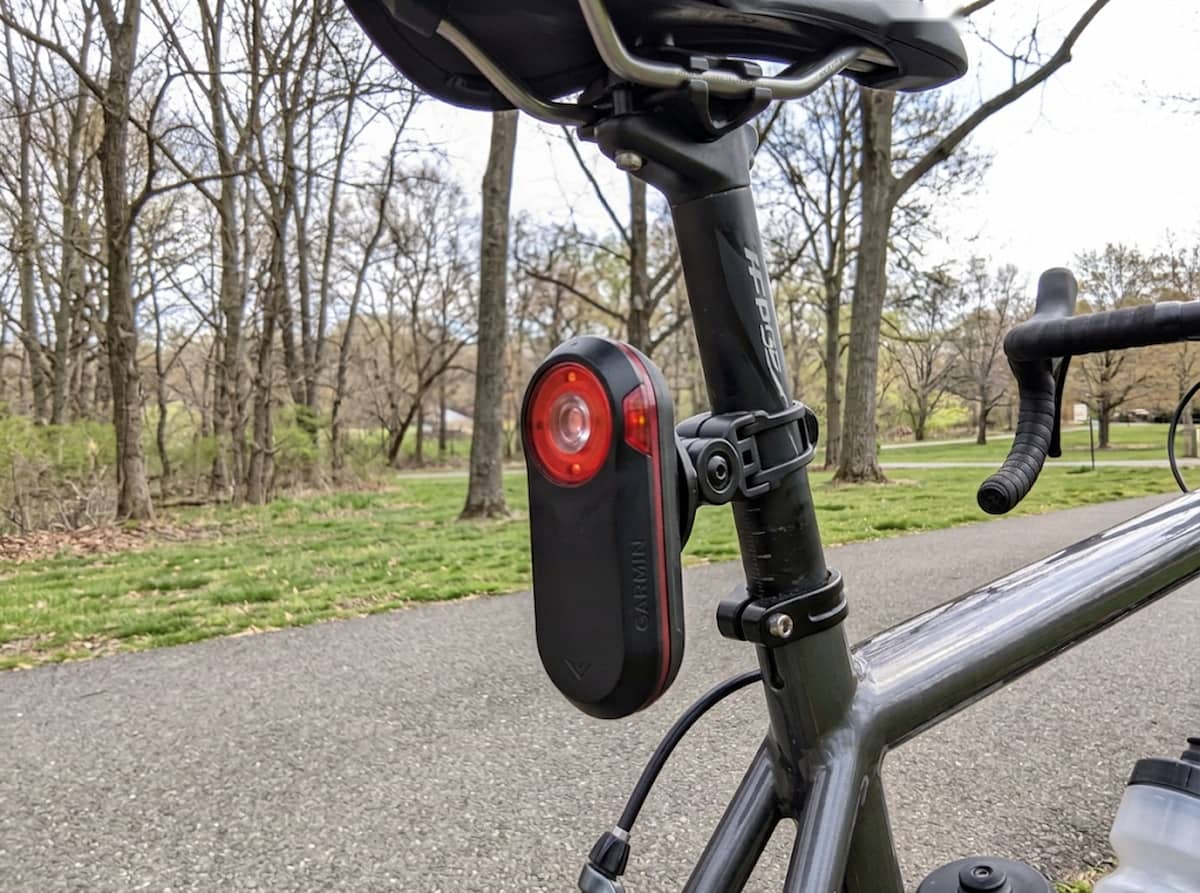
Garmin Varia Mount Comparison
| Mount | Best For | Compatible Varia Models |
|---|---|---|
| Garmin Quarter-Turn Seat Post Mount | Direct factory replacement, round seatposts | RTL510, RTL515, RVR315 |
| TUSITA Seat Post Mount (Round, D-Shaped, Aero) | Aero or D-shaped seatposts the OEM mount won’t clamp | RTL510, RTL515, RVR315 |
| Garmin Seat Rail Mount Kit | Under-saddle mounting, cleaner cockpit look | RTL510, RTL515, RVR315 |
| TUSITA Rear Cargo Rack Mount | Commuters and bikepackers running a rear rack | RTL510, RTL515, RVR315 |
| TUSITA Saddle Bag Clip Mount | Riders who already run a saddle bag and want the radar clipped to it | RTL510, RTL515, RVR315 |
Garmin Quarter-Turn Seat Post Mount
This is the mount Garmin sells as a direct upgrade from the stock rubber band, and for most riders with a standard round seatpost it’s the obvious first choice. It clamps around the post with a rubber insert, locks the radar in place with the same quarter-turn twist your bike computer likely already uses, and eliminates the wobble that comes with the elastic strap. The tradeoff is fit: several riders with 31.6mm or larger posts report it’s snug to the point of not closing, so measure your post diameter before you order rather than guessing from the frame size.
TUSITA Seat Post Mount (Round, D-Shaped, Aero)
Aero seatposts and D-shaped posts are where the Garmin OEM mount runs into trouble, since its clamp is built for a round profile. This TUSITA mount uses an adjustable band system instead of a fixed clamp, so it wraps around round, D-shaped, and aero cross-sections without needing a different part number for each. It’s the mount to reach for if you ride a modern aero road frame or a triathlon bike, and it holds the same quarter-turn interface as the Garmin hardware so the radar itself doesn’t care which bracket it’s sitting in.
Garmin Seat Rail Mount Kit
If your seatpost is already carrying a bike computer mount, a saddle bag strap, or you simply don’t want anything visible on the post itself, this kit moves the radar down to the saddle rails instead. It bundles a seat rail clamp, a friction flange extender, a quarter-turn adapter, and a lever-lock adapter, which covers most saddle rail shapes without extra hardware. The height ends up lower than a seatpost mount, which some riders prefer for a cleaner silhouette and others find puts the radar too close to a saddle bag if they’re running one. Worth checking before you commit if you already carry a bag back there.
TUSITA Rear Cargo Rack Mount
Commuters and touring riders running a rear rack have a different problem: the seatpost or saddle rails are already spoken for by panniers or a rack-top bag, and the radar needs a home somewhere else. This mount bolts to the standard 50mm to 85mm light bracket holes most rear racks already have, using the M5 hardware included in the box. It’s a narrower use case than the seatpost options above, but if you’re running a rack anyway it keeps the radar out of the way of your cargo setup entirely.
TUSITA Saddle Bag Clip Mount
If you already run a saddle bag and don’t want to deal with fitting a separate mount onto the post or rails, this clips the radar directly onto the bag itself. It’s built for bags with a slot at least 40mm wide, so check your bag’s mounting loop before ordering, and it uses the same quarter-turn interface as every other mount on this list. The obvious tradeoff is that the radar’s position moves with the bag, so if you swap bags often or run a bag that sits at an odd angle, one of the fixed mounts above will give you a more consistent aim.
Why the Stock Mount Isn’t Enough for Many Riders
Garmin includes a mounting option in the box with every RTL515 and RTL510, but it’s a rubber band and bracket combo, not a dedicated clamp. It works fine as a starting point, and plenty of riders never replace it. The complaints tend to show up in three places. The band stretches over time and lets the radar rotate slightly out of position, which matters more than it sounds like since the radar’s field of view is aimed based on how level it sits.
The bracket doesn’t fit cleanly on aero or D-shaped posts, so it sits at an angle instead of flush. And if you swap the radar between two bikes, rebanding it every time gets old fast. A dedicated mount solves all three, and once you know your post shape and mounting preference, picking one is a five-minute decision rather than a research project.
How to Choose the Right Garmin Varia Mount
Most of the confusion around Varia mounts comes down to three questions: what shape is your seatpost, do you want the radar on the post or under the saddle, and which Varia device do you own.
Seatpost shape. A round seatpost works with either the Garmin OEM mount or the TUSITA adjustable version. An aero or D-shaped post narrows you to the TUSITA mount or the seat rail kit, since the OEM clamp is built around a circular profile and won’t seat properly on a flattened or teardrop post.
Seatpost versus seat rail. Mounting on the post itself is simpler and puts the radar higher, which some riders feel improves the angle for vehicles approaching from further back. Mounting under the saddle on the rails is lower profile and keeps the post clear for other accessories, but can conflict with a saddle bag if you run one. If you’re deciding between the two, our guide to seatpost versus saddle-rail camera mounting covers the same tradeoff from a GoPro angle, and the physical constraints are nearly identical.
Which Varia you own matters. The RTL515, RTL510, and RVR315 all use the same quarter-turn interface, so any mount built for one fits the others. The RCT715, which adds a built-in camera to the radar and tail light, uses a different mounting interface and is not compatible with the standard quarter-turn mounts listed above, so don’t assume a mount built for the RTL515 will work if you’re running the camera model. If you haven’t bought the radar yet, the Garmin Varia RTL515 is the version all four mounts above are built around.
Installation Tips That Save You a Return
A few habits prevent most of the fit problems riders run into with these mounts. Measure your seatpost diameter with calipers or a tape measure rather than guessing from your frame’s marketing spec sheet, since actual post diameter varies more than riders expect and the difference between 27.2mm and 31.6mm is the difference between a mount that clamps and one that doesn’t close.
Check the angle of the radar once it’s mounted, not just whether it’s physically attached. The Varia’s detection range depends on it sitting close to level with the road, so a mount that leaves it tilted forward or back can quietly shrink the effective range even though the light still turns on and pairs normally. Finally, if you’re moving from the stock rubber band to any of the mounts above, keep the band as a backup. It packs flat in a saddle bag and works in a pinch if a bolt loosens on a long ride.
Frequently Asked Questions
Will any Garmin Varia mount fit my seatpost?
Not automatically. The Garmin OEM quarter-turn mount is built for round posts only. If your post is aero or D-shaped, use the TUSITA adjustable mount or move to a seat rail mount instead.
What’s the difference between quarter-turn and friction-flange mounting?
Quarter-turn is a twist-lock interface, the same system Garmin uses on its bike computer mounts, and it’s what the RTL515, RTL510, and RVR315 all use. A friction-flange adapter is typically included as a converter piece so a quarter-turn accessory can attach to an older friction-style mount base, and you’ll see it bundled in kits like the Garmin seat rail mount above.
Can I mount my Varia under the saddle instead of on the seatpost?
Yes. The Garmin seat rail mount kit is built for exactly this, clamping to your saddle’s rails rather than the post. It’s a good option if your seatpost is already crowded or you want a lower, less visible mounting point.
Does the RCT715 use the same mount as the RTL515?
No. The RCT715 radar camera uses a different mounting interface than the standard quarter-turn system, so mounts built for the RTL515 and RTL510 are not compatible with it.
Can I run a saddle bag and a Varia mount at the same time?
Generally yes, but the seat rail mount can crowd a larger saddle bag depending on how far back it sits. A seatpost-mounted option, either the OEM quarter-turn mount or the TUSITA adjustable version, tends to leave more clearance if you’re already running a bag under the saddle. If you’d rather not deal with clearance at all, the TUSITA saddle bag clip mount attaches the radar to the bag itself instead of the post or rails.
Does a third-party mount void my Garmin warranty?
No. Swapping the mount doesn’t affect the Varia unit itself, since the mount is a separate accessory and not something you’re modifying on the radar or light. Garmin’s warranty covers the device, not the bracket holding it.
Can I use the same mount on two different bikes?
Only if both bikes have the same seatpost shape and diameter, or if you buy a second mount for the other bike. The radar itself pops off the quarter-turn interface in seconds, so most riders who swap between bikes just buy a cheap second mount rather than trying to make one work everywhere.
Related Reading
For the phone side of your bike setup, see our best phone mounts for electric bikes guide. If you’re also running an action camera, our best GoPro bike mounts article covers handlebar, seatpost, and helmet placement in more detail.