
Pulling harder is the biggest mistake people make with an adhesive phone mount, and it’s usually what leaves a scratch or a discolored patch behind. This guide covers exactly how to remove an adhesive phone mount from dashboard trim without causing that damage.
I’ve been working with car phone mounts for more than 20 years through MountGuys, and adhesive-backed mounts have always presented the same problem: the better the adhesive works, the harder the mount can be to remove later.
Many adhesive phone mounts use aggressive acrylic foam tape similar to 3M VHB. After months or years of hot summers, cold winters, vibration, and constant pressure, that adhesive can hold extremely well.
The method I use is simple: warm the adhesive, separate the mount slowly, remove as much of the pad as possible, and then clean the remaining residue. For the final residue, Goo Gone Automotive is what I normally use.
If you’re replacing the old mount rather than reinstalling it, our car phone mounts by vehicle guide covers vehicle-specific options that avoid large adhesive pads.
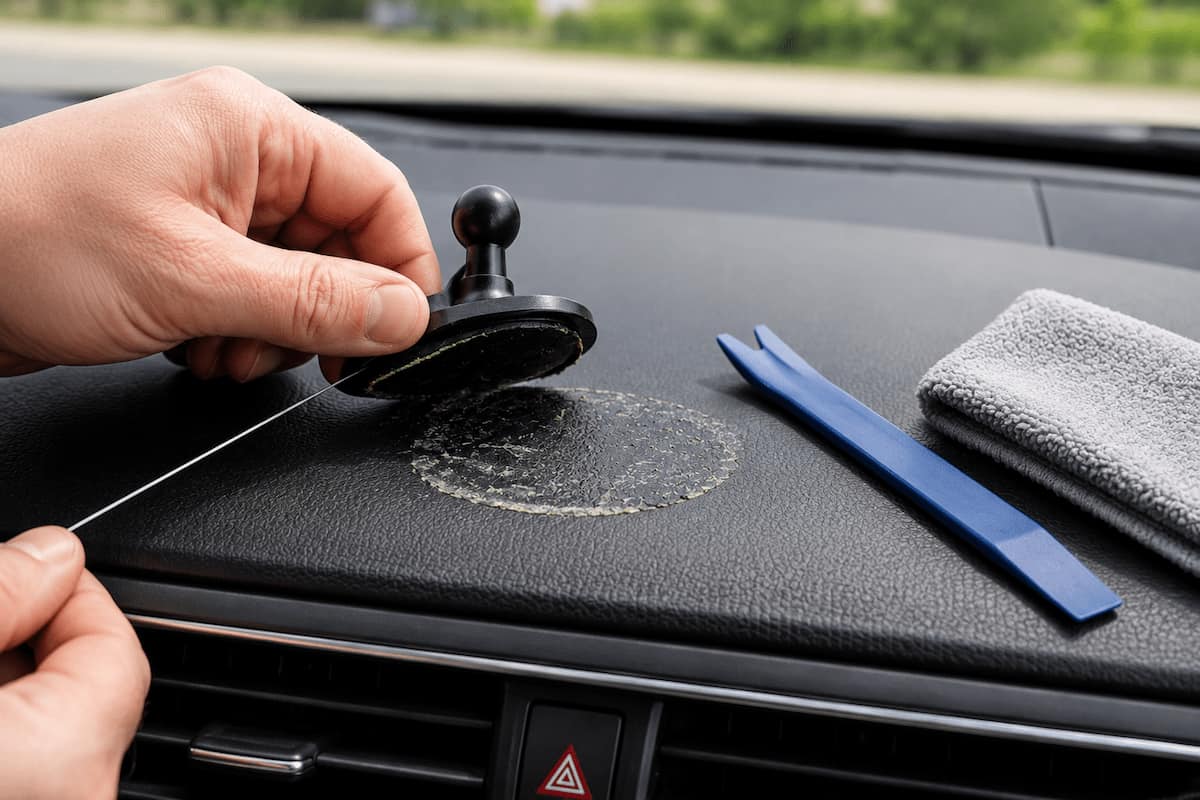
Adhesive phone mount being removed from a dashboard with visible adhesive residue.
Table of Contents
Why Is It So Hard to Remove an Adhesive Phone Mount From Dashboard Surfaces?
An adhesive phone mount has a tougher job than it appears. It has to hold a phone securely through vibration, potholes, cornering forces, temperature swings, and the constant pull of the mounting arm.
Manufacturers use high-strength acrylic foam adhesive, often called VHB, or Very High Bond, because it creates a long-lasting bond rather than one built to peel away easily.
For removal, I treat this as two separate jobs: separate the mount from the dashboard, then remove the adhesive residue left behind. Pulling harder on the mount tries to do both at once and puts unnecessary stress on the dashboard.
What You’ll Need
You don’t need many specialized tools:
- Hair dryer
- Dental floss or thin fishing line
- Plastic trim tool, plastic scraper, or old credit card
- Goo Gone Automotive Spray Gel or another compatible adhesive remover
- Clean microfiber cloths
- Mild soap and water for cleanup
- Meguiar’s Quik Interior Detailer for the final cleaning step
I prefer a hair dryer over a heat gun here. A heat gun can get hot enough to damage interior materials quickly, while a hair dryer gives more margin for error. I also stick to plastic tools around a dashboard, not a screwdriver, razor blade, or metal scraper.
Step 1: Warm the Adhesive
Start with a hair dryer on low or medium heat. Aim it at the base of the mount and keep it moving, warming the adhesive gradually rather than making the dashboard itself hot. I usually start with 30 to 60 seconds, then test the mount.
Be especially careful near an infotainment display, instrument screen, speaker grille, or stitched trim. The mounting area should feel warm, not scorching.
Step 2: Cut Through the Adhesive Instead of Pulling Against It
Once the pad is warm, work dental floss or thin fishing line behind one edge of the mount. Hold an end in each hand and use a gentle back-and-forth sawing motion, cutting through the foam adhesive layer rather than tearing it off the dashboard.
If you can’t get the line underneath right away, use a plastic trim tool or old credit card to create a small opening first, then feed the line through and keep working. If it gets harder to move, stop and add a little more heat.
Don’t worry about leaving adhesive behind at this stage. Getting the mount off safely matters more than getting the tape off in one piece.
Step 3: Remove as Much Adhesive as Possible Without Chemicals
Once the mount is off, check what’s left. Sometimes it’s a thin film, other times most of the original foam pad. Before reaching for a remover, take off as much as you can by hand: rub the warm adhesive with your thumb so it rolls into small balls, or use a plastic scraper or old credit card on thicker pieces.
The less adhesive left behind, the less solvent you’ll need next. This is also a good moment to confirm what your dashboard is made of before applying any cleaner.
Step 4: Remove the Remaining Adhesive With Goo Gone Automotive
For the sticky film left behind, Goo Gone Automotive is what I personally use. The Spray Gel format is easier to control on a dashboard than a thin liquid that wants to run toward vents and seams.
Apply a controlled amount, let it sit for a few minutes, then wipe with a clean microfiber cloth. Stubborn spots may need a second application. Don’t flood the dashboard; keep remover away from switches, seams, vents, and electronics.
View Goo Gone Automotive on Amazon →
Professional Alternative: 3M General Purpose Adhesive Cleaner
3M General Purpose Adhesive Cleaner is a solvent-based option built specifically for adhesive residue, and it’s commonly used in automotive detailing. I treat it as the stronger alternative rather than my first choice for routine cleanup.
If you use it, apply a controlled amount to a clean cloth instead of spraying it across the dashboard, and test compatibility in an inconspicuous spot first.
View 3M General Purpose Adhesive Cleaner on Amazon →
Step 5: Clean and Finish the Dashboard With Meguiar’s
Removing the adhesive isn’t the end of the job. Adhesive removers can leave a film, and you’ll likely have fingerprints around the area from working on the mount. Clean away any remaining remover according to the product directions.
For the final pass, I like Meguiar’s Quik Interior Detailer. Treat the whole surrounding section of dashboard, not just the small spot where the mount was, so the finish looks uniform rather than one clean square in a sea of dust and buildup.
View Meguiar’s Quik Interior Detailer on Amazon →
Why Is There a Lighter Spot Where the Mount Was?
That doesn’t necessarily mean the dashboard is damaged. You clean everything up, and the spot underneath doesn’t quite match the rest of the dashboard.
That’s rarely damage. If the mount sat there for years, that patch was protected from sunlight, UV exposure, cleaners, and normal wear while the surrounding dashboard kept aging. Cleaning the whole area evenly with an interior detailer can make the contrast less noticeable, but it won’t reverse real UV fading.
What If the Adhesive Mount Still Won’t Budge?
Some adhesive mounts become extremely stubborn after years of exposure to heat.
If yours barely moves, don’t respond by pulling harder.
Instead:
- Warm the mounting pad again.
- Use a plastic tool to create a very small opening.
- Feed dental floss or thin fishing line behind the mount.
- Work through the adhesive with a slow sawing motion.
- Reapply gentle heat whenever the adhesive starts resisting again.
This takes longer than prying the mount off, but it transfers far less force into the dashboard. That’s exactly what you want.
Be Extra Careful With Textured and Soft-Touch Dashboards
A smooth, hard plastic dashboard is the easiest case. Textured dashboards take more patience since adhesive works into the grain, and aggressive scraping can flatten the texture and leave a smooth patch that stands out more than the original residue.
Soft-touch dashboards deserve extra caution too, since some interiors use a coating over the plastic that strong solvents or aggressive rubbing can affect. Use less cleaner, less pressure, and more time. If your dashboard is actual leather, skip Goo Gone Automotive Spray Gel and use a product approved for leather instead.
What I Would Not Use to Remove Dash Mount Adhesive
You’ll find plenty of adhesive-removal advice online that isn’t a good fit for an expensive dashboard. I’d avoid:
- Razor blades
- Metal scrapers
- Acetone
- Nail polish remover
- Aggressive paint solvents
- Excessive heat from a heat gun
Modern dashboards use painted plastic, vinyl, rubberized coatings, synthetic covers, and leather, and the goal isn’t just getting the glue off. It’s removing the mount without leaving proof it was ever there.
How to Avoid This Problem With Your Next Phone Mount
If this has convinced you to avoid adhesive mounts going forward, here are a few alternatives.
Consider a Vehicle-Specific Mount
Many vehicle-specific mounts attach to existing seams, trim, or console points instead of a large adhesive pad. Start with our car phone mounts by vehicle guide to see what’s available for your make and model.
Use a Vent Mount
A good vent mount skips adhesive entirely and comes off in seconds, though vent designs vary a lot between vehicles. Our Andobil air vent mount review shows one example and where it works well.
Consider a MagSafe-Style Mount
For compatible phones, magnetic mounting makes attaching and removing the phone easier, though the mount itself still needs a secure attachment point. See our guide to the best MagSafe car mounts if that route interests you.
If You Use Adhesive Again, Start With a Clean Surface
If you’re installing another adhesive mount in the same spot, make sure every trace of old adhesive and remover is gone first. The surface needs to be clean and dry before a new pad goes on, or your next problem will be the opposite of this one: the mount won’t stay attached.
Can You Reuse the Phone Mount?
Usually you can reuse the mount itself, just not the original adhesive pad. Once you’ve cut through or peeled away a high-bond foam pad, replace it with the correct adhesive or mounting pad for that mount, and let the surface dry completely before applying it.
Frequently Asked Questions
How do you remove an adhesive phone mount from a dashboard?
Warm the mounting pad gently with a hair dryer, then work dental floss, thin fishing line, or a plastic trim tool behind the mount. Separate the mount from the adhesive slowly instead of pulling it straight off. Once the mount is gone, remove the remaining adhesive separately.
How do you remove 3M VHB-style adhesive from a car dashboard?
Start with gentle heat to soften the adhesive. Use fishing line or dental floss to work through the foam layer, then roll or lift away as much of the remaining adhesive as possible. Use a compatible adhesive remover only for the residue that’s left behind.
Can I use Goo Gone on a car dashboard?
Goo Gone Automotive Spray Gel is intended for surfaces including plastics and dashboards, but test it in an inconspicuous area first. The manufacturer specifically says not to use the Automotive Spray Gel on leather.
Is 3M Adhesive Cleaner better than Goo Gone?
Not necessarily, they’re just different tools. Goo Gone Automotive is what I use most for dash-mount residue since it’s easy to control and made for automotive cleanup. 3M General Purpose Adhesive Cleaner is a stronger, professional-grade option worth reaching for on stubborn residue.
Can I use rubbing alcohol to remove phone mount adhesive?
Isopropyl alcohol can help with some residue, but whether it is appropriate depends on the dashboard material and finish. Test any cleaner on a hidden area first. For heavy adhesive residue, I prefer a dedicated adhesive remover.
Can I use a razor blade on dashboard adhesive?
I wouldn’t. Razor blades can permanently scratch plastic, vinyl, painted trim, and soft-touch surfaces. Use a plastic trim tool, plastic scraper, old credit card, dental floss, or fishing line instead.
Can heat damage a car dashboard?
Yes. Excessive heat can damage certain dashboard materials. That’s why I prefer a hair dryer on low or medium heat instead of a heat gun. Keep it moving and use only enough heat to soften the adhesive.
Why is the dashboard lighter underneath the old phone mount?
That spot was protected from years of sunlight, UV exposure, cleaners, and normal wear while the surrounding dashboard kept aging. Cleaning the whole area evenly can reduce the contrast, but it cannot reverse true UV fading.
What should I use after removing the adhesive?
Once all adhesive-remover residue has been cleaned away, an interior detailer such as Meguiar’s Quik Interior Detailer can be used to clean the surrounding dashboard and leave a more uniform finished appearance.
The Bottom Line
After more than two decades working with phone mounts, the biggest mistake I see is treating adhesive removal as a test of strength. It isn’t.
Heat it, separate it, remove the bulk of the adhesive, then clean the residue. Goo Gone Automotive handles most remaining adhesive for me, the 3M cleaner is there for stubborn residue, and Meguiar’s Quik Interior Detailer finishes the job on the surrounding dashboard.
Take your time and match your products to your dashboard material, and there’s a good chance nobody will ever know a mount was there.