
A suction cup mount is built to grip glass. Press one onto a car dashboard and most of the time it slides off, tips forward, or lets go the moment you hit a pothole. That is not a defect in the mount. It is a mismatch between how suction works and what most dashboards are made of, and it is the reason so many drivers give up on dashboard mounting before they even try a fix. This guide describes how to prep a suction cup mount for dashboard use.
This guide covers what solves the problem: choosing a suction mount designed to hold on both glass and dash surfaces, plus the two accessories that turn any textured or curved dashboard into a suction-friendly surface. It matters most for drivers in states that restrict windshield-mounted devices, including California and Minnesota, where the dashboard is the only legal option left.
Quick Comparison
| Product | Best For | Permanent? |
|---|---|---|
| iOttie Easy One Touch 6 | A suction mount that locks onto glass and smooth dash surfaces on its own | No |
| Bracketron Nav-Mat | Portable setups, textured dashboards, moving between vehicles | No |
| Arkon Adhesive Disk | A rigid, permanent dash surface for one vehicle | Yes |
| eSamcore Dashboard Pad | A budget-friendly adhesive disk with a wide temperature range | Yes |
Why Suction Cups Fail on Most Dashboards
A suction cup needs a smooth, non-porous surface to form a seal. Glass qualifies. Most dashboards do not. Manufacturers texture the dash to cut down on glare, and the plastics used are often soft-touch or rubberized rather than hard and flat. Any one of those traits is enough to make a suction cup let go within minutes.
The fix is not a stronger suction cup. It is giving the suction cup a surface it can grip, either by starting with a mount built to handle that job or by adding an accessory that creates a glass-like surface on the dash itself.
Start With a Suction Mount Built for the Job: iOttie Easy One Touch 6
Before reaching for an accessory, it is worth using a suction mount that was designed with dashboard mounting in mind rather than one made for windshields alone. The iOttie Easy One Touch 6 uses a gel pad suction base with a locking lever, and it is rated for both windshield glass and flat or lightly textured dashboard surfaces. On dash areas that are reasonably smooth, it will hold directly with no accessory needed.
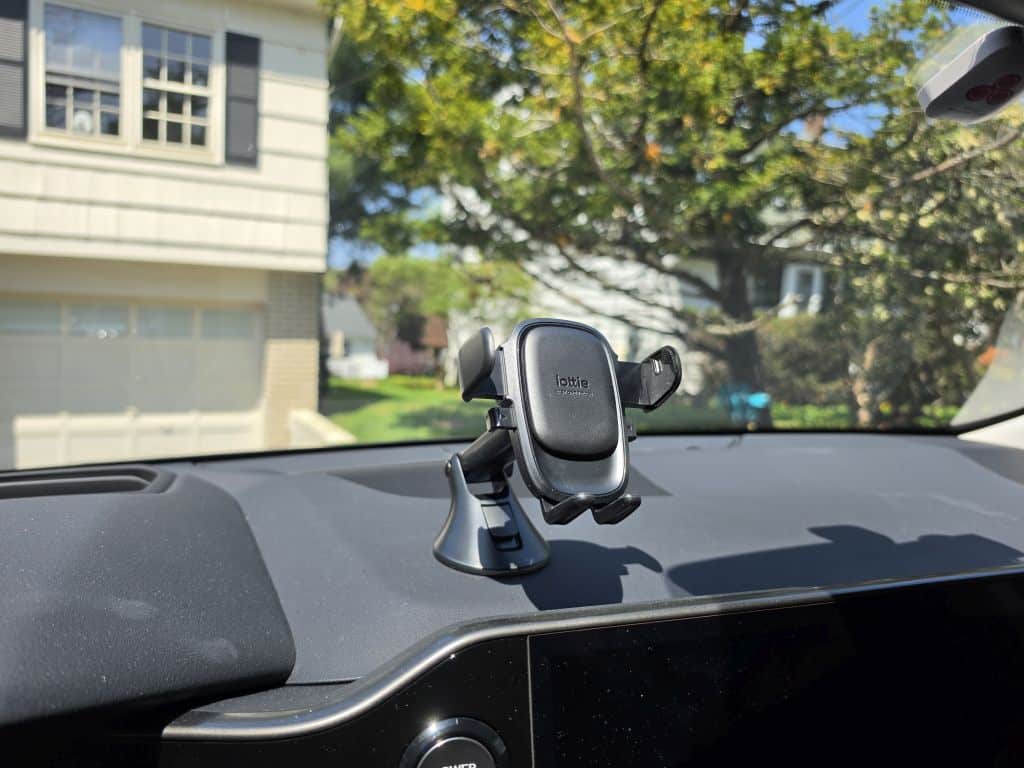
This is the mount that is shown in the feature image above.
The one-touch cradle arms open automatically when a phone is pressed in and close around it with spring tension, so there is no fiddling with a case-specific clip. The mount telescopes and swivels, which makes it easy to angle the phone toward the driver’s seat regardless of where on the dash it ends up.
Where the dash is more heavily textured or curved, the iOttie mount is also the better base to pair with the Nav-Mat or an adhesive disk below, since its wide suction cup transfers evenly onto either accessory’s flat plate.
Option 1: The Bean Bag Pad
The bean bag style dash pad is the better choice for anyone whose dashboard has any real texture or curve to it. It sits on top of the dashboard using weight and friction instead of adhesive, so it can move to another vehicle, tuck into a glove box when parked, or come off entirely without leaving a trace.
The Bracketron Nav-Mat is the best-known product in this category and has an extensive track record. It weighs roughly 1.5 pounds, measures 8 inches across at the base, and has a 3.5-inch smooth plastic plate at the center. That plate is what your suction mount attaches to, the same way it would grip a windshield. The weighted body conforms to curved or sloped dash shapes that would cause a rigid plate to rock, and an anti-skid underside adds a second layer of grip against the dash itself.
Setup takes about 30 seconds: place the Nav-Mat on a clean section of dashboard, press the suction mount onto the center plate, and it is ready to use.
The Nav-Mat holds devices up to about one pound, which covers a phone or GPS unit comfortably. A tablet on a heavy cradle can push past that. If a tablet is the goal, see our guide to the best tablet mount for car use for better-suited hardware.
Option 2: Adhesive Mounting Disks
An adhesive disk takes a different approach. Instead of resting on the dash, it bonds to it. Peel the backing, press the disk onto a clean section of dashboard, let it cure, and the result is a smooth plastic surface permanently fixed in place for the suction mount to grip, just like glass.
The Arkon 90mm Adhesive Mounting Disk uses 3M adhesive and fits most 80mm suction pedestals, including the ones bundled with Garmin and TomTom units. Arkon also sells 70mm and 80mm versions, so check the base diameter of your mount before ordering.
The eSamcore Dashboard Pad Mounting Disk covers the same job at a lower price point. It measures 3.1 inches across, uses a flexible adhesive plate rather than a rigid one, and is rated to hold from -4°F to 176°F, which matters if the vehicle sits in direct sun or a cold garage for long stretches. It comes as a single disk rather than a multi-pack, so it suits drivers who only need to fit one mount.
Either disk delivers a rock-solid grip once cured, with none of the shifting a bean bag pad can have during a hard turn. For drivers who are not moving the mount between vehicles and want the most stable possible setup, an adhesive disk is the right call.
Installation for both disks follows the same steps: clean the mounting area thoroughly, remove the paper backing, press the disk firmly in place, and give it a full 24 hours before attaching a suction mount. Skipping the cure time is the most common reason either one fails early.
View Arkon Disk on Amazon →
View eSamcore Disk on Amazon →
Which Setup Should You Choose?
Start with the mount itself. The iOttie Easy One Touch 6 is worth using regardless of which path you take, since it is built to hold on both glass and dash surfaces and gives the best odds of a direct grip if your dashboard happens to be smooth enough.
If the dash has any texture or curve, layer in an accessory. The Nav-Mat is the right pick for most drivers: portable, reversible, and effective on nearly any dash surface. An adhesive disk, whether the Arkon or the eSamcore, makes sense for a single daily driver where a permanent, zero-shift setup matters more than portability. Commercial drivers and long-haul truckers who live in one cab tend to prefer that option for exactly that reason.
For a phone-only setup, an air vent phone mount sidesteps the dashboard and windshield question entirely and works well for most daily commutes.
Frequently Asked Questions About a Suction Cup Mount for Dashboard Use
Will a suction cup mount work on a textured dashboard?
Not directly, in most cases. A suction cup needs a smooth surface to seal against. A dash pad or an adhesive disk creates that surface. A mount like the iOttie Easy One Touch 6 improves the odds on lightly textured dashboards, but heavier texture still needs an accessory.
Can I use the Bracketron Nav-Mat with any suction mount?
Yes, in most cases. It is designed to work with the factory suction bases that come with GPS units and most aftermarket phone mounts. The center plate is 3.5 inches across, which fits the suction base of most standard mounts, including the iOttie Easy One Touch 6.
How do I know which size adhesive disk to buy?
Measure the diameter of your suction mount’s base and choose a disk slightly larger than that. Arkon offers 70mm, 80mm, and 90mm versions. The eSamcore disk measures 3.1 inches. Most common phone and GPS mounts use a base in the 70mm to 80mm range.
Will dashboard conditioner affect the Nav-Mat or an adhesive disk?
Yes. Silicone-based dashboard protectants make surfaces slippery and cut into the grip of both. Clean the area with a dry cloth first and avoid re-applying conditioner to that section of the dash.
Is dashboard mounting legal everywhere?
Dashboard mounting is generally permitted in states that restrict windshield mounting. California and Minnesota are the two most commonly cited examples. Rules vary by state and can change, so check local law directly. Our guide on GPS laws by state covers this in more detail.
Can I remove an adhesive disk without damaging the dashboard?
With care, yes. Saturate the edges with rubbing alcohol on a cotton swab, then slowly work a length of dental floss under the disk to cut through the adhesive. It takes patience, but it avoids gouging or tearing the dash surface.