
A motorcycle mirror phone mount or motorcycle mirror phone holder is an excellent alternative when your handlebars are crowded or you want your smartphone positioned higher in your line of sight for navigation. Depending on the model, these mounts attach to the exposed mirror shaft, the threaded mirror base, or associated control-perch hardware, leaving more room around your motorcycle’s switches and levers. They are especially useful on scooters, naked motorcycles, commuter bikes, and motorcycles with enclosed or non-tubular handlebars.
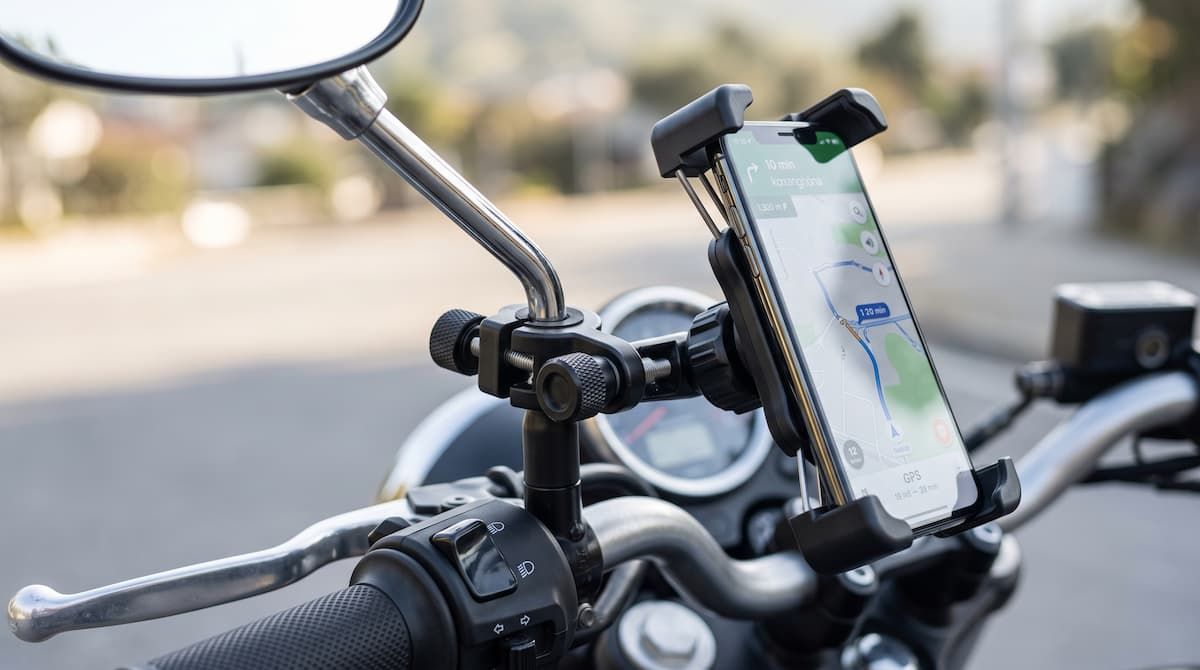
Quick Answer: Choose the Quad Lock Mirror Stem Mount if you want a low-profile setup that bolts cleanly to your threaded mirror base, or the clamp-on Quad Lock Mirror Mount if your bike or scooter has an exposed 10mm to 16mm mirror shaft. For a universal cradle that does not require a special phone case, pick the Arkon RoadVise Ultra Mirror Mount for bolt-hole installations, the Techmount Mirror Shaft Kit for 8mm to 15mm mirror stalks, or a modular RAM Mirror Mount with X-Grip.
Before ordering, it is critical to distinguish between a mount that clamps around the cylindrical mirror stalk and one that bolts to the mirror’s threaded base. Below, we compare five proven mirror mounting options from Quad Lock, RAM, Arkon, and Techmount, explain how each attaches, and walk through the thread pitch, shaft diameter, and clearance checks that prevent ordering mistakes. You can also explore other cockpit positions in our main motorcycle mounts hub.
Best Motorcycle Mirror Phone Mounts Compared
The best motorcycle mirror mount depends on your bike’s mirror hardware and whether you prefer a twist-lock case or a universal spring cradle. Here is how our top five options compare at a glance.
| Mount | Best For | Mounting Style | Phone Retention |
|---|---|---|---|
| Quad Lock Mirror Stem Mount | Best overall threaded mount | Threaded mirror base (M8 / M10) | Quad Lock case or universal adapter |
| Quad Lock Mirror Mount | Scooters and commuters | Mirror shaft clamp (10mm to 16mm) | Quad Lock case or universal adapter |
| RAM Mirror Mount + X-Grip | Most flexible modular setup | Mirror shaft clamp (3/8″ to 5/8″) | Universal X-Grip cradle (sold separately) |
| Arkon RoadVise Ultra Mirror Mount | Best complete universal kit | 11mm mirror base / pinch-bolt ring | Universal two-handed cradle (2.52″ to 5.71″) |
| Techmount Mirror Shaft Kit | Universal clamp-on cradle kit | Mirror shaft clamp (8mm to 15mm) | Universal TechGripper cradle (up to 4.3″) |
Important: Some motorcycle mounting systems require additional components, while others include the mounting base, adjustment arm, and phone cradle in one box. Quad Lock mounts require a Quad Lock case or adhesive adapter, and modular RAM bases require a separate socket arm and X-Grip cradle. Always check what the listing includes before ordering.
Two Ways to Mount a Phone to a Motorcycle Mirror
There are two distinct mechanical ways to attach a smartphone holder to a motorcycle mirror assembly. Understanding the difference before you shop is essential because the mounting brackets are not interchangeable.
1. Threaded Mirror Base Mounts
A threaded mirror base mount attaches at the bottom of the mirror stalk where the mirror threads into the handlebar master-cylinder perch, clutch perch, or fairing bracket. Most designs use a metal mounting tab or ring terminal that sits underneath the mirror’s threaded base or jam nut, though some thread directly into an unused mirror boss or pinch-bolt hole.
These installations produce a clean, factory-style appearance because they use existing fastener points rather than wrapping a clamp around the upper mirror arm. However, you must verify your mirror’s thread diameter (typically M10 or M8), thread pitch, thread direction (standard right-hand vs. reverse left-hand threads), and whether the threaded boss sits recessed below plastic scooter bodywork.
2. Clamp-On Mirror Shaft Mounts
A clamp-on mirror mount attaches directly around the exposed cylindrical metal rod of the mirror arm. Most kits include split polymer bushings or rubber spacers so the clamp can grip common shaft diameters ranging from 8mm to 16mm (5/16 inch to 5/8 inch).
This approach is often faster to install because you do not have to unthread or re-aim the mirror base. Clamp-on holders are popular on scooters and commuter bikes whose lower mirror threads are hidden beneath plastic handlebar cowls. The main requirement is having a straight, cylindrical section of exposed metal stalk where the jaws can clamp squarely without resting on a sharp bend, tapered casting, or rubber boot.
Best Motorcycle Mirror Phone Mounts
1. Quad Lock Mirror Stem Mount: Best Overall
Quad Lock makes one of our favorite low-profile motorcycle mounting systems, and its Mirror Stem Mount (part number QLM-MSTM) is purpose-built for riders who want to anchor their phone at the threaded mirror base rather than clamping onto the upper stalk. Machined from die-cast aluminum, the bracket installs between the mirror stem and the handlebar perch and includes both an M10 flat washer and an M8 shoulder washer for standard 10mm and 8mm mirror threads.
Its biggest mechanical advantage is the rigid, angled offset arm paired with a tool-free gimbal pivot head. That offset geometry lifts and shifts your smartphone away from the brake fluid reservoir, switchgear housing, and windshield, while allowing portrait or landscape viewing without bulky double-socket arms. Instead of bulky spring jaws, Quad Lock’s patented dual-stage twist lock engages a model-specific Quad Lock case or Universal Adapter in one quick turn.
One crucial detail to check before ordering: if your mirror thread sits recessed down inside plastic bodywork (common on many maxi-scooters) or uses a left-hand reverse thread that needs extra clearance, Quad Lock sells a separate Mirror Stem Mount Adaptor Kit containing 20mm steel thread risers in M10 x 1.25, M10 x 1.25 left-hand, M10 x 1.5, and M8 x 1.25 pitches. We also strongly recommend adding Quad Lock’s optional Vibration Dampener to protect your smartphone’s camera stabilization hardware.
Advantages:
- Clean, low-profile die-cast aluminum installation at the mirror base
- Angled offset arm clears brake reservoirs and instrument clusters
- Includes M10 and M8 fitting washers for standard exposed mirror perches
- Secure dual-stage twist-lock retention in portrait or landscape
- Compatible with Quad Lock’s optional Vibration Dampener and wireless charging heads
Potential drawbacks: Requires a compatible Quad Lock phone case or Universal Adapter (sold separately), and motorcycles with recessed or reverse-thread mirror bosses may require Quad Lock’s separate thread adapter kit.
Best for: Riders looking for a compact, rigid, threaded mirror-base smartphone mount.
2. Quad Lock Mirror Mount: Best for Scooters
Quad Lock also offers a clamp-on model simply called the Quad Lock Mirror Mount (part number QLM-MIR-2). Despite the similar name, this bracket uses a completely different attachment method from the threaded Mirror Stem Mount above. Instead of bolting under the mirror base, it clamps directly around the exposed cylindrical mirror stalk.
The glass-filled nylon clamp comes with three nested EPDM rubber spacer rings that fit 10mm, 12mm, 14mm, and 16mm (3/8-inch, 1/2-inch, 9/16-inch, and 5/8-inch) round mirror shafts. That diameter range covers the vast majority of motor scooters, mopeds, and commuter motorcycles whose lower mirror threads are buried beneath plastic handlebar shrouds where a base bracket cannot reach.
Because the hinged collar wraps around the existing stalk, you do not have to unbolt your mirror or disturb its factory thread alignment during installation. Like the stem version, this mount uses Quad Lock’s compact dual-stage locking head, rotates for vertical or horizontal navigation, and accepts the optional Quad Lock Vibration Dampener.
Advantages:
- Clamps directly around the mirror stalk without removing the mirror
- Includes spacers for 10mm, 12mm, 14mm, and 16mm round mirror shafts
- Ideal for scooters with enclosed plastic handlebar covers
- Compact twist-lock head leaves minimal hardware on the bike when riding without a phone
Potential drawbacks: Requires an exposed, cylindrical mirror shaft section of 10mm to 16mm, and requires a separate Quad Lock phone case or adhesive Universal Adapter.
Best for: Scooters, mopeds, and commuter motorcycles with accessible round mirror stalks.
3. RAM Mirror Mount with X-Grip: Most Flexible
If you want a modular motorcycle mirror mount phone holder that works with almost any smartphone case and can be reconfigured across multiple bikes, RAM Mounts remains the industry benchmark. Rather than locking you into a fixed one-piece bracket, RAM’s B-size (1-inch) elastomeric rubber ball-and-socket architecture lets you pair a mirror-specific base with your choice of socket arm length and a universal X-Grip phone cradle.
For round mirror stalks, the RAM Torque Mini Rail Base (part number RAM-B-408-37-62U, linked in our comparison table and button below) clamps directly around 3/8-inch to 5/8-inch (9.5mm to 15.8mm) mirror bars using sizing inserts and vibration-resistant nylock nuts. Riders who prefer to bolt under a threaded mirror base can instead use RAM’s angled 9mm bolt-head base (RAM-B-272U) or M10 x 1.25 threaded base (RAM-B-349U).
Once your base ball is installed, adding a B-size double socket arm and RAM X-Grip cradle lets you articulate the phone inward toward the instrument cluster, raise it above the master cylinder, or tilt it away from tank bags and windscreens. The spring-loaded stainless steel X-Grip arms accommodate bare phones and thick rugged cases alike without proprietary adapters, and you can reuse the arm and cradle on any future vehicle.
Advantages:
- Unmatched 360-degree positioning and reach adjustment via 1-inch B-size ball joints
- RAM Torque base grips 3/8-inch to 5/8-inch mirror shafts securely with nylock hardware
- X-Grip cradle accommodates a wide range of phones and thick cases without special adapters
- Marine-grade powder-coated aluminum components can be reused across motorcycles, ATVs, and cars
Potential drawbacks: A complete three-part RAM assembly is bulkier than a Quad Lock mount, and you must combine the base with a compatible B-size arm and X-Grip cradle. Always install the included RAM rubber safety tether over the corners of your phone when riding.
Best for: Riders who want maximum arm adjustability and universal phone compatibility across multiple cases or bikes.
Note that the button below is for the RAM Torque 3/8-inch to 5/8-inch mirror shaft base component:
To finish the assembly, you can also see this RAM arm and X-Grip option.
4. Arkon RoadVise Ultra Mirror Mount: Best Complete Kit
Arkon earns a top spot in this roundup because its RoadVise Ultra Motorcycle Mirror and Pinch-Bolt Mount (model KNRM11) delivers a complete, ready-to-install mounting package in one box without requiring a proprietary phone case or separate component shopping. It is built for riders who want heavy-duty mechanical retention at a threaded mirror stem or handlebar pinch bolt.
The KNRM11 kit anchors via a metal 11mm ring terminal base that fits over a standard 10mm mirror stem thread or control pinch bolt, paired with a 3.75-inch Robust composite shaft using 25mm (1-inch) ball joints and a security tightening knob. At the top sits Arkon’s RoadVise Ultra cradle, which uses a high-tension dual-spring mechanism and a rear locking knob to prevent the jaws from creeping open over rough pavement.
According to Arkon’s specifications, the RoadVise Ultra cradle holds devices from 2.52 to 5.71 inches wide, giving it enough span for standard smartphones in thick armor cases as well as large phones and compact foldables. The low-profile jaws are shaped to stay clear of rear camera lenses, and the center backrest includes a recessed pocket sized to hold an optional MagSafe or Qi wireless charging puck (charging hardware is not included).
Advantages:
- Complete kit includes the 11mm bolt-ring base, 3.75-inch shaft, and RoadVise Ultra cradle
- Wide 2.52-inch to 5.71-inch cradle capacity fits almost any phone and protective case
- Rear locking knob locks the spring jaws in place for extra security on bumpy roads
- 360-degree rotation for portrait or landscape navigation
- Recessed cradle center accommodates optional MagSafe or Qi charging discs
Potential drawbacks: Two-handed cradle loading is slower than a magnetic or twist-lock mount, and the assembly does not include a dedicated high-frequency camera vibration dampener. Confirm that your mirror bolt or pinch bolt matches the 11mm mounting ring before ordering.
Best for: Riders who want a complete, heavy-duty universal cradle kit that bolts to an existing mirror base or pinch bolt.
5. Techmount Mirror Shaft Kit: Best Universal Cradle Alternative
Techmount offers a clean clamp-on alternative for riders who want a traditional side-gripping phone cradle on an exposed mirror stalk rather than a bolt-under base or a dedicated locking case. The Techmount Mirror Shaft Kit (part number 4-30815BTGRIP) combines a CNC-machined 6061-T6 aircraft-grade aluminum shaft clamp with the company’s universal TechGripper cell phone cradle.
The two-piece clamp attaches directly around your motorcycle or scooter mirror stalk using 18-8 stainless steel fasteners and includes synthetic bushings sized for 8mm, 10mm, 14mm, and 15mm (5/16-inch to 9/16-inch) round mirror shafts. That inclusion of an 8mm bushing is particularly helpful on vintage motorcycles, lightweight mopeds, and smaller dual-sport bikes whose mirror rods are narrower than the 10mm minimum of the Quad Lock clamp.
Above the short 2-inch shaft, the TechGripper cradle uses stainless steel compression springs and soft rubberized side grips to hold smartphones up to 4.3 inches wide without requiring a special case. Keep in mind that Techmount uses a proprietary 17mm ball head connection rather than the 1-inch (25.4mm) ball standard used by RAM, so the cradle and arm are not cross-compatible with B-size RAM sockets.
Advantages:
- Machined 6061-T6 billet aluminum mirror clamp with stainless steel hardware
- Includes reducer bushings for 8mm, 10mm, 14mm, and 15mm mirror stalks
- Complete kit includes the TechGripper universal cradle for phones up to 4.3 inches wide
- No proprietary phone case or mirror removal required
Potential drawbacks: Uses a 17mm ball joint that does not interchange with 1-inch RAM components, and lacks an integrated optical camera vibration dampener. Verify current stock and kit contents on the product page before ordering.
Best for: Riders with 8mm to 15mm exposed mirror shafts who prefer a machined aluminum clamp and a conventional spring cradle.
Motorcycle Mirror Mount Compatibility: What to Check
A motorcycle mirror phone mount is only as secure as its mechanical fitment. Before ordering, spend five minutes inspecting your mirror assembly against these four checkpoints.
Mirror Thread Diameter, Pitch, and Engagement
If you choose a threaded mirror base bracket (such as the Quad Lock Mirror Stem Mount or Arkon KNRM11), the mounting hole or adapter must match your motorcycle’s fastener size. Most Japanese, European, and modern commuter motorcycles use M10 or M8 mirror stems, while many Harley-Davidson models use a 5/16-inch through-hole mount with an under-perch acorn nut.
If your setup requires a screw-in thread riser or replacement bolt, remember that thread pitch matters just as much as diameter. Most Honda, Kawasaki, Suzuki, and Triumph models use M10 x 1.25 fine-pitch threads, whereas many BMW and Ducati models use M10 x 1.5 coarse-pitch threads. Also verify that adding a 2mm to 3mm mounting bracket tab underneath your mirror base leaves at least five to six full turns of thread engagement in the perch so the threads cannot strip under wind load.
Standard Right-Hand vs. Reverse Left-Hand Threads
Not every motorcycle mirror unscrews counterclockwise. Several manufacturers, most notably Yamaha on the right-hand (throttle-side) mirror, use a reverse left-hand thread so the mirror rotates loose instead of snapping the brake master cylinder casting if the right mirror strikes an obstacle. Check your owner’s manual or inspect the locknut before applying wrench force or ordering thread extenders.
Mirror Shaft Diameter and Straight Length
If you are ordering a clamp-on mount (such as the Quad Lock Mirror Mount, RAM Torque Mini, or Techmount Mirror Shaft Kit), measure the exposed mirror stalk at the exact spot where the clamp will sit. Many cast or aerodynamic mirror arms taper as they rise or feature tight bends near the base. Using a cheap digital caliper or wrapping a strip of paper around the rod confirms whether your shaft is 8mm, 10mm, 12mm, 14mm, or 16mm and ensures you have enough straight, round metal for the clamp jaws to seat flush.
Master Cylinder, Switchgear, and Mirror Sightline Clearance
Even when the fastener fits, the phone and adjustment arm need room to sit without crowding your hands or controls. Confirm that the bracket clears the front brake fluid reservoir, clutch cable adjuster, turn-signal housing, and windshield at full steering lock. Just as importantly, sit on the bike in your normal riding posture and make sure the mounted smartphone does not block your rearward view in the mirror glass.
How to Install a Motorcycle Mirror Phone Mount
Exact torque specs vary by brand, but following a structured sequence prevents cross-threaded perches and slipping clamps.
Installing a Threaded Mirror Base Mount
- Identify the mirror thread and locknut setup: Slide back the rubber weather boot at the bottom of the mirror stalk and check whether the mirror threads directly into the perch or uses a separate jam nut and adapter.
- Loosen and remove the mirror: Note whether the mirror uses standard right-hand or reverse left-hand threads before loosening the locknut with an appropriately sized open-end wrench.
- Dry-fit the mounting tab and washer: Place the mount’s base tab (and matching M8 or M10 reducer washer, if supplied) over the mounting boss and check that it clears the master cylinder cap and plastic cowl.
- Thread the mirror or riser adapter in by hand: Always start threads by hand for several full turns to avoid cross-threading soft aluminum control perches.
- Aim the mirror and torque the locknut: Sit on the bike, align your rearward mirror view and the mount’s offset arm angle, and tighten the fastener to the manufacturer’s specification.
- Attach the phone and test full steering lock: Dock your phone and turn the handlebars completely from left lock to right lock to verify nothing touches the tank, fairing, or windscreen.
Installing a Clamp-On Mirror Shaft Mount
- Measure the exposed mirror stalk: Clean the metal shaft and select the rubber spacer or polymer bushing that matches its exact diameter.
- Seat the spacer on a straight section of the rod: Position the bushing away from curves or weld seams so the clamp jaws contact the spacer evenly across their full width.
- Tighten the clamp fastener evenly: Snug the hex bolt or nylock hardware to the specified torque without over-crushing the bushing. Never try to compensate for an oversized clamp by cranking the bolt past its limit without a spacer.
- Adjust the viewing angle and check clearance: Dock your smartphone, set your portrait or landscape tilt while seated, and verify unobstructed mirror visibility and handlebar travel before riding.
Do Motorcycle Mirror Mounts Need Vibration Dampening?
Vibration protection is something we strongly recommend whenever you mount a modern smartphone on a motorcycle. High-frequency engine harmonics and road impacts travel straight up the front forks, through the handlebar perches, and into the mirror stalks. Because a mirror arm acts as a cantilevered metal rod, it can sometimes amplify buzz at specific engine RPM ranges rather than isolating your phone from it.
Modern flagship phones equipped with optical image stabilization (OIS) and closed-loop autofocus use tiny mechanical springs and magnetic coils to steady the camera lens. Apple, Samsung, and Google have all warned that prolonged exposure to high-amplitude motorcycle vibrations can permanently degrade those delicate camera mechanisms, resulting in a camera that buzzes or fails to focus.
If you choose either the Quad Lock Mirror Stem Mount or the clamp-on Quad Lock Mirror Mount, adding Quad Lock’s purpose-built elastomer Vibration Dampener takes less than five minutes and isolates high-frequency oscillations before they reach the phone. While RAM’s rubber ball joints absorb some broad road shock, they are not a direct substitute for a dedicated elastomer isolator if you ride daily with a late-model iPhone or Galaxy camera phone.
Mirror Mount vs. Handlebar Mount vs. Fork Stem Mount
A mirror mount is a problem-solver on bikes with crowded or covered bars, but it is worth comparing against other motorcycle mounting locations before you commit.
| Mount Type | Main Advantage | Potential Limitation |
|---|---|---|
| Mirror Mount | Frees handlebar space and raises screen height | Requires compatible mirror threads or exposed stalk |
| Handlebar Mount | Widest product selection and central placement | Requires exposed round 7/8″ to 1-1/4″ bar tubing |
| Fork Stem Mount | Clean, centered position on sport bikes with clip-ons | Requires an open, hollow steering stem bore |
| Clutch / Brake Perch Mount | Bolts directly to existing control-clamp pinch bolts | Requires matching bolt spacing and lever clearance |
| Gas Tank Mount | Keeps handlebars completely clear of accessories | Lower viewing angle requires looking down from the road |
On scooters, maxi-scooters, and commuter motorcycles with plastic handlebar shrouds, mirror mounts are usually the easiest path to a clean installation. Supersport motorcycles with clip-on bars and fairing-mounted mirrors often work better with fork stem phone mounts, while naked bikes, cruisers, and adventure bikes with uncrowded round tubing have the widest range of choices among conventional handlebar phone mounts.
Are Mirror Phone Mounts Good for Scooters?
Yes. Scooters are among the very best candidates for a mirror-mounted phone holder. Because most modern scooters enclose their handlebars inside molded plastic bodywork to hide cables and switches, there is no exposed 7/8-inch metal tubing for a traditional handlebar clamp to grip.
The mirror stalks, however, emerge right through the top of the handlebar shroud at a comfortable viewing height. If your scooter has at least an inch of straight, cylindrical 10mm to 16mm mirror rod exposed above the rubber boot, a clamp-on holder like the Quad Lock Mirror Mount, RAM Torque Mini, or Techmount Mirror Shaft Kit installs in minutes without touching the bodywork.
If your scooter’s mirror stalk is flat, tapered, or too short to clamp, you can use a threaded base mount such as the Quad Lock Mirror Stem Mount or Arkon RoadVise Ultra. Just check whether the threaded boss sits recessed below the plastic cover; if it does, you will need a 20mm thread-extension riser so the mounting tab sits slightly above the plastic trim rather than crushing it.
Common Motorcycle Mirror Mount Problems
The Mount Doesn’t Fit the Mirror
This almost always happens when a rider buys a clamp-on shaft mount for a flat/tapered mirror arm, or buys a threaded base bracket without checking for a recessed scooter boss or reverse thread. Confirm whether you are clamping onto the upper rod (measure outer diameter in millimeters) or bolting under the lower base (check M8 vs. M10 thread size and pitch).
The Phone Blocks the Mirror Glass
If your phone screen obscures the inner half of your mirror, loosen the pivot or offset arm and swing the phone inward toward the center of the handlebars or lower toward the control housing. If a short clamp-on bracket cannot clear the mirror glass, switching to a modular RAM socket arm or Quad Lock’s angled Mirror Stem Mount provides extra horizontal offset.
The Mount Rotates or Slips at Highway Speed
On clamp-on mounts, rotation indicates that the wrong spacer bushing was installed or the clamp was mounted over a slightly tapered section of the mirror stalk. On threaded base mounts, slipping happens when the mirror jam nut is not tightened firmly against the mounting tab or a thin lock washer is missing.
The Cradle Doesn’t Fit a Thick Protective Case
Universal cradles vary widely in both jaw width and claw depth. The Arkon RoadVise Ultra expands up to 5.71 inches wide and handles thick protective cases easily, while the Techmount TechGripper caps out at 4.3 inches wide. Always measure your phone inside its case before choosing a mechanical cradle.
Frequently Asked Questions
Are motorcycle mirror phone mounts universal?
No. While universal phone cradles can hold many different smartphone sizes, the mirror attachment hardware is specific to your motorcycle’s mirror design. Threaded base mounts require matching bolt hole sizes (usually M8 or M10) and surface clearance, while clamp-on mounts require a round, exposed mirror stalk within the clamp’s supported diameter range (typically 8mm to 16mm).
Can I install a phone mount without removing the mirror?
Yes. Clamp-on mirror shaft mounts, including the Quad Lock Mirror Mount (10mm to 16mm), RAM Torque Mini Rail Base (3/8 inch to 5/8 inch), and Techmount Mirror Shaft Kit (8mm to 15mm), clamp directly around the outside of the mirror stalk without unthreading or removing the mirror from the handlebar perch.
Can I use a mirror phone mount on a Harley-Davidson?
Yes, provided you match the hardware to your setup. Many Harley-Davidson models use a 5/16-inch unthreaded through-stem that passes through the control perch with an acorn nut underneath, plus a round mirror stalk that works well with a 3/8-inch to 1/2-inch shaft clamp or an under-perch bolt tab. Measure your mirror stem diameter or under-perch bolt clearance before ordering.
Do mirror mounts protect phone cameras from vibration?
Not automatically. Engine and road vibrations travel through the handlebar controls straight into the mirror stalk. To protect delicate optical image stabilization (OIS) camera sensors, choose a mounting system that supports a dedicated elastomer isolator, such as the optional Quad Lock Vibration Dampener.
Is a mirror mount better than a handlebar mount?
A mirror mount is better on scooters, commuter bikes with plastic handlebar covers, and motorcycles whose handlebars are already crowded with switches, heated-grip controllers, or GPS units. It also positions the screen higher in your line of sight. On bikes with plenty of exposed 7/8-inch or 1-inch tubular bar space, a traditional handlebar mount offers more central placement options.
Our Recommendation
For a motorcycle with an accessible threaded mirror base, the Quad Lock Mirror Stem Mount is our top overall pick. Its die-cast aluminum offset arm clears bulky brake reservoirs cleanly, and pairing it with a Quad Lock case and optional Vibration Dampener gives you one of the most compact, camera-safe navigation setups on the market. If your bike or scooter has an exposed 10mm to 16mm mirror stalk and you would rather not unbolt the mirror, choose the clamp-on Quad Lock Mirror Mount instead.
For riders who prefer a universal cradle that works with any phone case right out of the box, the Arkon RoadVise Ultra Mirror Mount is the best complete bolt-on kit, while the Techmount Mirror Shaft Kit covers 8mm to 15mm exposed mirror rods with a machined aluminum clamp. Finally, if you need long-reach positioning flexibility or want to swap components between multiple vehicles, build a modular RAM Mirror Mount with X-Grip using the RAM Torque shaft base.