
Not every motorcycle gives you a clean place to clamp a phone mount on the bars. Sport bikes with clip-ons, naked bikes with crowded switchgear, touring bikes with seven accessories already fighting for position, cruisers with wide pullback bars where a standard clamp sits too far out of view — in all of these situations, a handlebar clamp mount is either impractical, uncomfortable, or simply impossible. The good news is there are three solid alternative anchor points that every motorcycle already has: the clutch or brake perch, the mirror post, and the fork stem. Each one opens up a clean, stable mounting position without touching the handlebars at all.
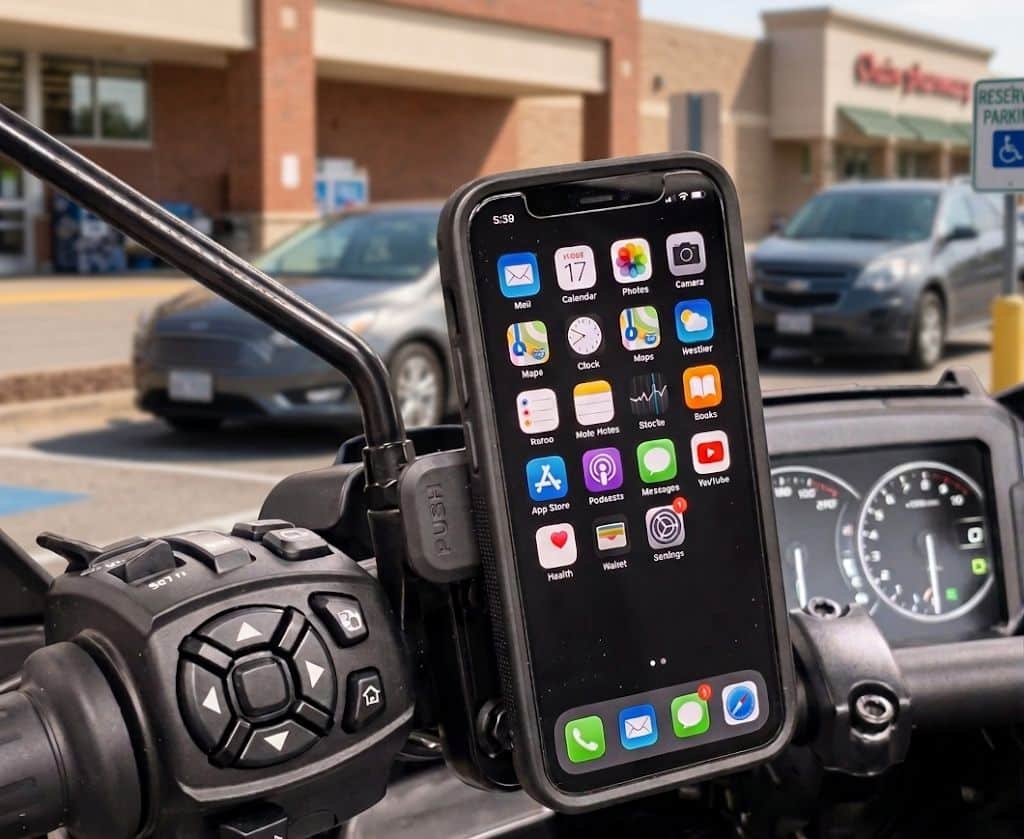
This guide covers all three options, explains which situations each one suits best, and recommends specific mounts for each location. If your bars are full, you have a tight cockpit, or you just want a cleaner install, one of these will work for your bike.
When to skip the handlebar clamp
A handlebar clamp mount is the default choice for most riders, and for good reason: easy to install, easy to remove, and compatible with nearly every phone or GPS. But several situations push riders toward alternative anchor points.
Clip-on handlebars on sport bikes leave almost no usable flat space between the triple clamp, levers, and switchgear. Adventure bikes running a GPS unit, a USB charger, and hand guards often have no bar space left. Cruisers with wide, swept-back bars can put a handlebar clamp mount awkwardly far from the rider’s line of sight. And some riders simply want a cleaner look, with nothing clamped to the bars at all. In all of these cases, mounting off the perch, the mirror post, or the fork stem delivers a better result.
Summary Comparison
| Mount | Best For | Anchor Point |
|---|---|---|
| RAM Mounts Perch Base | All-around use, maximum adjustability | Clutch / brake perch |
| Quad Lock Brake/Clutch Mount | Clean install, Quad Lock case owners | Clutch / brake perch |
| Tackform Perch Mount | Aggressive riding, sport bikes | Clutch / brake perch |
| Techmount TechGripper | Low-profile, no ecosystem required | Clutch / brake perch |
| BRCOVAN Mirror Mount Base | BMW, adventure bikes, clean centerline look | Mirror post / M10 bolt |
| RAM Fork Stem Mount Kit | Sport bikes, centerline position | Fork stem hole |
Clutch and Brake Perch Mounts
The perch mount approach replaces one or both of the bolts securing your clutch or brake lever assembly to the handlebar. A slightly longer bolt with an integrated mounting base takes their place, giving you a rock-solid anchor directly on the control perch. No handlebar clamping, no extra clutter on the bar — just a base that uses structural hardware already on the bike.
This is particularly useful on sport bikes with clip-on handlebars, naked bikes with crowded controls, adventure bikes running multiple accessories, and touring bikes where bar space is already committed to something else. The result is typically a cleaner, more stable setup than a handlebar clamp, because you’re using one of the most solid mounting points on the bike.
1. RAM Mounts Perch Base (RAM-B-309-1U) — best overall perch mount
The RAM Motorcycle Perch Base attaches to your clutch or brake reservoir using included 40mm stainless steel hardware and terminates in RAM’s standard 1-inch B-size rubber ball. From that ball, you build out the rest of the mount using RAM’s modular system: add a 1-inch arm and an X-Grip cradle for the complete setup. See our RAM Mount assembly guide for full instructions.
The reason this is the best all-around perch pick is the flexibility of the RAM ecosystem. You can run any arm length, any cradle style, and any phone size. If you upgrade your phone or change bikes, you swap the cradle or reposition the arm without replacing the base. RAM’s rubber ball-and-socket system also provides inherent vibration absorption, which matters on long highway miles. The base is compatible with the hole spacing found on most standard motorcycle clutch and brake reservoirs.
2. Quad Lock Brake/Clutch Motorcycle Mount — best for Quad Lock users
The Quad Lock Brake/Clutch Mount is the right pick for riders already in the Quad Lock ecosystem. It attaches directly to the clutch or brake perch and uses Quad Lock’s dual-stage locking system to keep the phone secure. Compared to a cradle mount, the Quad Lock connection is significantly more resistant to vibration-induced movement, since the phone locks in with a deliberate twist rather than sitting in spring-loaded arms.
The optional Quad Lock vibration dampener is worth adding if you ride a bike with significant engine vibration, especially an inline-four at highway revs or any twin. Modern smartphones with OIS camera hardware can develop gyroscope damage from sustained motorcycle vibration, and the dampener addresses this directly. If you don’t already own Quad Lock cases, this mount requires buying into that ecosystem. For riders who already use Quad Lock, it is one of the cleanest perch mount setups available.
3. Tackform Perch Mount — best for aggressive riding
The Tackform Motorcycle Perch Mount uses dual 20mm balls with locking joints and a rigid aluminum arm, which gives it a fundamentally different feel from the RAM ball-and-socket system. Where RAM’s rubber balls allow some flex, Tackform’s design locks down hard. There is virtually no movement once tightened. For riders on sport bikes, adventure bikes on rough trails, or anyone who finds that ball-socket mounts feel slightly wobbly at speed, Tackform is the answer.
The trade-off is less post-installation adjustability than RAM. Once you set the angle and lock it down, repositioning requires loosening everything and starting over. Most riders set it once and forget it, which makes this less of a practical concern than it sounds. Compatible with Harley-Davidson, Gold Wing, Honda, and most standard perch configurations. The mount includes hardware and can be paired with Tackform’s own phone cradle or any cradle with a 20mm ball socket.
4. Techmount TechGripper Control Mount — best low-profile all-in-one
The Techmount Control Mount with TechGripper is the most self-contained option in the perch category. Rather than a modular base-plus-arm system, Techmount integrates the perch mount and phone cradle into a compact all-in-one design that sits closer to the handlebar and extends less into the cockpit. The TechGripper cradle uses a DuPont Delrin spring mechanism with 18 lbs/sq.in of clamping force and holds phones up to 4.3 inches wide with or without a case. No ecosystem requirement whatsoever.
Made in the USA from aircraft-grade aluminum with a lifetime warranty. Techmount has been making this specific product for over a decade and has a consistent following among Harley and touring bike riders who want something less bulky than a full RAM arm system. Our Techmount overview covers the full product line in more detail.
Mirror Post Mounts
Mirror post mounts use the M10 bolt that holds your side mirror to the handlebar as the anchor point. On most motorcycles this is an M10 x 1.25 or M10 x 1.5 threaded post, and a mirror base adapter slips over or threads onto that post before you reinstall the mirror. The result is a 1-inch ball base positioned at the mirror location, from which you run an arm and cradle exactly as you would from any other RAM base.
This approach is popular on BMW bikes, which have particularly well-placed mirror positions relative to the rider’s sightline. It also works well on adventure bikes where the cockpit is already dense, and on any bike where the mirror post puts the phone in a naturally good viewing position. The downside compared to a perch mount is that you’re working with a smaller, thinner base plate, so the torque capacity is lower. Fine for a phone, but not a GPS with a heavy arm.
5. BRCOVAN Mirror Mount Base — best mirror post mount
The BRCOVAN mirror base comes as a 2-pack and uses a 10mm mounting hole with a 1-inch B-size TPU ball. It’s CNC-machined from 6061-T6 aluminum with a hard-anodized surface, and the ball is fully compatible with any B-size double-socket 1-inch arm. You slip it over your mirror post bolt before threading the mirror back on and you have a permanent base for the rest of the system.
The angled bolt head design positions the ball slightly offset from the mounting hole, which puts the arm in a natural position once the mirror is reinstalled. Comes with an Allen key for installation. The 2-pack is useful if you want bases on both mirrors or want a spare. Compatible with BMW, Honda, Kawasaki, Yamaha, Suzuki, Triumph, and most other bikes using standard M10 mirror mounts.
Fork Stem Mounts
Fork stem mounts drop into the predrilled hole at the top of the fork stem, the one that’s usually covered by a cap or plug. On most bikes this hole is 12mm to 25mm in diameter and gives you a centered mounting point directly in front of the instrument cluster, at the top of the triple clamp. The phone ends up dead-center on the bike, slightly below eye level when riding, in roughly the same field of view as the speedometer.
This is the go-to setup for sport bikes and naked bikes where the cockpit geometry makes a centered mount position the most practical. The centerline placement also looks significantly cleaner than a side-mounted perch or mirror post mount. The main limitation is fitment: you need to confirm your fork stem hole diameter matches the mount before ordering, and not every bike has an accessible stem hole at all. Fully faired sport bikes sometimes have the stem covered by bodywork.
6. RAM Mounts Fork Stem Mount Kit (RAM-B-176-A-UN7U) — best fork stem mount
The RAM fork stem kit includes the fork stem base, a short double-socket B-size arm, and an X-Grip cradle in one package. The base fits stem hole diameters from 12mm to 38mm, which covers most motorcycles. Installation involves removing your existing stem cap or plug, inserting the RAM base, and securing it with the included hardware. The complete kit means you’re not sourcing individual components from RAM’s modular system: base, arm, and cradle are all in the box.
The RAM system’s rubber ball joints provide some vibration damping here as well, which is especially useful given that the fork stem is a high-vibration location, close to the front wheel and directly connected to the steering head. The short arm included in the kit keeps the phone compact against the triple clamp rather than extended out into the cockpit. If you need more height or reach, the base is B-size compatible and will accept any standard RAM double-socket arm. Our fork stem mount guide covers fitment details and alternative options in more depth.
Which anchor point is right for your bike?
The short version: perch mounts work on almost everything, mirror mounts work best on BMW and adventure bikes with well-placed mirror posts, and fork stem mounts are the cleanest option for sport bikes and naked bikes with an accessible stem hole.
For riders who primarily want to avoid handlebar clutter without doing any measuring or fitment research, the RAM perch base is the lowest-friction starting point. It fits the widest range of bikes, uses the most solid anchor point, and plugs into the largest ecosystem of arms and cradles. If you run out of perch bolt spacing or find the perch position awkward for your cockpit geometry, the mirror post is the next best option. Fork stem mounts require the most fitment verification upfront but deliver the best visual result when the geometry works out.
Installation tips for all three mount types
- Measure before ordering. Perch mounts need reservoir bolt hole spacing. Fork stem mounts need stem hole diameter. Mirror post mounts need to confirm M10 thread pitch. Five minutes with a ruler and thread gauge saves a return shipment.
- Replace one perch bolt at a time. Never remove both bolts simultaneously. Remove the first, install the mount bolt, then do the second. This prevents the reservoir from shifting during installation.
- Use thread locker on all mounting hardware. Medium-strength thread locker on the mount bolt threads prevents vibration from walking bolts loose over time. This applies to all three mount types.
- Check lever clearance after installing a perch mount. After installation, squeeze the clutch and brake lever fully through their complete range of motion. The mount and arm must not contact the lever at any point.
- Set your angle while seated on the bike. The viewing angle that looks right in the garage changes once you’re in your riding posture. Sit on the bike, assume your normal position, and lock everything down from there.
- Fork stem: confirm the hole isn’t load-bearing. On most bikes the stem hole is a service/adjustment point with no structural role. On some bikes it may be used for steering damper hardware. Confirm your bike’s specific layout before installing.
Frequently Asked Questions
Are clutch perch mounts safe?
Yes, when installed correctly. The reservoir bolts are structural hardware designed to handle significant mechanical force. A mount that replaces those bolts with hardware of the same spec is using one of the most solid anchor points on the bike. The key is matching the OEM bolt specification exactly and checking lever clearance after installation.
Should I mount on the clutch side or the brake side?
Either works mechanically. Most riders prefer the clutch side because the left hand is less frequently engaged while riding. A mount on the clutch side is less likely to be in the way during frequent braking. On bikes with a hydraulic clutch, some riders prefer the brake side for aesthetic or ergonomic reasons. Test both positions while seated on the bike before committing.
Will my reservoir bolt spacing fit the RAM perch base?
The RAM-B-309-1U fits hole centers between 0.94 and 1.58 inches. This covers most standard Japanese, European, and American motorcycles. Measure your reservoir bolt spacing before ordering. Tackform and Techmount also include hardware for common configurations, and Tackform publishes a compatibility list on their site.
Do any of these mounts require a specific phone case?
Only the Quad Lock mount requires a specific case. Phones need a Quad Lock or MAG-compatible case to attach. The RAM X-Grip, Tackform cradle, Techmount TechGripper, and RAM fork stem X-Grip all work with any phone in any case. The SP Connect Mirror Mount Pro requires an SP Connect case.
Should I worry about phone vibration damage?
On high-vibration bikes, particularly air-cooled twins and some inline-fours at certain RPM ranges, sustained motorcycle vibration can potentially damage smartphone camera gyroscopes over time. If you ride a high-vibration bike for long distances regularly, the Quad Lock vibration dampener is worth adding to any perch mount setup. RAM’s rubber ball-and-socket system also absorbs some vibration inherently, and the RAM fork stem kit’s ball joints provide an additional layer of damping at that anchor point.
What if none of these positions work on my specific bike?
If the perch spacing is wrong, the mirror post geometry is awkward, and the fork stem hole is inaccessible, a handlebar clamp mount is still often the right answer for most bikes. Some cockpit configurations simply favor the bar clamp, and there is no reason to force an alternative anchor point if the geometry doesn’t work out.
Related guides
- Best Motorcycle Handlebar Phone Mounts
- Motorcycle Fork Stem Phone Mounts
- How to Assemble a RAM Mount
- Techmount Phone Mounts for Motorcycles
SEO Metadata
Title: Motorcycle Phone Mounts Without Handlebar Clamps: Perch, Mirror, and Fork Stem Options
Meta description: No room on your handlebars? These perch, mirror post, and fork stem phone mounts give you a cleaner, more stable install without touching the bars.
Focus keyword: motorcycle clutch phone mount
Secondary keywords: motorcycle perch mount, motorcycle mirror post phone mount, fork stem phone mount, RAM motorcycle perch base, Quad Lock clutch mount, Tackform perch mount