
Most motorcycles give you a clear path to mounting a phone. The handlebars work, the fork stem is an option, and a clutch perch mount handles the rest. But there is a category of bikes where none of those approaches fit cleanly. Clip-on handlebars leave no clamping room. Heavily faired cockpits block traditional positions. Some touring bikes and custom builds just have layouts that make handlebar mounting awkward or impossible.
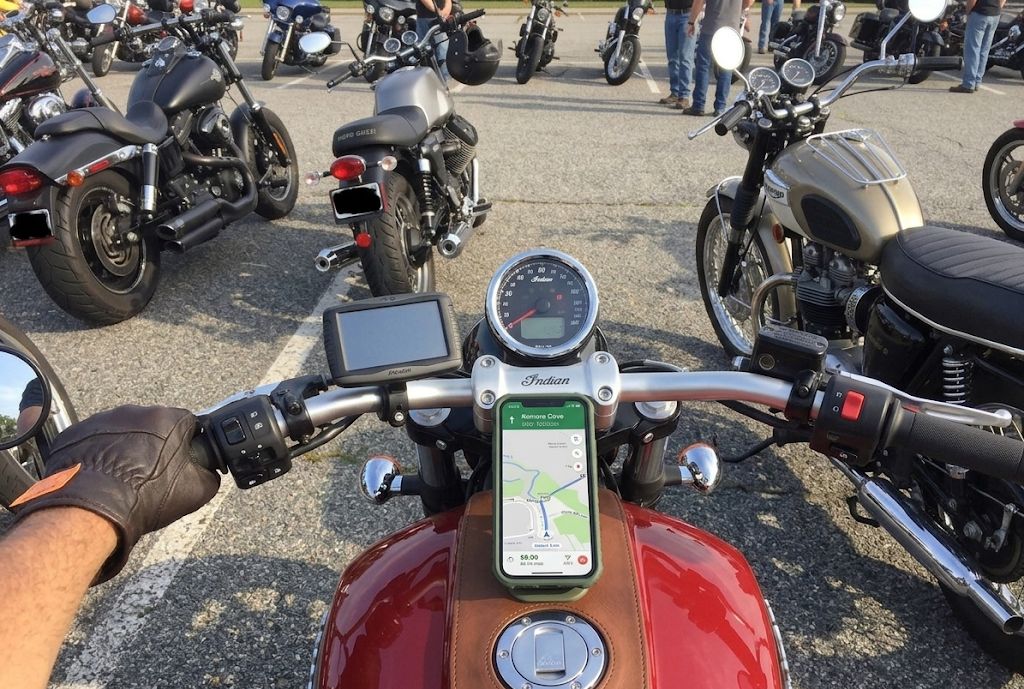
That is where gas tank mounts come in. They are not the default recommendation, and this guide will be clear about when they make sense versus when you should look elsewhere. But for riders dealing with tight cockpit geometry or limited mounting real estate, the gas tank is often the only viable surface. The right setup depends on your bike, your riding style, and how much you are willing to invest in the installation.
Quick Comparison: Best Motorcycle Gas Tank Phone Mounts
| Mount | Best For | Mount Type |
|---|---|---|
| Krator Tank Mount + RAM X-Grip | Touring and long-distance riders | Bolt-on |
| Cuxwill Magnetic Tank Mount | Casual riders, multi-bike households | Magnetic |
| Quad Lock Adhesive Mount | Bikes where bolt-on and magnetic won’t work | Adhesive |
When a Gas Tank Mount Actually Makes Sense
Before getting into specific products, it is worth being direct: handlebar mounts are better in almost every situation. The viewing angle is more natural, installation is simpler, and you do not have to look down while riding. If your handlebars can support a mount, use them.
Gas tank mounts exist for situations where that is not possible. The most common scenarios include:
- Clip-on handlebars on sport bikes where there is simply no room to clamp anything
- Heavily faired cockpits where fairings block access to the bars entirely
- Fork stems that are too narrow or obstructed by cables and hardware
- Custom builds where handlebar geometry does not accommodate standard clamp diameters
- Touring bikes like certain Harley-Davidson and Indian models where the cockpit is already crowded with controls and instruments
If any of these describe your bike, a gas tank mount is a legitimate solution. The trade-off is viewing angle: you will need to look down rather than forward, which is fine for glancing at navigation but not ideal for constant interaction with your phone.
The 3 Types of Motorcycle Gas Tank Phone Mounts
There are three fundamentally different approaches to mounting a phone on a gas tank. Each works through a different attachment method, and each has a different risk and reward profile.
1. Bolt-On Tank Mounts: The Most Secure Option
Bolt-on mounts use the existing hardware on your gas tank cover or console to create a mechanical connection. There are no adhesives involved, no magnets, and no guesswork about whether it will hold. If the bolt pattern matches your bike, this is the best possible foundation for a tank-mounted phone setup.
The Krator tank mount is a widely used base in this category. It bolts directly onto the gas tank cap using your existing hardware, supports Yamaha, Suzuki, Ducati, and Triumph models, and includes an adjustment point that lets you fine-tune the angle and tilt. The mount itself is a base only, which means you pair it with a RAM arm and phone holder to complete the setup. That combination of Krator base, RAM double socket arm, and RAM X-Grip cradle gives you a fully adjustable, fully mechanical system with no adhesives anywhere in the chain.
The modular approach also means longevity. If you upgrade your phone or swap bikes, you replace only the holder, not the entire mount. For riders doing long-distance touring or highway miles, this is the most stable and dependable option in the category.
2. Magnetic Tank Mounts: The Easiest Option
Magnetic mounts sit directly on the gas tank using industrial-grade magnets. No installation required, no tools, no bolts. You set it down and ride. That simplicity makes them the most popular choice for riders who want flexibility rather than a permanent setup.
The Cuxwill magnetic tank mount uses six N52 neodymium magnets, which are among the strongest available in consumer products. The all-metal construction means no plastic components to crack or fatigue over time, and the silicone anti-slip base pad protects your tank finish from direct metal contact. The phone cradle pivots and swivels, giving you some ability to adjust viewing angle even after placement. It fits phones from 4.7 to 6.7 inches and is compatible with both iPhone and Android devices.
The practical advantages are real. You can move the mount between bikes without any tools. You can remove it instantly when fueling or parking in a sketchy area. And because there is no permanent attachment, your tank stays pristine underneath.
The downsides are also real. Magnetic mounts sit lower on the tank, which means a more pronounced downward viewing angle compared to handlebar mounts. They are also not ideal for aggressive riding or sustained high-vibration conditions. Debris trapped between the magnet and tank surface can cause paint wear over time, so cleaning both surfaces before each ride is a good habit.
3. Adhesive Tank Mounts: Use With Caution
Adhesive mounts bond directly to the tank surface using high-strength tape, typically 3M VHB. When installed correctly on a clean, flat surface and given proper cure time, the bond is genuinely strong. But this type of mount is the most demanding to install and the hardest to reverse.
Quad Lock is the right brand for this approach. Their adhesive mount is part of their broader ecosystem, which means it pairs with any Quad Lock case or universal adapter. The mount itself is low-profile and solid, and Quad Lock’s build quality is well above average for the category. The system also supports their vibration dampener accessory, which is worth adding given that adhesive mounts transmit engine vibration directly into the phone.
The limitations of adhesive mounting are not really about the product. They are about the method itself. Motorcycles vibrate constantly, and that vibration stresses adhesive bonds differently than it stresses a screw. Temperature swings accelerate this over time. Removal can damage certain tank finishes, and there is no clean way to reposition the mount once it has fully cured.
Vibration Dampening: Why It Matters More Than It Used To
Modern smartphones, particularly recent iPhone and Android flagship models, include optical image stabilization systems that are sensitive to high-frequency vibration. Mounting a phone directly to a rigid surface on a motorcycle can transmit engine vibration into the device at frequencies that degrade OIS performance over time. Apple has acknowledged this as a concern and recommends vibration-isolating mounts for motorcycle use.
For bolt-on systems, adding a vibration dampener between the arm and the phone holder addresses this. For Quad Lock users, their dedicated vibration dampener accessory inserts between the mount and the phone cradle. Both are small additions that protect a device that likely costs significantly more than the mount itself.
Magnetic mounts by their nature provide some degree of vibration isolation, since the phone is not rigidly locked to the mount. Whether that is sufficient depends on your bike’s vibration profile, but it is a genuine secondary benefit of the magnetic approach.
Common Problems With Gas Tank Mounts
- Downward viewing angle: All tank mounts require you to look down more than handlebar mounts. This is acceptable for occasional navigation checks, not for constant phone interaction.
- Glare from sunlight: Tank surfaces can reflect light onto the screen, especially on bikes with glossy or metallic finishes.
- Fuel cap interference: Depending on the mount position, you may need to remove it before refueling. Always test this before your first ride.
- Fitment gaps: Not all tank surfaces are flat enough for magnetic or adhesive mounting. Curved tanks with aggressive geometry may limit your options to bolt-on setups only.
- Paint and finish concerns: Magnets, adhesives, and even silicone pads can affect certain tank finishes over time. Check your bike’s finish type before committing to any mount.
Installation Tips
- Always test your seated riding position before finalizing mount placement. What looks right standing next to the bike is often wrong when you are actually on it.
- Keep the mount well clear of the fuel cap. You do not want to discover clearance issues at a gas station.
- For adhesive mounts, clean the surface with isopropyl alcohol, let it dry fully, apply firm pressure during bonding, and wait 24 hours before riding.
- Use a vibration dampener on any rigid mount, especially if you are running a recent iPhone or high-end Android.
- For magnetic mounts, clean both the tank surface and the silicone base pad before every ride to prevent debris buildup.
Frequently Asked Questions
Are gas tank phone mounts safe to use while riding?
They are safe when used correctly, but the downward viewing angle requires more head movement than a handlebar mount. Use them for navigation reference only, not for extended phone interaction while moving.
Will a magnetic mount scratch my tank?
It can if debris gets between the magnet base and the tank surface. The Cuxwill uses a silicone anti-slip pad specifically to prevent this, but cleaning the contact surfaces before each ride is still good practice.
Which type of gas tank mount is the most secure?
Bolt-on mounts are the most secure by a wide margin. They use mechanical fasteners rather than magnetic or adhesive attachment, and they do not rely on surface conditions or temperature to maintain their hold.
Can I use a GPS device instead of a phone on a tank mount?
Technically yes, though the downward viewing angle is a bigger issue for GPS units than for phones, since you tend to look at navigation data more frequently. A handlebar or windshield mount is a better fit for dedicated GPS devices.
Does the Krator mount fit Harley-Davidson bikes?
The Krator ACM-SDTY2 is specifically designed for Yamaha, Suzuki, Ducati, and Triumph. Krator makes separate versions for Honda, BMW, and Kawasaki. Harley-Davidson bikes often use proprietary mounting solutions or require a model-specific gas tank base.
Do I need a special case for these mounts?
For Quad Lock adhesive mounts, yes, a Quad Lock case or universal adapter is required. For the Krator bolt-on with RAM X-Grip and the Cuxwill magnetic mount, no special case is needed.
Related Mount Guides
- Best Motorcycle Phone Mounts
- Motorcycle Fork Stem Phone Mounts
- Clutch and Brake Perch Phone Mount Guide
- Best Handlebar Phone Mounts for Motorcycles
Bottom Line
Motorcycle gas tank mounts are a niche solution, and this guide has tried to be honest about that throughout. If your handlebars can support a mount, use them. The viewing angle is better, installation is simpler, and there is no compromise on stability.
But if your bike genuinely does not support a handlebar mount, the gas tank is a workable alternative. The Krator bolt-on system paired with a RAM arm and X-Grip holder is the most secure and reliable option. The Cuxwill magnetic mount is the most practical for riders who want flexibility and tool-free installation. The Quad Lock adhesive mount is there for edge cases where neither of the other two approaches will work.
Know your bike, know the trade-offs, and choose the option that fits both.