
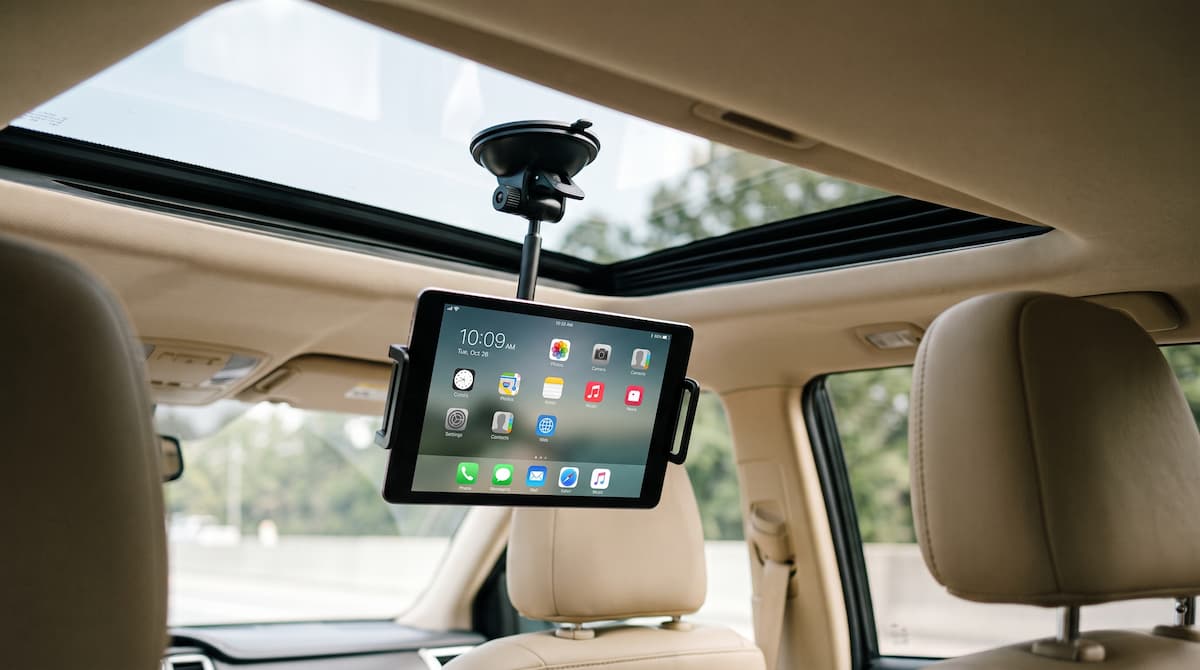
Just when it seems like every mounting location inside a vehicle has been covered, one option still flies under the radar: the sunroof. It sounds unusual at first, but once you think about it, mounting a phone or tablet to the sunroof solves a specific problem extremely well: rear seat visibility. This guide covers sunroof phone mount ideas (tablets too).
Unlike headrest mounts, which position a screen behind one seat, a sunroof mounted device sits centered in the vehicle. That means both rear passengers get a clean, equal view without needing multiple mounts or awkward angles pointed at just one seat.
Why Mount a Device on the Sunroof at All?
The biggest advantage of a sunroof mount is positioning. A device mounted overhead and centered gives both rear passengers a shared, equal view, something no single seat mount can replicate. Headrest mounts are the default choice for backseat entertainment, but they were designed around a single viewer. Angle the screen for the passenger behind the driver and the passenger behind the front seat gets a sideways sliver of it.
A sunroof mount solves that by putting the screen where both kids, or both adults, can actually see it. This matters most for:
- Backseat entertainment on long road trips
- Streaming video for two or more passengers at once
- Vehicles where the headrests don’t have a good mounting point, or the seats sit too far apart for one mount to serve both
- Keeping the device out of reach of small hands, which cuts down on dropped phones and constant repositioning
There is also a practical side benefit that gets overlooked. Because the mount attaches to glass rather than a seat structure, it comes off in seconds and leaves nothing behind on the upholstery. That is worth knowing if you switch vehicles often or share a car with someone who does not want a permanent bracket clamped to their headrest.
What Actually Makes a Sunroof Mount Reliable
This is where most buyers get it wrong, and it is also where most of the negative reviews on generic suction mounts come from. Not every suction mount is built to hold weight upside down. A mount that performs fine on a dashboard, sitting under its own weight with gravity pulling it down into the base, behaves completely differently when it is inverted and gravity is now pulling the device straight down and away from the glass.
Three things separate a mount that survives overhead use from one that does not:
- A genuine locking suction base. Look for a two stage lever or lock mechanism, not a simple press and stick pad. The lever creates a true vacuum seal rather than just surface tackiness, and that is the difference between a mount that holds through highway bumps and one that lets go on the first pothole.
- An arm that matches your priorities. A short, rigid arm minimizes wobble and gives you the most stable picture, which matters more for video playback than for a quick glance at a map. A longer gooseneck arm trades a bit of that rigidity for the ability to position the screen exactly where you want it, useful if your rear seats sit unusually far apart or close together. As long as the arm is a rubberized, properly built gooseneck and not thin floppy plastic, it will hold up fine overhead when paired with a locking suction base.
- A stable, wide opening cradle. This matters even more for tablets than phones. A cradle that only grips at two points will let a heavier device rock in the wind coming through a cracked window. Look for a cradle with multiple contact points and a spring loaded or ratcheting design that keeps tension on the device rather than relying on friction alone.
Best Sunroof Mounts Compared
Here is how the four mounts we recommend for sunroof use stack up against each other. All four use genuine locking suction bases rated for overhead use.
| Mount | Device Range | Arm Style | Best For |
|---|---|---|---|
| Sunroof Tablet Holder Mount, Anti-Shake | 4 to 12.9 inches | Dual aluminum ball joint arms | Maximum stability for tablets and large phones |
| Aluminum Tablet Holder, Dual Suction | 4.7 to 15 inches | Adjustable dual suction base | Widest device compatibility, including full size iPad Pro |
| MAGIC JOHN Metal Suction Mount | 4 to 7 inches | Short rigid arm | Steadiest possible phone only setup |
| APPS2Car MagSafe Long Arm Mount | Phones, MagSafe compatible | 15 inch gooseneck | Flexible positioning when seats sit far apart |
Best Sunroof Tablet Mounts
For tablets, you need a mount that can handle both weight and width, since a wobbling 10 inch screen is far more distracting than a wobbling phone. The Sunroof Tablet Holder Mount is purpose built for this exact use case rather than adapted from a windshield mount.
It uses aluminum alloy arms with double ball joints on each end, a hidden double lock suction design, and support for devices from 4 inches up to 12.9 inches, which covers everything from a phone to a full size iPad Pro. The dual arm construction is what makes the difference here. A single arm flexes under the weight of a tablet when the car goes over a bump. Two arms working together resist that flex.
If you want the broadest device compatibility, the Aluminum Tablet Holder with Dual Suction stretches up to 15 inches, which covers the largest tablets on the market along with the iPad Air 13 inch. It uses the same locking suction philosophy, a dual base rather than a single cup, which spreads the holding force across two contact points instead of one. That matters more the heavier and wider the device gets.
Best Sunroof Phone Mounts
Smartphones are lighter and easier to mount, but stability still matters, especially if the phone is being used for video rather than a quick glance at directions. If you want the steadiest possible setup, the MAGIC JOHN Metal Suction Mount uses a short rigid arm and a durable metal body rather than plastic, with 360 degree rotation built into the cradle. A short arm has almost nothing to flex, which makes it the closest thing to a fixed mounting point you can get from a suction base.
If you would rather have more reach, say bringing the phone lower and closer to the front seats, or positioning it off center to split the difference between two rear passengers, the APPS2Car MagSafe Long Arm Mount is worth a look. Its 15 inch gooseneck will not sit quite as rock steady as a short rigid arm, since any gooseneck introduces some give over rough roads. But the two stage locking suction cup keeps the base itself secure overhead, and the extra length buys you flexibility in exactly where the screen ends up. It is also MagSafe compatible, which makes attaching and removing the phone faster than a cradle style mount.
Installation Tips for a Sunroof Mount
Getting a good hold the first time saves you from redoing this every time you get in the car. A few things make a real difference:
- Clean the glass first. Use glass cleaner and a lint free cloth. Dust, road film, and even fingerprints reduce the vacuum seal significantly.
- Press and lock in one motion. Push the cup flat against the glass, then engage the lock lever while holding firm pressure. Locking before the cup is fully flat traps air and weakens the seal.
- Test before you drive. Give the mounted device a firm tug in the direction gravity will pull it, straight down, before you pull out of the driveway.
- Recheck after temperature swings. Suction cups lose a small amount of grip in extreme heat or cold. A quick relock after the car has been parked in direct sun for hours is good practice.
What to Avoid
- Weak or press on suction mounts. These will fail upside down regardless of arm type. If the product listing does not mention a locking mechanism, assume it does not have one.
- Cheap, unbraced gooseneck arms. A gooseneck itself is not the problem. A gooseneck made from thin plastic tubing that will not hold its shape is the problem. If you go with a longer arm, make sure it is rubberized and rigid feeling, not floppy.
- Adhesive mounts. These can damage the glass over time and make it difficult to open the sunroof without removing the mount entirely.
- Vent mounts repurposed for overhead use. These clip to an air vent and were never designed to bear weight against gravity from above. They are not a substitute for a proper suction mount.
Frequently Asked Questions
Will a suction mount stick to a sunroof?
Yes, but only if the glass is smooth and clean. Textured, tinted, or coated surfaces will not hold suction properly, and no amount of pressing will fix that.
Is it safe to mount a tablet overhead?
It can be, as long as you use a mount built for larger devices with a genuine locking suction base rather than a simple press on cup. Always test the hold before driving.
Can I use a gooseneck arm on a sunroof mount?
Yes, as long as the arm is well built, rubberized and rigid rather than thin plastic, and paired with a two stage locking suction cup. You get more flexibility in positioning at the cost of a small amount of extra movement compared to a short rigid arm.
Can I still open my sunroof with a mount installed?
In most cases, no. The mount will need to be removed before opening the sunroof, so this setup works best if you are not opening it regularly during the drive.
Bottom Line
Sunroof mounts are a niche solution, but a smart one when used correctly. They provide one of the best centered viewing angles for rear passengers, especially compared to single seat mounting options that only serve one child at a time.
The suction base is what actually determines whether a sunroof mount survives, not the arm style. A genuine locking suction cup is what keeps a mount from failing overhead, whether you pair it with a short rigid arm for maximum stability or a longer gooseneck for flexible positioning. Get the suction base right, and either style becomes a reliable, repeatable setup for phones and tablets alike.