
Choosing the right fish finder mount matters more than most boat owners realize. A weak or poorly positioned mount does not just make the screen harder to read. It can introduce vibration, force constant readjustment, waste console space, and make an expensive sonar or chartplotter feel cheap every time you are on the water.
That matters because fish finders are no longer small displays tucked into the corner of a jon boat. Today’s units from Garmin, Lowrance, Raymarine, and Humminbird combine chartplotting, sonar, side imaging, and networking into larger, heavier screens. Many of those units still use bail, gimbal, or bracket-style mounting systems, which tells you something important: marine electronics demand stronger, more adjustable hardware than a generic consumer device mount can provide.
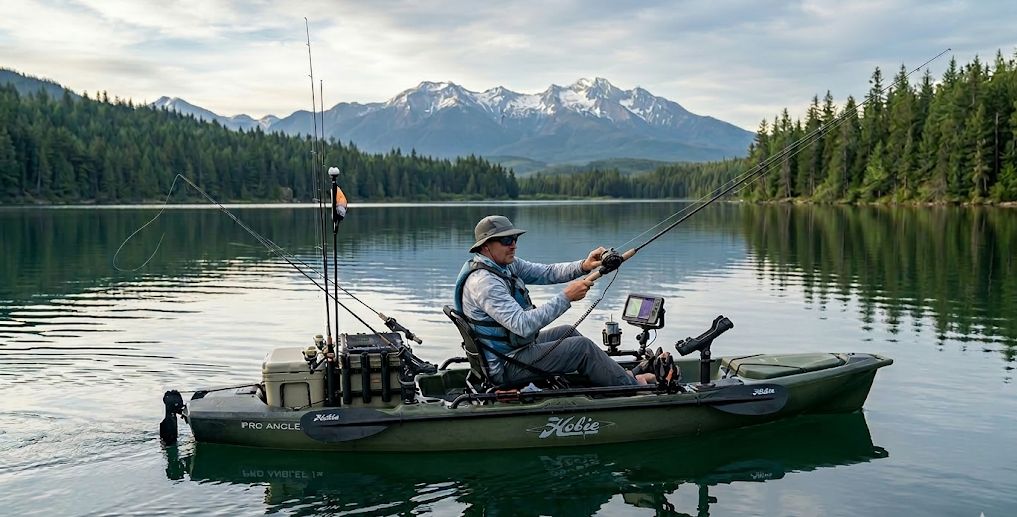
Whether you are rigging a bass boat, a center console, a kayak, or a small aluminum flat, the goal is the same: keep the display stable, visible, and easy to adjust while the boat is moving. This guide covers the best current options, including universal aftermarket systems and OEM bracket solutions from the major brands.
Quick Comparison: Best Fish Finder Mounts
| Mount | Best For | Boat Type |
|---|---|---|
| RAM Marine Electronics Mount | Maximum adjustability, heavy units, long-term upgrade path | Bass boats, center consoles, larger craft |
| Brocraft Universal Marine Mount | Rigid platform for 7″ to 12″ displays, quick removal | Most console and deck boats |
| Scotty Fish Finder Mount | Portable setups, track-system integration, quick removal | Kayaks, canoes, small inflatables |
| Humminbird OEM Gimbal Mount | Exact fit for HELIX, XPLORE, and APEX families | Any boat with a confirmed Humminbird install |
| Brocraft Transducer + Fish Finder Combo | Portable or semi-portable rigs where drilling is not ideal | Kayaks, pontoons, canoes, inflatables |
Best Fish Finder Mounts for Boats
1. RAM Marine Electronics Mount — Best Overall
If you want one fish finder mount system that works across the broadest range of boats and electronics, RAM is still the benchmark. The advantage is not just strength. It is the combination of adjustability, modularity, and marine reputation that RAM has built over decades. Their double-ball systems let you position the display higher, closer, or at a more useful viewing angle than most stock brackets allow, and once tightened properly, they hold their position through rough water without drifting.
This matters most for owners of Garmin ECHOMAP, Lowrance HDS or Elite FS, Raymarine Axiom, and Humminbird HELIX units who are unhappy with a flat, fixed, or low-mounted factory bracket. Instead of only tilting forward and back, a RAM-style arm gives you a more usable line of sight whether you are standing to fish, sitting at the helm, or fighting glare in open sun.
The D-size (2.25″ ball) version handles units up to 15 pounds, making it suitable for even the larger 12″ to 16″ combo units that are now common on fully rigged bass boats and center consoles. RAM backs all of their marine mounts with a lifetime warranty, which is a meaningful commitment in a category where saltwater exposure can punish inferior materials quickly. If you upgrade electronics later, the system largely stays the same: you swap the top plate or adapter, not the whole mount.
2. Brocraft Universal Marine Mount — Best Budget Upgrade
Brocraft has become a legitimate name in this space because it focuses on exactly what many boat owners need: a larger, more rigid platform for fish finders and chartplotters without the premium price tag of a full RAM system. The multi-pattern universal top plate accepts most major brand brackets, the rotation locks down firmly, and the anodized aluminum construction holds up to salt air and repeated UV exposure.
This is a strong option for anyone stepping up from smaller screens to 7″, 9″, or 12″ class displays, or for anyone whose stock gimbal bracket feels underdone in practice. The more valuable your electronics become, the less tolerance you have for mounts that wobble or sag after a season of use.
Brocraft also fits well on boats where deck or console space is limited and you want something that looks and feels like a proper installed solution rather than an improvised attachment. It is the kind of mount you choose when you want the unit to feel bolted in, not just perched there.
3. Scotty Fish Finder Mount — Best for Kayaks and Small Craft
Not every angler is rigging a larger console boat. Plenty of people need a mount that works on a kayak, canoe, inflatable, or compact fishing setup where space is tight and the ability to remove or reposition the unit quickly is just as important as holding it steady. Scotty is one of the most practical answers in that space.
The reason Scotty works so well here is that its entire product line is built around modular adaptability. The Scotty post mount ecosystem connects to rail mounts, clamp mounts, track adapters, and side or deck mount bases, which means one fish finder mount head can work across multiple boats depending on which base you pair it with. Their universal top plate accepts most major brand brackets and locks down with the same post-and-release system as their rod holders and camera arms.
We’ve recommended Scotty’s fish finder mounts to anyone using the Scotty mounting ecosystem across other accessories, and the logic is the same here: if you already have a Scotty base on your kayak or small boat, adding a compatible fish finder mount is one of the cleanest setups you can build. It is not the right answer for a heavy 12″ chartplotter on a center console. For smaller craft and portable setups, it is one of the smartest.
4. Humminbird OEM Gimbal Mounts — Best Brand-Matched Option for Humminbird Owners
Sometimes the right answer is not a universal aftermarket system. If you own a Humminbird HELIX, XPLORE, or APEX unit and want a clean, exact fit with no guesswork, an OEM gimbal mount is worth serious consideration. Humminbird’s own accessories catalog includes dedicated mounts for their major product families, built in high-strength aluminum with ratcheted or adjustable designs that are engineered specifically for those units.
This is the route to take when your display position is already correct and you simply need solid, model-specific hardware. The fit is exact, compatibility is guaranteed, and the mount looks like a proper extension of the electronics package rather than an adaptation. That matters on finished boats where the install needs to look clean.
The limitation is flexibility. OEM gimbals are typically less versatile than a modular RAM-style system if you want more extension, a different position, or the ability to accommodate a future upgrade. But for many Humminbird owners, that tradeoff is worth it.
5. Brocraft Transducer + Fish Finder Combo — Best for Portable Rigs
This is a different but important subcategory. Some anglers do not just need a display mount. They need a semi-portable system that handles both the fish finder head and the transducer arm together, particularly when permanent drilling is not an option or when the boat changes from trip to trip.
Brocraft’s kayak and pontoon-specific transducer systems address this directly. Their marine-grade 6061-T6 aluminum arm swivels 360 degrees, telescopes for depth adjustment, and clamps to most gunwale sizes. The universal fish finder mounting plate adapts to Lowrance, Garmin, Humminbird, and Eagle units without modification.
This is more niche than a standard console mount, but for the right boat it is exactly the right answer. We covered Brocraft’s transducer products in depth in our dedicated transducer mounts guide, where they came out as a top pick on both value and build quality.
What a Fish Finder Mount Actually Needs to Do
A fish finder mount has a harder job than most marine accessories. It has to support the weight of the unit, resist vibration and wave shock, allow enough tilt to fight glare at different times of day, and hold its position after repeated adjustment cycles. That job gets harder as display sizes increase and as units get heavier with larger screens and more integrated hardware.
The core requirements in order of importance:
Strength: Fish finders and combo units weigh significantly more than phones or handheld GPS devices. A 9″ to 12″ combo unit with a protective case can easily exceed 3 to 5 pounds, and the mount needs to hold that weight through rough-water pounding without loosening over a season of use.
Adjustability: Glare is one of the most overlooked problems in fish finder mounting. The angle that works at 7 AM on a calm morning is often wrong by noon when the sun has moved. A mount with meaningful tilt range lets you make that adjustment without tools or second-guessing.
Corrosion resistance: Saltwater and spray punish cheap hardware fast. Powder-coated marine-grade aluminum is the material standard to look for. Chrome or polished finishes look good at the dock but corrode more visibly after a season offshore.
Low vibration transfer: At speed on a choppy lake or coastal inlet, vibration from the hull transfers directly to a rigidly mounted display. RAM’s rubber ball isolators dampen that meaningfully. A good fish finder mount should make the screen easier to read at speed, not harder.
Correct footprint: The base has to actually fit your helm, console, gunwale, or track system. This is where checking mount dimensions against your available surface before buying saves a lot of frustration.
How the Major Brands Approach Mounting
Understanding how Garmin, Lowrance, Raymarine, and Humminbird handle mounting from the factory helps you make a smarter aftermarket decision.
Garmin units like the ECHOMAP and STRIKER families commonly support either bail/swivel mounting or flush mounting depending on the unit and install location. That makes aftermarket upgrades especially useful when you want more reach, better articulation, or a cleaner position than the included bracket provides. Garmin’s own installation documentation treats bail-mount logic as a standard path, not a downgrade.
Lowrance maintains a broad accessories ecosystem for lines like the HDS Live and Elite FS, including model-specific mounting templates and brackets. Lowrance owners often have two paths: keep the standard bracket setup, or move to a heavier-duty aftermarket system when the application demands more adjustability or a different footprint.
Raymarine Axiom and Element units are commonly sold into installations where either bracket mounting or flush mounting makes sense depending on helm design. This makes aftermarket mounting especially valuable when the stock placement is too low, too fixed, or not ideal for the way you actually use the boat.
Humminbird actively sells OEM mounts and hardware for HELIX, XPLORE, and APEX families with language that emphasizes stability, adjustability, and easy unit removal. That same set of priorities is exactly why the aftermarket alternatives above are worth considering, particularly for owners who want more creative positioning than a stock gimbal allows.
Common Fish Finder Mounting Mistakes
Mounting too low: A display mounted at console level or below makes it nearly impossible to read while running the boat. The screen needs to be at a height where you can glance at it comfortably from the helm position, not lean over the console every time you want to check depth or structure.
Underestimating unit weight: The jump from a 5″ or 7″ unit to a 9″ or 12″ unit is not just a screen size increase. It is a significant weight increase, and a mount that worked fine for the smaller unit may flex, sag, or loosen over time with the heavier one.
Ignoring tilt range: Many boat owners focus entirely on whether the mount will hold the unit, and completely ignore whether it tilts far enough to fight glare at midday or when the sun is off the stern. A mount that only tilts 20 degrees may be useless in certain conditions. Look for 30 to 45 degrees of tilt range minimum.
Using non-marine hardware: Car-style suction cup mounts, consumer adhesive mounts, and generic camera mounts are not designed for the vibration, spray, UV exposure, and repeated adjustment cycles that marine use demands. They fail faster and less predictably in that environment.
Not matching the mount to the boat: A RAM D-size arm is overkill on a kayak and may be exactly right on a bass boat. A Scotty post mount that works beautifully on a kayak track system is the wrong choice for a 12″ HELIX on a fiberglass center console. Think about the actual boat first, then the mount.
How to Choose the Right Fish Finder Mount
The best fish finder mount depends on three things: your unit, your boat, and how you use both.
If you run a larger display from Garmin, Lowrance, Raymarine, or Humminbird and fish in choppy or rough water, lean toward a heavier-duty system like RAM. The modularity, weight capacity, and vibration damping justify the higher entry point for anyone who depends on their electronics to find fish reliably.
If you want a solid platform at a more accessible cost and your boat has a standard flat-mount surface, Brocraft is a serious option. Their universal top plates work with most major brand brackets and the rotation lock holds well under real-world conditions.
If you are on a kayak, canoe, or small inflatable, Scotty’s post mount ecosystem is one of the cleanest solutions available. The modular base system means one mount head can move between boats as needed, and the quick-release design makes unit removal for storage or transport genuinely fast.
If your position is already dialed in and you own Humminbird electronics, the OEM gimbal route is worth considering for the fit precision and clean install it provides.
Frequently Asked Questions
Can I use a RAM mount on any fish finder brand?
RAM makes model-specific adapter plates for Garmin, Lowrance, Humminbird, and Raymarine units, as well as universal top plates that accept most manufacturer gimbal brackets. For the majority of fish finders sold today, there is a RAM mounting solution that fits either directly or through a gimbal bracket adapter.
What is the difference between a gimbal mount and a ball mount for fish finders?
A gimbal mount attaches the unit via a bracket that pivots on a fixed axis, allowing tilt adjustment in one plane. A ball mount, like those in the RAM system, uses a round ball-in-socket design that allows adjustment in multiple axes simultaneously. Ball mounts offer more positioning flexibility. Gimbal mounts are simpler, lower profile, and often preferred for clean OEM-style installations where the position is fixed.
Do I need a different mount for saltwater vs. freshwater?
Not necessarily a different category of mount, but you should pay closer attention to material quality when fishing salt. Powder-coated marine-grade aluminum and stainless steel hardware hold up well in both environments. Avoid raw aluminum, plated steel, and any mount described only as “corrosion-resistant” without specifying the material. RAM and Scotty both use materials appropriate for salt exposure.
Can I mount a fish finder on a kayak without drilling?
Yes. Scotty’s clamp-mount bases and RAM track-mount systems allow fish finder installation on kayaks with integrated track systems without requiring any drilling. If your kayak does not have a factory track, Scotty’s rail mount and portable clamp options can attach to most kayak gunwales or side rails. See our kayak track mount guide for compatible systems.
What size RAM ball do I need for my fish finder?
For units under 2 pounds, the B-size 1″ ball (RAM-B-111U-A) is sufficient. For units from 2 to 6 pounds, the C-size 1.5″ ball systems are the standard recommendation. For larger 9″ to 16″ combo units that approach or exceed 6 pounds, the D-size 2.25″ ball (RAM-D-111U series) provides the holding power and stability needed for rough-water use.
Will a universal mount work with my specific fish finder model?
Most modern fish finders from Garmin, Lowrance, Humminbird, and Raymarine use standard gimbal bracket mounting patterns. Universal top plates from RAM and Brocraft are designed to accept those standard brackets directly. The exceptions are some older Humminbird units with proprietary mounting patterns and select flush-mount-only models. If you have a less common unit, confirm the top-plate hole pattern against your existing bracket before ordering.
Related Marine Mount Guides
- Best Boat Phone Mounts
- Marine iPad and Tablet Mount Guide
- Transducer Mounting Guide
- Scotty Mounting System Guide
- Best Kayak Track Mount Systems
Bottom Line
The best fish finder mount is the one that matches the actual reality of your boat and electronics, not the most popular option on a generic list. If you want maximum flexibility and long-term upgrade potential, RAM is the safest overall choice. If you want a capable universal platform at a lower entry cost, Brocraft deserves a close look. If you are rigging a kayak or small craft, Scotty’s modular system makes considerably more sense than overbuilding the setup.
Most importantly, think beyond whether the mount will hold the unit. The right fish finder mount should improve visibility, resist vibration, survive the marine environment, and make your electronics genuinely easier to use every single time you are on the water.