
Bulletpoint mounts use a modular 20mm ball-and-socket system engineered to hold smartphones, tablets, action cameras, two-way radios, and auxiliary monitors inside pickup trucks and off-road SUVs. While the component most drivers recognize first is the laser-cut metal RubiGrid dashboard platform, RubiGrid is only one part of the broader Bulletpoint Mounting Solutions ecosystem. The company also builds single-device and dual-ball vehicle bases, Carbon Fiber and Kevlar hybrid socket arms, MagSafe heads, spring-loaded phone cradles, and 4-hole AMPS adapters around the exact same 20mm ball standard.
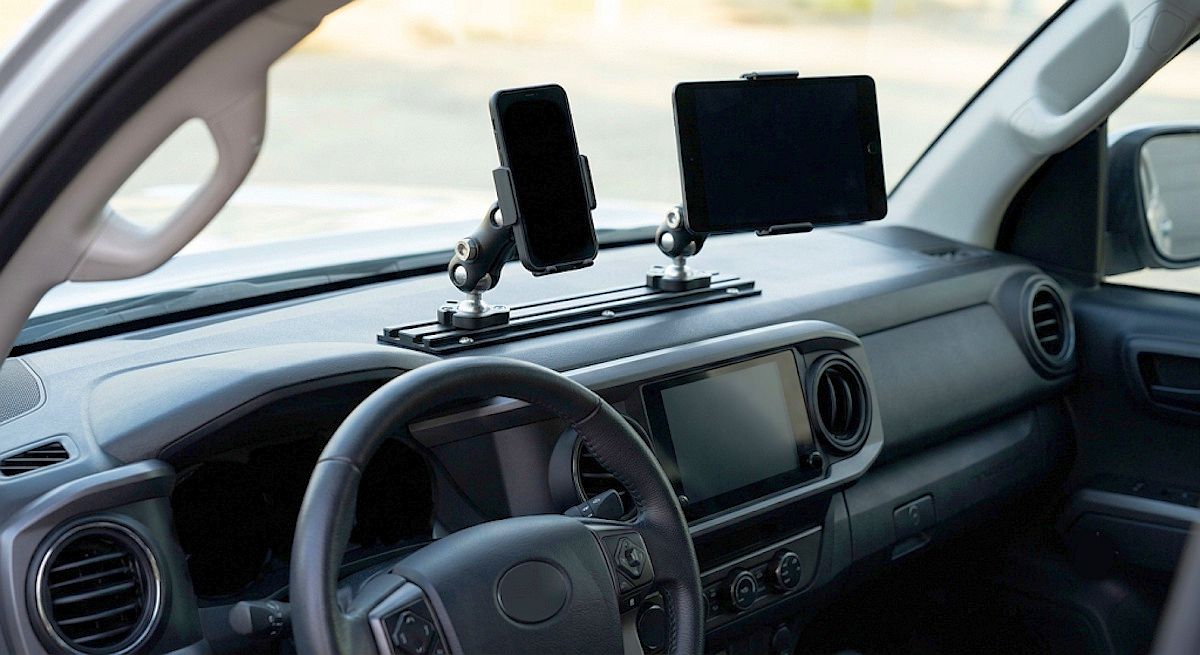
Quick Answer: RubiGrid is Bulletpoint Mounting Solutions’ vehicle-specific, laser-cut metal dash platform for trucks and SUVs. It uses modular 20mm (0.787-inch) ball-and-socket hardware so you can mount up to four or five devices—such as phones, tablets, GMRS radios, trailer monitors, and GoPros—on a single base. Tackform’s 20 Series uses the exact same 20mm ball size and cross-mates directly with Bulletpoint arms and balls, whereas RAM Mounts’ standard B-size system uses a larger 1-inch (25.4mm) ball that requires an adapter ball to connect.
This guide explains how the Bulletpoint 20mm ecosystem works, what comes inside a RubiGrid dash mount kit, how 20mm hardware compares with RAM Mounts, where Tackform 20mm accessories fit in, and how to avoid the most common vehicle-fitment mistakes. To see how vehicle-specific RubiGrid platforms compare across split truck generations, check our GMC Sierra phone mounts guide, or explore every mounting style in our main phone mounts hub.
What Are Bulletpoint Mounts?
Bulletpoint Mounting Solutions is an automotive mounting manufacturer focused on heavy-duty, vehicle-specific dashboard mounts for pickup trucks, Jeeps, and body-on-frame SUVs. Instead of selling disposable plastic vent clips or windshield suction cups that bake loose in summer sun, the brand builds modular metal bases and carbon-fiber arms around a standardized 20mm ball-and-socket joint.
Because every piece in the catalog shares that 20mm geometry, you do not have to replace your dashboard base when you upgrade your phone or add a second device. A complete Bulletpoint phone mount setup consists of four modular building blocks:
- 1. A Vehicle-Specific Base or RubiGrid Platform: Anchors into the upper dashboard recess or behind the center screen bezel of your specific truck or SUV (plus universal flat-dash and VHB flex bases for unsupported vehicles).
- 2. A 20mm Mounting Ball: Either pre-threaded into a single-device metal base or bolted through the slotted channels of a RubiGrid platform using a 2-hole or 4-hole AMPS flange.
- 3. A Double-Socket Mounting Arm: Clamps onto the 20mm base ball at one end and the device holder’s 20mm ball at the other, allowing 360-degree articulation and reach adjustment.
- 4. A Device Holder: Secures your smartphone, iPad/tablet, GMRS or CB radio mic, action camera, or auxiliary towing monitor.
While the multi-device RubiGrid platform gets the most attention in truck and overland forums, Bulletpoint also produces compact single-ball and dual-ball Metal Series bases for drivers who only want to mount one phone cleanly beside the infotainment screen.
See Bulletpoint mounting options on Amazon →
What Is the RubiGrid Dash Mount Platform?
RubiGrid is Bulletpoint’s flagship multi-device dashboard mounting platform. At its core, RubiGrid is a two-piece, precision laser-cut metal foundation rather than a phone cradle: a lower vehicle-specific metal base pan anchors into your dashboard’s top tray or behind the center touchscreen, and a removable slotted steel grid plate fastens on top using six recessed machine set screws.
Before securing that top slotted grid plate, you slide one or more 20mm AMPS mounting balls along the laser-cut slots to the exact left-to-right and front-to-back positions you want, locking each ball down from underneath with four machine screws and nylon locknuts. Because each AMPS ball is bolted through a steel slot with nylock hardware, the ball mounts cannot slide or twist loose over washboard dirt trails the way open T-slot rail systems sometimes can.
Depending on the width of your truck’s dashboard tray, a single RubiGrid platform can hold anywhere from three to seven mounting balls (most full-size truck and Jeep platforms support four to five devices plus a threaded 1/4″-20 camera stud). Owners commonly configure a single RubiGrid base to hold:
- A primary driver smartphone running CarPlay, Android Auto, or onX Offroad navigation
- A passenger phone or an 8-inch to 11-inch iPad/tablet for trail mapping
- A wireless trailer backup camera display or TPMS tire-pressure monitor for fifth-wheel and travel-trailer towing
- A GMRS, HAM, or CB two-way radio handset hanger or auxiliary switch panel controller
- A GoPro or dash-mounted action camera on a 1/4″-20 threaded adapter ball
The distinction that trips up first-time shoppers is that RubiGrid is the name of the slotted multi-device platform, not every product Bulletpoint sells. Most vehicle-specific RubiGrid kits sold on Amazon ship as a starter bundle that includes the laser-cut metal RubiGrid base, one 20mm AMPS ball, one carbon-fiber/Kevlar arm, and one universal spring-loaded phone holder—giving you a ready-to-use single-phone mount on day one with empty grid slots ready for expansion later.
View RubiGrid Mounts on Amazon →
How the 20mm Ball Mount System, Arms, and Holders Work
Every component above the RubiGrid base relies on two mechanical standards: the 20mm (0.787-inch) mounting ball and the industry-standard 4-hole AMPS mounting pattern (30.17mm by 38.05mm, plus 2-hole diagonal AMPS spacing). Understanding the arm lengths and holder styles in the 20mm catalog helps you avoid ordering an arm that blocks your touchscreen or a magnetic head that does not match your phone case.
1. Carbon Fiber + Kevlar Hybrid Arms vs. Aluminum Micro Arms
Bulletpoint’s standard double-socket arms use a hollow tube woven from Carbon Fiber and Kevlar (which gives the matte weave a subtle blue tint under direct sunlight) paired with CNC-machined aluminum 20mm socket couplers and thumbscrews at both ends. Because carbon fiber and Kevlar are both lighter and stiffer than cast plastic, they dampen high-frequency dashboard buzz while resisting droop. Bulletpoint sizes its arms by shaft length (which differs from end-to-end total length):
- Micro (2.61″ / 6.6cm total) & Mini 1cm (3.54″ / 9cm total): Machined from solid billet aluminum rather than carbon/Kevlar. Best when you want a phone or radio tucked as tight and low against the RubiGrid base as possible.
- Short 4cm (4.7″ / 12cm total) & Standard 7cm (5.9″ / 15cm total): The most popular Carbon Fiber + Kevlar sizes included in vehicle starter kits. They provide just enough reach to clear the upper lip of a recessed dash tray or touchscreen bezel without acting like a long vibration lever.
- Long 10cm (7.1″ / 18cm total) & Long+ 13cm (8.26″ / 21cm total): Useful for bringing a secondary device down beside the center stack, though longer arms require a rigid bolt-in base to prevent bounce on rough roads.
2. Spring-Loaded Cradles, DiabloM6, and MagSafe Holders
On the device end of the arm, Bulletpoint offers three main smartphone interfaces, all featuring an integrated rear 20mm ball stud (or a direct 20mm socket on “Nubby Edition” low-profile heads):
- Universal Spring-Loaded Phone Holder: Included with most RubiGrid bundles. Features twin spring-loaded arms that expand up to 3.4 inches wide with octagonal rubber grip pads that keep a slight air gap behind your phone to reduce heat transfer in summer sun.
- MagSafe-Compatible Magnetic Holders (Charging & Non-Charging): Built with a ring of neodymium magnets aligned to iPhone 12 through iPhone 17 MagSafe geometry (and includes adhesive metal rings for Android/non-MagSafe cases). Bulletpoint also sells a heavy-duty motorized clamping wireless charger for off-road trail use.
- DiabloM6 Magnetic Holder: A compact six-magnet puck designed for flat stick-on steel plates during paved street driving.
Important Ball-Size Compatibility Rule: Bulletpoint and Tackform 20 Series both use 20mm (0.787-inch) ball-and-socket hardware. Standard consumer Garmin GPS mounts use a smaller 17mm ball, and RAM Mounts’ popular B-size system uses a larger 1-inch (25.4mm) rubber ball. Never clamp a 1-inch RAM B-size arm directly onto a 20mm ball—it will slip under load. For a complete look at RAM’s letter codes, read our RAM Mounts system guide.
See 20mm ball mount components and adapters on Amazon →
Can You Use Tackform 20mm Parts With Bulletpoint?
Yes—and knowing that Tackform’s 20 Series shares the exact same 20mm ball standard is one of the best upgrades available to any Bulletpoint or RubiGrid owner. Because a 20mm (0.787-inch) metal ball from Tackform fits directly inside a 20mm Bulletpoint socket arm (and a 20mm Bulletpoint ball fits directly inside a Tackform 20 Series arm), you can mix and match components freely between the two brands.
Tackform’s 6061-T6 billet aluminum 20 Series catalog is especially useful when you want a specific holder tension, arm length, or specialty adapter that Bulletpoint does not carry, including:
- Tackform Enduro 20MAXX & 20LITE All-Metal Spring Cradles: Billet aluminum octagonal-grip phone cradles offered in two spring tensions (20LITE for easy one-handed daily truck commuting, and 20MAXX with heavy-duty spring tension and optional vibration dampening for severe off-road use), accommodating wide phones and OtterBox cases up to 3.75 inches wide.
- Billet Aluminum 20mm Arms & Dual-Socket Elbows: Heavy-duty aluminum arms with optional anti-theft security knobs.
- Ball-Size Conversion Adapters (20mm to 17mm & 20mm to 25.4mm): Double-ended step-up and step-down barbell adapters that let you connect a 17mm Garmin GPS cradle or a 1-inch (25.4mm) RAM B-size accessory directly onto a 20mm RubiGrid arm.
- Thick-Plate 2-Hole Diamond & 4-Hole AMPS 20mm Balls: CNC-machined 6061-T6 aluminum AMPS ball bases that bolt right into RubiGrid slots or third-party ProClip and PanaVise brackets.
One detail to check when shopping Tackform’s catalog: while Tackform’s 20 Series is 100 percent 20mm, Tackform also manufactures a separate 1-inch (25.4mm) DuraLock line and proprietary “Fast Track” rail brackets. Always verify that the part title specifies 20mm Ball or 20 Series before adding it to a Bulletpoint build.
See Tackform 20mm mounting accessories on Amazon →
What You Need for a Complete RubiGrid Dash Mount Setup
When planning a multi-device RubiGrid installation, map out every device you want on the dashboard before ordering so you do not end up short one AMPS ball or arm on install day. Every device position on a RubiGrid platform requires a three-part stack:
- Layer 1 — The Vehicle-Specific RubiGrid Base: Matches your exact make, model, year, screen size, and trim package. Most starter kits include the base plus one 20mm AMPS ball, one arm, and one universal phone cradle.
- Layer 2 — An Additional 20mm AMPS Ball + Arm for Each Extra Device: If your RubiGrid starter kit comes with one phone setup and you want to add a tablet and a trailer monitor, you will need two additional 20mm AMPS balls (which bolt into the open slots on the RubiGrid plate) and two additional 20mm socket arms.
- Layer 3 — A Dedicated Device Holder for Each Arm: Such as a MagSafe head, a second phone cradle, a universal tablet clamp, a two-way radio clip, or a 2-hole/4-hole AMPS adapter plate on the back of a GPS dock.
Pay close attention to mid-cycle interior refreshes when selecting your RubiGrid base. Automakers frequently keep the exterior sheet metal of a pickup truck identical while overhauling the dashboard center stack—or even offer two completely different dashboards in the same model year depending on trim level.
Real-World Fitment Example (GMC Sierra & Chevy Silverado): On the GMC Sierra, Bulletpoint sells two completely different RubiGrid bases: a Recessed-Tray RubiGrid (for 2019 to 2022 Sierra 1500/Limited, 2022 to 2026 Pro, and 2020 to 2023 Sierra HD models with the deep upper dash cubby) and a separate 13.4-Inch Screen RubiGrid (for 2022+ Sierra 1500 SLE/Elevation/SLT and 2024+ Sierra HD SLE/SLT models). Furthermore, Bulletpoint excludes 2022+ AT4 and Denali “Stacked Dash” models from the 13.4-inch base. See our GMC Sierra phone mounts guide for the full trim-by-trim breakdown.
See Bulletpoint phone mounts and holders on Amazon →
Where RubiGrid Works Best (And When It Is Overkill)
| Use Case | How Well It Fits | Why |
|---|---|---|
| Work Trucks & Towing Rigs | Excellent | Anchors a phone, tablet, trailer camera monitor, TPMS display, and radio mic on one rigid metal base |
| Overlanding & Off-Road 4x4s | Excellent | Bolted metal dash platform and carbon/Kevlar arms prevent device bounce on washboard trails |
| Daily Commuter (Single Phone Only) | Fair | Works well, but a compact single-phone screen or bezel bracket takes up less dash space |
| Motorcycles & Powersports Bars | Not Applicable | RubiGrid is a flat/recessed truck dash platform; use RAM or Quad Lock on handlebars |
RubiGrid earns its price tag when you mount two or more devices—or when you drive a Jeep Wrangler, Gladiator, or full-size pickup over rough terrain where generic suction cups and vent clips shake loose. For off-road Jeep builds in particular, the upper dash recess in the Wrangler JL and Gladiator is tailor-made for a bolt-in metal grid; you can compare how RubiGrid stacks up against single-phone Jeep mounts in our Jeep Wrangler and Gladiator phone mounts guide.
On the other hand, if you commute on paved roads with a single smartphone and never plan to add a tablet, camera, or radio, a full multi-slot RubiGrid platform is often more metal hardware than you need. And if you are looking to mount a phone on a motorcycle handlebar rather than a truck dashboard, skip dashboard platforms altogether and see our Quad Lock mounts guide.
Bulletpoint RubiGrid vs. RAM Mounts: Key Differences
Both Bulletpoint and RAM Mounts rely on modular ball-and-socket hardware, and both use the industry-standard 4-hole AMPS bolt pattern on their base plates. However, the two brands approach vehicle mounting from opposite directions:
| Feature | Bulletpoint (RubiGrid) | RAM Mounts |
|---|---|---|
| Standard Ball Size | 20mm (0.787-inch) metal ball | 1-inch (25.4mm) B-size elastomeric rubber ball (plus A, C, D, E sizes) |
| Primary Focus | Vehicle-specific truck, Jeep, and SUV upper-dash platforms | Universal bases across cars, trucks, motorcycles, boats, aviation & forklifts |
| Arm Construction | Carbon Fiber + Kevlar hybrid tubes (or billet aluminum Micro/Mini) | Powder-coated marine-grade cast aluminum or high-strength composite |
| Multi-Device Setup | Slotted laser-cut metal grid holds 3 to 5+ balls on one factory-fit base | Built from individual drill-down plates, suction cups, seat-bolt pods, or rails |
| Cross-Brand Compatibility | Directly compatible with Tackform 20 Series (20mm) & 4-hole AMPS plates | Compatible with 1-inch (25.4mm) B-size accessories & 4-hole AMPS plates |
Neither ecosystem makes the other obsolete. RAM’s catalog is unmatched when you need a twist-lock windshield suction cup, a no-drill passenger seat-bolt pod, a motorcycle handlebar U-bolt, or a heavy 1.5-inch C-size or 2.25-inch D-size marine chartplotter mount (see our RAM mount ball sizes guide for load ratings across sizes A through E).
Bulletpoint wins when you own a supported pickup truck or SUV and want a custom-contoured, laser-cut metal dash platform that looks like factory equipment inside the upper dashboard tray. Better yet, if you already own a favorite 1-inch RAM B-size socket arm and X-Grip cradle, you can bolt a 1-inch (25.4mm) AMPS ball (such as the `RAM-B-202U` or Bulletpoint’s 1-inch adapter ball) directly into the slots of a RubiGrid base and run your RAM hardware right alongside your 20mm arms.
Compare RAM B-size mounting components on Amazon →
RubiGrid Installation & Common Buying Mistakes to Avoid
Installation steps vary significantly depending on your truck’s dashboard architecture. Many newer setups (such as the 2018 to 2023 Jeep Wrangler JL/Gladiator and 2022+ Silverado/Sierra 13.4-inch screen models) are 100 percent no-drill installations that bolt directly into two factory OEM screw holes hidden under the rubber dash tray mat or behind the center screen. Other recessed-tray platforms (and Bulletpoint’s Universal 3-Ball and 4-Ball RubiGrid bases) secure to the plastic sub-tray floor using included self-tapping screws or stainless through-bolts, washers, and nylock nuts paired with 3M VHB automotive tape.
Before ordering a RubiGrid base or adding 20mm accessories, avoid these seven common buyer mistakes:
- Ignoring trim-level dashboard exclusions: Having the right model year and screen size does not always guarantee fitment. On refreshed 2022+ GMC Sierra and Chevy Silverado trucks, for example, Luxury/Off-Road trims like the Sierra AT4, AT4X, Denali, and Silverado High Country/ZR2 use a different upper dash molding than SLE/SLT/LT trucks and are excluded by Bulletpoint’s 13.4-inch RubiGrid.
- Overlooking special-edition dash indicators (like the Jeep Wrangler 4xe): On the 2018 to 2023 Jeep Wrangler JL, the standard RubiGrid base does not fit the plug-in hybrid Wrangler 4xe because the 4xe places battery charging indicator lights in the center of the top dash tray (requiring a 4xe-specific split base).
- Ordering extra device holders without extra 20mm AMPS balls and arms: Remember that every new device added to a RubiGrid platform needs its own 20mm AMPS base ball, its own socket arm, and its own holder.
- Trying to clamp a 1-inch RAM B-size arm onto a 20mm ball: A 1-inch (25.4mm) socket arm is 5.4mm larger than a 20mm ball and will not lock down securely without a 20mm-to-1-inch adapter ball.
- Using overly long arms for heavy tablets: Bulletpoint’s 20cm extra-long arms are intended for stationary use, not moving vehicles. Keep tablet and heavy monitor arms as short as practical (Micro, Mini 1cm, or 4cm Short) to eliminate leverage bounce on rough roads.
- Forgetting Tackform’s 20 Series when shopping for specialty cradles: If you want an all-metal billet spring cradle or a 20mm-to-17mm Garmin adapter, Tackform’s 20mm parts drop right onto a Bulletpoint arm.
- Buying a multi-device grid when you only want a minimal single-phone mount: If you never plan to mount a second device and want zero hardware on top of the dash pad, a compact screen-corner or bezel mount takes up far less visual space.
Smart Buying Tip: Count how many devices you plan to run over the next two years before choosing between a full RubiGrid platform and a single-device bracket. If you tow a trailer, run a GMRS radio, or carry a secondary work phone or iPad, the RubiGrid platform pays for itself immediately by keeping every screen organized on one rigid base.
View RubiGrid Mounts on Amazon →
Frequently Asked Questions
What are Bulletpoint mounts?
Bulletpoint mounts are modular vehicle mounting systems built around a 20mm (0.787-inch) ball-and-socket standard. Manufactured by Bulletpoint Mounting Solutions, the lineup includes vehicle-specific laser-cut metal RubiGrid multi-device dash platforms, single-device metal bases, Carbon Fiber and Kevlar hybrid arms, MagSafe heads, spring-loaded phone cradles, and 4-hole AMPS adapters for trucks, Jeeps, and SUVs.
What is a RubiGrid dash mount?
RubiGrid is Bulletpoint Mounting Solutions’ slotted, laser-cut metal dashboard platform designed to hold multiple devices (typically three to five or more) across the upper center dashboard of a compatible pickup truck or SUV using movable 20mm AMPS mounting balls.
Is RubiGrid the same thing as Bulletpoint?
No. Bulletpoint Mounting Solutions is the brand, while RubiGrid is its multi-device slotted platform series. Bulletpoint also sells single-ball Metal Series vehicle mounts, adhesive Flex Mounts, magnetic bases, arms, and phone or tablet holders that do not use a full RubiGrid platform.
Will a RAM Mount arm fit a 20mm Bulletpoint ball?
No, not directly. RAM’s standard B-size system uses a 1-inch (25.4mm) rubber ball, which is significantly larger than a 20mm (0.787-inch) Bulletpoint ball. A 1-inch RAM B-size socket arm cannot clamp tightly onto a 20mm ball. However, because RubiGrid uses standard AMPS slots, you can bolt a 1-inch AMPS ball onto a RubiGrid base (or use a 20mm-to-25.4mm dual-ball adapter) to integrate RAM B-size arms and cradles.
Can I use Tackform parts with a Bulletpoint RubiGrid mount?
Yes. Tackform’s 20 Series uses the exact same 20mm ball-and-socket dimension as Bulletpoint. Any Tackform 20mm arm, Enduro 20MAXX/20LITE phone cradle, camera stud, or 20mm AMPS ball will mate directly with Bulletpoint’s 20mm balls and arms. Just verify that the Tackform item is from its 20mm (20 Series) line rather than its 1-inch (25.4mm) line.
How many devices can a RubiGrid dash mount hold?
Most vehicle-specific RubiGrid platforms hold between three and five devices comfortably, while wide Jeep and full-size truck grids can accept up to six 20mm AMPS balls plus a seventh 1/4″-20 camera stud. The practical number depends on the physical width of your devices (for example, an iPad plus two phones) and how you stagger your arm lengths.
Does installing a RubiGrid mount require drilling into the dashboard?
It depends on the vehicle generation. Many popular RubiGrid platforms (such as the 2018 to 2023 Jeep Wrangler JL/Gladiator and 2022+ GMC Sierra/Chevy Silverado 13.4-inch screen bases) require zero drilling and bolt straight into existing factory screws under the rubber dash mat or behind the screen. Other recessed-tray platforms require driving included self-tapping screws or bolts through the floor of the removable upper dash cubby.
Is a RubiGrid platform worth it if I only mount one phone?
If you drive rough off-road trails, work out of your truck, or want the option to add a trailer monitor, radio, or second phone later, yes—the starter kit comes with one phone holder and gives you a rock-solid metal base. If you only want a minimal single-phone holder for paved street commuting and never plan to expand, a compact single-device bezel mount is smaller and less expensive.
Bottom Line: Are Bulletpoint Mounts Worth It?
For truck, Jeep, and SUV owners who want a rock-solid, expandable cockpit command center, Bulletpoint mounts make a compelling case. By pairing a vehicle-specific, laser-cut metal RubiGrid dash mount with stiff Carbon Fiber and Kevlar arms and standardized 20mm ball hardware, you can start with a single phone today and add a tablet, GMRS radio, action camera, or towing display later without replacing your foundation. And because Tackform’s 20 Series shares that exact 20mm ball dimension, you have a deep aftermarket of compatible billet cradles, arms, and adapters at your fingertips.
Shop Bulletpoint Mounting Options on Amazon →
Want to see how vehicle-specific RubiGrid platforms compare against compact single-phone brackets in your exact pickup? Check out our model-specific truck guides for the GMC Sierra, Chevy Silverado, RAM 1500, RAM 2500, and Toyota Tacoma.