
If you’ve shopped for a mount for a ham radio, a Garmin GPS, a police scanner, or a satellite radio, you’ve probably run into the term “AMPS mounting pattern” without much explanation of what it actually means. It’s one of those pieces of mounting jargon that gets assumed rather than explained, but understanding it makes finding compatible hardware a lot easier.
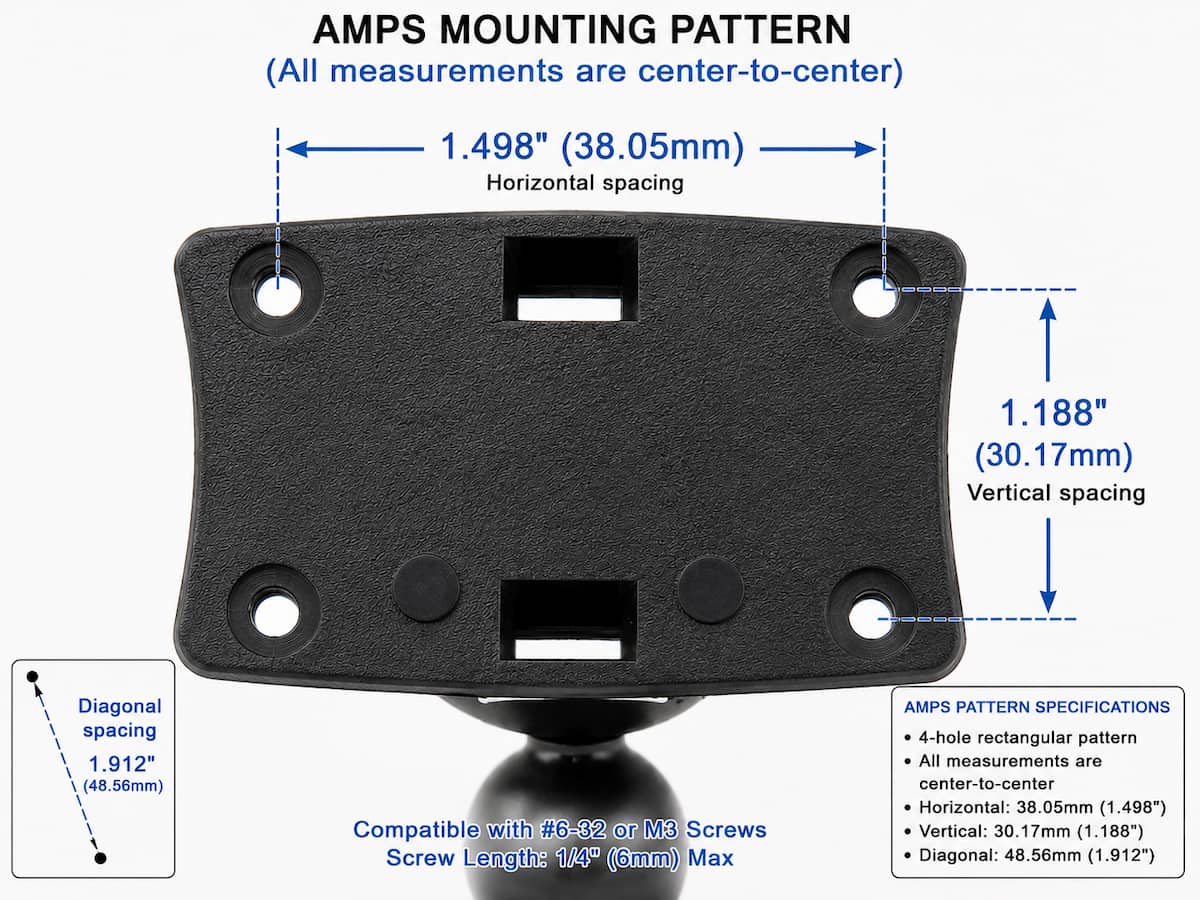
The short version: the AMPS pattern is a standard bolt pattern, available in both 4-hole and 2-hole layouts, that appears on the back of hundreds of different electronic devices and on thousands of mounts. If your device has AMPS holes and your mount has AMPS holes, they connect. It’s the closest thing the consumer mount industry has to a universal standard, and knowing how to spot it, and which layout you’re working with, saves a lot of guesswork.
AMPS Mount Types at a Glance
| Mount Type | Best For | AMPS Compatibility |
|---|---|---|
| Seat Bolt Mount | Ham radios, scanners | 4-hole plate at arm tip |
| Flat Surface Mount | Permanent dash/console installs | 4-hole plate, rigid arm |
| Cup Holder Mount | No-tools temporary setups | 4-hole plate, gooseneck arm |
| Suction Cup Mount | Windshield, movable between vehicles | 4-hole plate, ball-and-socket |
| Handlebar / Mirror Mount | Motorcycle GPS cradles | 4-hole plate on stem or clamp base |
What the AMPS Mounting Pattern Actually Is
The AMPS pattern consists of threaded holes arranged in a rectangle, spaced 1.498″ (38.05mm) horizontally by 1.188″ (30.17mm) vertically, center to center, in its full four-hole layout. Those specific dimensions are what define the pattern. As long as the hole spacing matches, any AMPS-compatible device will bolt to any AMPS-compatible mount, regardless of brand.
A separate two-hole version exists as well. Rather than using all four corners, it uses just the diagonal pair, spaced 1.912″ (48.56mm) apart corner to corner. This isn’t a different standard so much as a subset of the same rectangle. Many mounts are drilled to accept both the full four-hole pattern and the two-hole diagonal, which is why compatibility is rarely an issue even when a device only has two mounting points.
4-hole rectangle: 1.498″ x 1.188″ (38.05mm x 30.17mm) center to center
2-hole diagonal: 1.912″ (48.56mm) center to center
The pattern is sometimes called the “4-hole AMPS pattern” specifically to distinguish it from the two-hole variant. If a product listing just says it supports “AMPS” without specifying, it typically means the 4-hole layout unless the listing states otherwise.
Where the Name Comes From
AMPS stands for Advanced Mobile Phone System, the original analog cellular network that launched in North America in the early 1980s. The pattern was developed as a mounting standard for early mobile phones and car phone equipment. The cellular industry has moved on entirely, but the hole pattern stuck around and got adopted by the broader consumer electronics mount industry. Today the name is essentially a legacy term; most people who use AMPS mounts have never thought about where the name came from.
Devices That Use the AMPS Pattern
The AMPS pattern shows up across a surprisingly wide range of devices, and not just in vehicles. Beyond the mobile use cases below, it’s also common in commercial and industrial settings: tablet holders on forklifts, POS tablets on restaurant counters, and electronic logging device (ELD) mounts in commercial fleet vehicles all frequently rely on the same hole spacing. Here’s where you’re most likely to encounter it.
Ham Radio Control Heads
This is where the AMPS pattern is most deeply embedded. Yaesu, Icom, and Kenwood all use AMPS-spaced holes on their head mounting plates. Because ham radio operators frequently build custom mobile installations, AMPS compatibility matters. It means a head bracket can bolt to a seat bolt mount, a flat surface mount, a cup holder mount, or any other AMPS-compatible base without needing a proprietary adapter. For the full range of mounting options, see our ham radio car mount guide and our article on RAM Mounts for ham radios.
Garmin and TomTom Motorcycle GPS Cradles
Garmin motorcycle GPS cradles, including those for the Zumo series, use the AMPS pattern on the back of the powered cradle. This is what allows a Zumo cradle to bolt directly to a RAM Mounts handlebar base or mirror mount without any special adapter. TomTom Rider cradles use the same pattern. Car GPS cradles from Garmin generally use a 17mm ball socket rather than AMPS, but motorcycle cradles are almost universally AMPS. Visit our Motorcycle GPS Mounts Hub for more.
Sirius and XM Satellite Radio Docks
After the Sirius/XM merger, the combined company standardized on the AMPS pattern for satellite radio docks. Almost every powered Sirius cradle made in the past fifteen years has four AMPS holes on the back, meaning a Sirius dock can use the same seat bolt mount, suction cup mount, or cup holder mount as a ham radio head, as long as the weight rating is appropriate.
Police and Handheld Scanners
Many Uniden and other scanner cradles use the AMPS pattern, which is part of why scanner mounting options are so plentiful despite scanners being a niche product. A standard AMPS seat bolt mount handles a scanner head just as well as it handles a ham radio head.
Some Smartphone Cradles
A number of aftermarket phone cradles, particularly older Arkon and Bracketron models, are built around the AMPS pattern. This approach is less common now that most phone mounts use integrated ball-and-socket or MagSafe designs, but you still see it on heavier-duty cradles designed for extended use.
4-Hole vs. 2-Hole AMPS Mounting Pattern: Which One Do You Need?
Both layouts are secure when properly installed, but they’re suited to different situations. The tradeoff comes down to contact points versus flexibility.
4-hole AMPS. With four points of contact instead of two, this is the more secure option and the better choice for wall, ceiling, forklift, and other industrial-style installations where the mount is bearing weight in a fixed orientation. The downside is size: in a tight or irregularly shaped mounting spot, a full four-hole plate may simply not fit.
2-hole AMPS. Because it only needs the diagonal pair of holes, this layout fits into tighter and more irregular spaces than the 4-hole version, and it still offers a genuinely secure, stable hold for its intended use. The tradeoff is load capacity: with two contact points instead of four, it’s generally better suited to lighter arms and holders rather than heavy tablets or industrial-duty equipment.
In practice, most consumer AMPS mounts are drilled to accept both patterns at once, so you rarely have to choose deliberately. It matters most when you’re working with a device that only has two mounting holes, or a mounting spot too small for the full rectangle.
Screws are not always included or universal, regardless of which pattern you’re using. Most AMPS hardware uses #6-32 or M3 screws no longer than 1/4″ (6mm), but Garmin cradles come with their own screws sized for their specific mounting plates, and ham radio head brackets often come with their own hardware too. If you’re building a custom installation with mismatched components, have a small assortment of both thread types on hand before you start, and don’t force a screw that’s running longer than 1/4″ into a plastic housing.
Standoff height occasionally matters as well. If a device’s AMPS holes are recessed or the back of the housing protrudes, a standard flat AMPS plate may not sit flush. A mount with short standoff posts, or small nylon spacers, solves the problem.
AMPS vs. VESA: Knowing the Difference
AMPS is for small electronics: phones, some GPS units, radio heads, scanners. Once you get into larger displays, monitors, and televisions, the AMPS hole spacing is too small and a different standard takes over: VESA. VESA patterns are specified in millimeters, with 75x75mm and 100x100mm being most common. If you’re mounting a tablet or larger display and the listing mentions VESA, that’s a different standard entirely from AMPS.
Why It Matters in Practice
The practical value of the AMPS mounting pattern is that it breaks the link between device brand and mount brand. You don’t need a Garmin mount for a Garmin GPS or an Icom mount for an Icom radio, you need an AMPS mount, and those are made by dozens of manufacturers at every price point. It also means hardware is reusable across devices: the seat bolt mount you bought for your scanner will work just as well for your ham radio head when you upgrade. The arm, the base, and the plate all stay; only the device changes.
For anyone building a mobile installation, whether it’s a ham radio shack in a truck, a GPS setup on a motorcycle, or a scanner mount in a patrol car, the AMPS pattern is the foundation everything else is built around.