
Quad Lock is one of the most recognizable names in the phone mount world, but it is also one of the easiest systems to misunderstand. A lot of people first see it as just another phone mount brand. That is not really what it is.
Quad Lock is better understood as a mounting ecosystem. Instead of buying a single universal cradle that squeezes your phone from the sides, you buy into a system built around a specific locking interface. Once your phone has that interface, you can move it from one Quad Lock mount to another: car, motorcycle, bicycle, desk, gym, or even a ball-adapter setup.
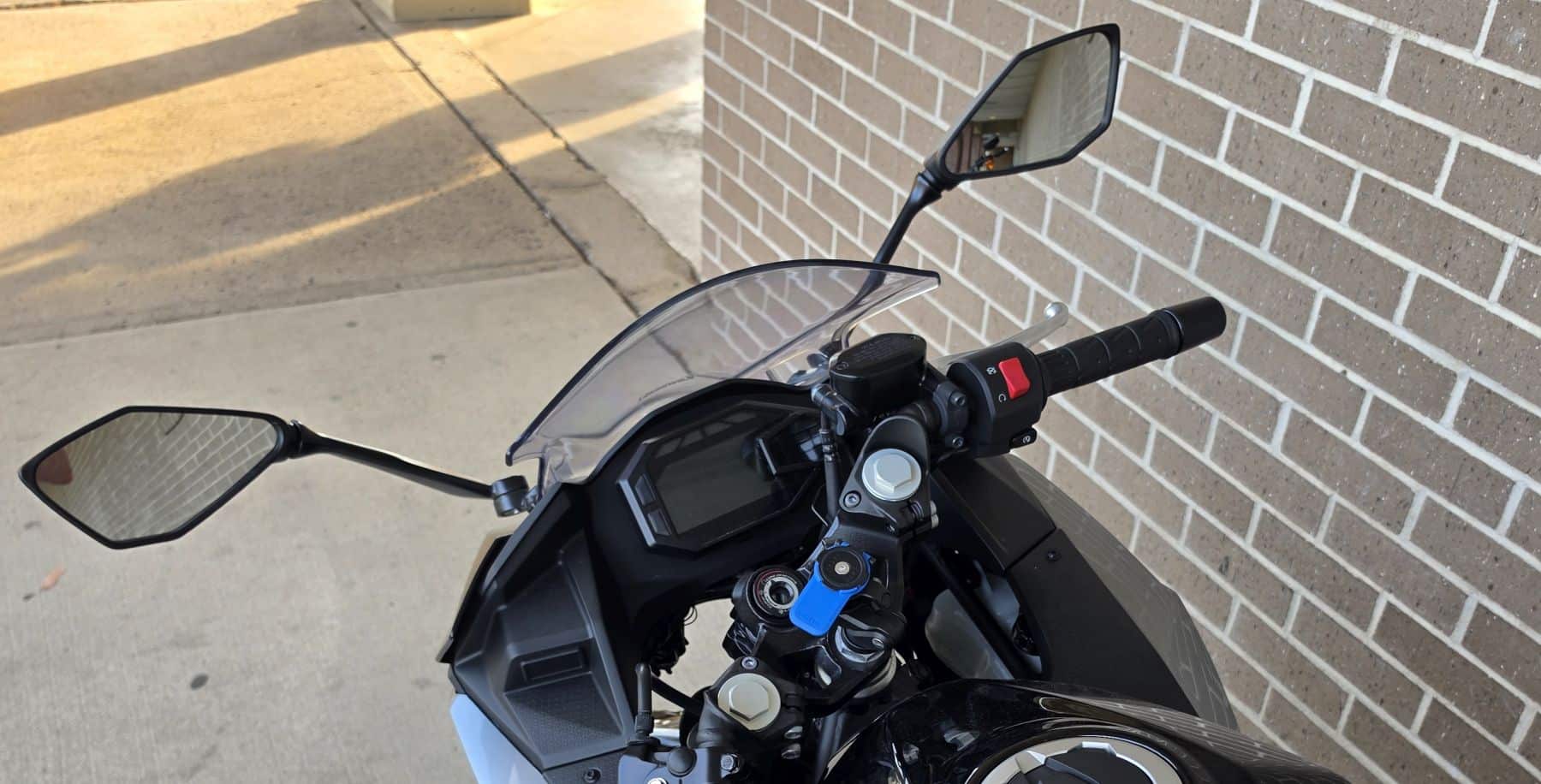
That approach is exactly why Quad Lock has become so popular. It does not just hold a phone. It creates a repeatable, secure way to mount the same phone in different places without learning a different mount every time.
This guide explains what Quad Lock mounts are, how they work, which specific motorcycle mounts riders reach for most, and where the system makes the most sense.
Table of Contents
Popular Quad Lock Motorcycle Mounts
| Mount | Best For | Handlebar / Perch Fit |
|---|---|---|
| Quad Lock Handlebar Mount | Riders who want the standard, most proven Quad Lock setup | 22mm to 32mm bars |
| Quad Lock Handlebar Mount Pro | Riders who want a CNC aluminum build, wider bar fit, and cleaner cable routing | 22mm to 35mm bars |
| Quad Lock Brake/Clutch Mount | Bikes with no free handlebar space, mounts off the brake or clutch perch | Standard two-bolt perch, left or right side |
What Is Quad Lock?
At its core, Quad Lock is a two-part idea. First, your phone needs a compatible Quad Lock case or a universal adapter. Second, you need a mount that accepts that interface. The mount can be for a car, motorcycle, bicycle, desk, truck, or another use case. Quad Lock’s official current catalog still spans all of those broad categories, which is why the system appeals to people who want the same phone to move between multiple environments.
That makes Quad Lock very different from old-school universal mounts. Traditional mounts try to fit almost any phone by using spring clamps, side arms, or magnetic pads. Quad Lock goes in the opposite direction. It asks you to commit to a specific interface first, and then rewards you with a much more secure and repeatable connection.
In practical terms, that means Quad Lock is less about a single product and more about a platform. If someone says they “have a Quad Lock,” what they usually mean is that they have bought into the system with a case or adapter and now use one or more matching mounts.
How Quad Lock Works
The heart of the system is the locking interface on the back of the case or adapter. That interface mates with the mount and locks using a twist motion. Instead of dropping your phone into side arms, you place the phone onto the mount, align the interface, and rotate it until it locks.
This is the most important thing to understand about Quad Lock: it is not trying to “hold” a phone the way a cradle does. It is trying to lock the phone in place. That is why it has become especially popular in higher-vibration environments like motorcycles and bicycles, where a weak clamp mount can feel sketchy or eventually shift out of position.
Removal is the reverse process. You press the release and twist the phone off. Once you get used to it, it becomes second nature, but it is still a little more deliberate than a quick drop-in universal cradle.
What You Need to Use Quad Lock
This is where many buyers get confused. A Quad Lock setup is rarely just one product.
Most users need three layers:
- A compatible case or universal adapter so the phone has the Quad Lock interface
- A mount base for the environment you care about most, such as a car vent mount, motorcycle handlebar mount, or bicycle out-front mount
- Optional accessories such as a vibration dampener, charging head, or ball adapter depending on where and how you use it
Quad Lock’s current ecosystem still includes those add-on layers. On the motorcycle side especially, the brand continues to offer a vibration dampener to reduce high-frequency vibration exposure, waterproof wireless charging heads, and a 1-inch ball adapter that lets the Quad Lock interface work with 1-inch ball clamp systems. For a closer look at how riders combine these layers, see our motorcycle mounts hub.
Where Quad Lock Works Best
| Use Case | How Well It Fits | Why |
|---|---|---|
| Motorcycles | Excellent | Very secure connection, motorcycle-specific mounts, dampener and charging options |
| Bicycles | Excellent | Compact and stable for repetitive movement |
| Cars | Good | Clean look and secure hold, though less instant than clamp mounts |
| Desk / home / office | Good | Useful if you want one consistent mounting interface everywhere |
Quad Lock is strongest where movement is constant. That is why motorcycles and bicycles are where the brand really stands out. In a car, it is still good, but the advantage is different. There the value is more about a cleaner, more integrated setup than about surviving heavy vibration.
Why Motorcycle Riders Care So Much About Quad Lock
Motorcycles are probably the clearest example of where Quad Lock’s design philosophy makes sense. A rider does not just want the phone to stay attached. They want it to stay attached predictably, without wobbling, sagging, or feeling like one bump could send it flying.
Quad Lock has built out a full motorcycle family around that use case, including handlebar mounts, clamp bolt mounts, fork stem mounts, brake/clutch mounts, brake reservoir mounts, mirror mounts, mirror stem mounts, a 1-inch ball adapter, and accessory charging options.
Another reason motorcycle riders pay attention to Quad Lock is camera protection. Quad Lock’s official support and product material continue to say the motorcycle vibration dampener is designed to protect smartphone camera image stabilization from the high-frequency vibrations produced by some motorcycles, and the company says the dampener reduces over 90% of high-frequency vibrations.
That does not mean every rider needs every accessory. But it does show that Quad Lock is not just selling a generic phone mount and pretending it works everywhere. It has built motorcycle-specific layers around the basic system.
Quad Lock Handlebar Mount vs Handlebar Mount Pro
The standard Quad Lock Handlebar Mount is the most popular mount in the entire lineup, and for good reason. It is built from glass-filled nylon composite with a blue lever, fits handlebars from 22mm up to 32mm using three included spacers, and delivers the same dual-stage locking mechanism as every other Quad Lock mount. For most riders doing paved commuting and weekend rides, this is the mount to buy. It just works.
The Handlebar Mount Pro uses the identical locking mechanism, so it is not a functional upgrade in terms of how the phone locks in. What changes is the build. The Pro is CNC machined from black anodized aluminum instead of nylon composite, comes with black stainless hardware and a black lever instead of the standard blue, and fits a wider bar range up to 35mm using four spacers instead of three. It also adds a discreet internal channel for routing a charging cable through the mount body, which keeps a wireless charging head setup looking cleaner.
Quad Lock Brake/Clutch Mount
Not every bike has room on the handlebars for a mount, and that is exactly the gap the Quad Lock Brake/Clutch Mount fills. It bolts directly onto a standard two-bolt brake or clutch perch using high tensile fasteners with serrated flanges, so it can be installed on either the left or right side depending on which perch has room. The mount offers 180-degree rotation and tilt adjustment to dial in a viewing angle, and it uses the same dual-stage locking mechanism as the rest of the Quad Lock lineup, so a phone locked into this mount feels exactly as secure as one locked into the handlebar mount.
This is a strong option for entry-level and mid-size motorcycles with limited handlebar real estate, or for riders who already have a GPS unit, switch panel, or other accessory occupying the bars.
Quad Lock vs Traditional Clamp Mounts
The easiest way to think about the difference is this: clamp mounts are about convenience first, while Quad Lock is about security first.
A traditional clamp mount is usually faster for casual daily driving. You can often drop the phone in with one hand, and you do not need a special case. That is why clamp mounts still make a lot of sense in cars.
Quad Lock asks for more commitment. You need the right case or adapter. You need to learn the twist-lock motion. And if you use multiple vehicles or mounting environments, you may end up buying several compatible pieces.
But the payoff is consistency. Once you understand the system, you know exactly how it works no matter where you use it. That consistency is a big part of the appeal.
| Feature | Quad Lock | Typical Clamp Mount |
|---|---|---|
| Phone security | Very high | Varies by mount quality |
| Ease of first-time use | Moderate | Very easy |
| Requires special case / adapter | Yes | Usually no |
| Best in high vibration | Yes | Not always |
| Ecosystem flexibility | High | Usually low |
Common Quad Lock Mount Mistakes
- Buying a mount first without realizing a case or universal adapter is required
- Assuming it is as fast as a one-handed drop-in cradle in a car
- Skipping the motorcycle vibration dampener on bikes with more vibration exposure
- Thinking all Quad Lock products are universal when some are environment-specific
- Comparing only the price of one mount instead of the cost of the full system
Are Quad Lock Mounts Worth It?
For the right buyer, yes. Quad Lock is worth it when secure mounting matters more than maximum convenience, and when you like the idea of using one interface across multiple setups.
If you just want a cheap, generic mount for occasional car use, Quad Lock may feel like too much system and not enough simplicity. But if you ride motorcycles, cycle regularly, or want a cleaner long-term ecosystem, the tradeoff makes much more sense.
The real strength of Quad Lock is not that each individual mount is magic. It is that the system is coherent. Cases, mounts, charging heads, vibration management, and even 1-inch ball compatibility all fit into one larger design approach. That is what separates it from a lot of random mount brands.
Frequently Asked Questions About Quad Lock Mounts
Do I need a special phone case for Quad Lock?
Yes. You need either a Quad Lock case built for your phone model or a universal adapter that attaches the locking interface to a case you already own.
Should I get the standard Handlebar Mount or the Pro?
Both use the same locking mechanism, so it comes down to bar size and build preference. The standard mount fits 22 to 32mm bars, while the Pro fits up to 35mm and swaps the nylon composite body for CNC machined aluminum with cleaner cable routing.
What if my bike has no room on the handlebars for a mount?
The Brake/Clutch Mount bolts onto a standard two-bolt brake or clutch perch instead, and can be installed on either side of the bike.
Is Quad Lock better than a magnetic mount for motorcycles?
For most riders, yes. A mechanical twist-lock connection is less likely to fail under sustained vibration than a magnetic hold, which is why Quad Lock built a dedicated motorcycle lineup around that difference.
Does Quad Lock work with a phone case I already own?
Only through a universal adapter, since dedicated Quad Lock cases are model-specific and replace your existing case.