
Installing a ham radio in a modern car is more difficult than it was ten or fifteen years ago. Vehicle interiors have changed dramatically — dashboards are smaller, center consoles are packed with touchscreens and climate controls, and airbag sensors occupy areas that once would have been easy mounting spots.
The good news is that mounting hardware has evolved alongside these changes. Today there are reliable mounting solutions for almost every vehicle layout, from compact sedans to large trucks and SUVs. The key is choosing the right mount for the type of radio you’re installing and the available space inside your vehicle.
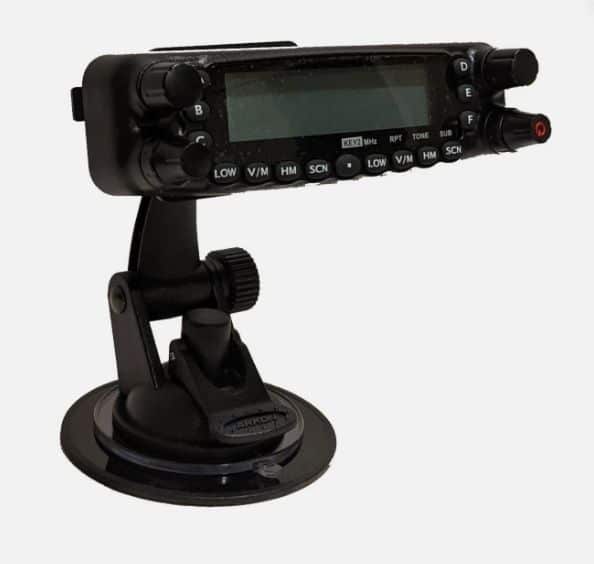
This guide walks through the most common installation scenarios: mounting handheld transceivers (HTs), installing mobile radios with detachable control heads, and selecting the right mounting hardware for each setup. Brands like Yaesu, Icom, and Kenwood all use slightly different mounting brackets for their radios, but most of the mounting systems discussed here work across all of them.
Best HAM Radio Mount Types at a Glance
| Mount Type | Best For | Installation | Verdict |
|---|---|---|---|
| Seat Bolt Mount | Permanent installs | Moderate | Best overall |
| Cup Holder Mount | Temporary installs | Very easy | Best no-drill |
| Dash Mount | Clean installs | Moderate/Hard | Best appearance |
First: Know What Type of Radio You’re Mounting
The best mounting approach depends largely on what type of radio you’re working with. Ham radios used in vehicles generally fall into three categories, and each one has slightly different mounting requirements.
Handheld transceivers (HTs) are portable radios such as Baofeng handhelds, Yaesu FT-series HTs, or Icom IC-series handheld units. These radios run on internal batteries and typically include a belt clip on the back. When used in a car, they’re usually placed in a cradle-style holder rather than permanently mounted since the entire radio is self-contained.
Mobile transceivers with detachable control heads are the most common type used in permanent vehicle installations. Radios such as the Yaesu FT-7900, FT-857D, Icom IC-2730A, IC-7000, and many Kenwood TM-series models allow the front control panel to be separated from the main radio body.
This design makes installation much easier in modern vehicles. The main radio body — which is the larger and heavier component — can be mounted out of sight under a seat, in the trunk, or behind a panel. The smaller control head is then mounted within reach of the driver. This approach keeps the installation clean while maintaining full control of the radio.
Compact mobile radios (all-in-one units) combine the control panel and radio body into a single device. These can work well in trucks and larger vehicles where space is less limited, but they can be harder to mount cleanly in smaller cars because they require a flat mounting surface large enough for the entire radio.
The AMPS Pattern: Why It Matters for Ham Radio Mounts
Many ham radio control head brackets use what’s known as the AMPS mounting pattern. This is a standardized four-hole rectangular pattern spaced 1.188 inches by 1.813 inches.
Mounting plates such as Icom’s MB-63 bracket or Yaesu’s YK-series brackets often include holes drilled to match the AMPS pattern. That means they can attach directly to a wide range of third-party mounting systems.
This compatibility is extremely useful because the AMPS pattern is used across many industries. GPS units, SiriusXM radios, police scanners, and other electronics frequently rely on the same mounting standard. As a result, there are dozens of mounts that can support ham radio control heads with little or no modification.
If your radio bracket doesn’t already include AMPS-compatible holes, it’s usually easy to add them with a drill. Most amateur radio operators are comfortable making small hardware modifications when needed.
Best HAM Radio Mount by Use Case
- Best Overall: Seat bolt mount
- Best No-Drill Option: Cup holder mount
- Best Clean Install: Vehicle-specific dash mount (PanaVise)
- Best for Temporary Setups: Windshield suction mount
Seat Bolt Mount (Most Popular)
Seat bolt mounts are one of the most popular options for mobile ham radio installations. Every vehicle has seat mounting bolts anchored to the floor, and those bolts provide a strong and stable mounting point.
Most seat bolt mounts use a flexible gooseneck arm roughly 18 inches long. This allows the control head to sit at roughly console height — close to where the factory stereo would normally be located. The viewing angle is comfortable, and the mount usually stays clear of vents, screens, and climate controls.
Installation is straightforward. Loosen the seat bolt, slide the mount’s bracket under the bolt, and tighten it back down securely with a wrench. It’s important to tighten the bolt firmly — hand tightening is not enough and can cause the mount to wobble.
Arkon makes a popular seat bolt mount with an AMPS adapter, and RAM Mounts also offers excellent seat-bolt mounting systems designed for heavier electronics.
A gooseneck seat bolt mount with AMPS plate is the most stable and adjustable option for most installs.
Cup Holder Mount
Cup holder mounts are one of the easiest ways to install a radio control head. The expandable base fits into a standard vehicle cup holder, and a short arm positions the radio head above the holder.
This approach requires no tools and no permanent modifications, which makes it a good choice for temporary installations or vehicles where seat bolts are difficult to access.
The downside is that it occupies one of your cup holders and can place the radio slightly lower than ideal for quick glances while driving. These mounts also require a solid cup holder base — sliding or retractable cup holders may not provide enough stability.
A cup holder mount with AMPS plate installs in seconds and is easily portable.
Flat Surface / Dash Mount
Flat surface mounts attach directly to a dashboard or center console using screws or adhesive plates. Arkon Mounts produces a variety of flat mounting bases that connect to adjustable arms and AMPS plates.
PanaVise also offers vehicle-specific mounts designed to fit into trim seams around factory radios and climate controls. These can produce very clean installations but require matching the mount to your exact vehicle model and year.
The challenge in many modern vehicles is simply finding an unused flat surface. Between large infotainment screens and driver-assist sensors, available mounting space is becoming increasingly limited. This is also the most invasive option as drilling is often required. Be sure you don’t drill into wires.
A flat surface mount with AMPS plate drills into the dash.
Windshield / Suction Cup Mount
Suction cup mounts attach directly to the windshield and allow the radio head to be positioned at almost any height. They’re useful for temporary setups or situations where the radio is moved between vehicles.
These mounts work best on clean glass. Periodically removing and cleaning the suction cup helps maintain a strong seal. It’s also worth checking local laws — some states restrict objects mounted on the windshield.
Stowing the Main Transceiver Body
If you’re using a radio with a detachable control head, the main transceiver body needs a secure mounting location.
Under the passenger seat is one of the most common choices. It keeps cable runs short and the radio accessible. However, be mindful of airbag sensors and wiring harnesses often located near seat frames.
The trunk or cargo area is another good option for larger radios. While the cable run is longer, it keeps the installation clean and eliminates interference with cabin components.
Behind the rear seat in trucks with fold-up rear seating provides a protected flat surface ideal for mounting larger transceivers.
If you’re installing an Icom IC-703 or IC-706 series, we have a dedicated guide covering mounting options for those specific models.
Handheld Transceiver Mounting
Mounting handheld radios in a vehicle can be slightly tricky because they are deeper and heavier than smartphones.
The RAM Finger Grip holder is a versatile option that works with many handheld radios. It includes adjustable support arms capable of holding devices up to about 1.6 inches deep, which is sufficient for most HTs.
For radios with non-removable belt clips, the HYS handheld ham radio belt clip mount grips the clip directly rather than the body of the radio. These mounts attach to standard 1-inch ball mounting systems such as those used by RAM.
These adapters fit any mounting system with a one inch ball.
Microphone Mounting
One often overlooked part of a mobile radio installation is microphone placement. Without a dedicated mount, microphones tend to slide around on the seat or fall onto the floor while driving.
The traditional solution is a screw-mounted mic hanger attached to the dash or radio bracket. A cleaner option is a vent-mounted holder like the HYS vent clip microphone holder, which allows you to hang the mic quickly without drilling into the dashboard.
We cover several different microphone mounting solutions in our full ham and CB radio mic holder guide.
Common HAM Radio Mounting Mistakes
- Mounting the control head too low, forcing you to look away from the road
- Using weak suction mounts for heavier radios
- Ignoring cable routing until after mounting
- Blocking HVAC controls or infotainment screens
- Mounting in airbag deployment zones